The Dickinson Croxley

Several British pen brands were made by (or for) large stationery companies. Despite being a secondary enterprise for these manufacturers, quality was generally as high, or higher than that of the dedicated pen makers. John Dickinson was and remains one of the largest paper manufacturers, establishing paper mills at Croxley in 1830. They were long famed for their Croxley Script paper, which is no longer made, and the excellent Basildon Bond and economy Lion Brand which are still available. Gradually, over decades, they expanded into other related areas, going into fountain pen sales in the late nineteen thirties. Their pens are high quality writing instruments. They sold well and are common today, though they are somewhat underrated by buyers.

There is some doubt about how Croxley pens were produced. I have read that Dickinson established their own pen factory at Croxley, but this is disputed by others who say that the pens were made by De La Rue or Conway Stewart. The pens that De La Rue made for other companies tend to look like their own product range and usually the quality is not especially high. Looking at Croxley pens, one would have to say that there is no reason to doubt that they could have been made by Conway Stewart, but there’s no compelling evidence that they were, either. All I can say is that Croxleys are very well made, with parts that fit together securely and no distortion of the plastic. The plating of the metal parts is very good, better than that usually seen on either Conway Stewarts or non-Onoto De La Rues. The well-stamped nibs are excellent, often medium but not infrequently broad and usually with some flexibility.

Croxleys were only made for a short period and the product range is small. The earliest one I have seen is very much an example of the Standard British Pen (of which more on another occasion), straight-sided with a large BHR clip-screw, a ball-ended clip and a straight lever, looking very much like a Summit or a Mentmore Autoflow. The Croxley most usually seen is quite similar, but it has a handsome arrow clip which is echoed by an arrow-shaped lever. A balance-shaped pen with a smoothly curved clip and an arrow lever was also made. The pens come in black and the usual range of marbled patterns. There is also a plain-but-handsome desk-set which turns up once in a blue moon.

Lack of variety probably limits their appeal to collectors but they are durable and handsome and, above all, they are writers’ pens, up there with Swan, Waterman and Onoto in terms of writing pleasure.


Quality – Some Preliminary Thoughts.

The issue of quality in fountain pens – or anything else – can’t be covered in a single blog post, so I’ll be coming back to this subject again. For the moment, though, I would like to tackle some of the mistaken ideas about quality that I often see, mostly arising from the various coffee-table books that purport to recount the history of the fountain pen.

The worst one, I think, is the confusion of quality with bling. Many of the illustrated fountain pen books show page after page of pens with precious-metal overlays, portrayed as the best exemplars of their kind. I believe that to be wrong-headed. Quality in a pen resides in fitness for purpose. A plain black hard rubber Waterman 52 is a better pen to use than one that has had a filigree or solid metal overlay applied. It has its original weight, balance and thickness and it will handle as it was designed to do. I understand, of course, that for many collectors the overlay pen is more desirable, and due to the inclusion of precious metal and admirable craftsmanship it is a more valuable object. That’s not an issue of quality, though, it’s an issue of opulence. I’m not disparaging anyone’s wish to own an object of great beauty for the beauty’s sake; I’m just making the point that opulence has no bearing on quality.

Another point of confusion is the long-held practice of assigning pens, by manufacturer, to first, second and third-tier quality. It must be clear to anyone who thinks about it for a moment that this has never worked and yet it persists. Almost all manufacturers, present and past, make a range of pens to suit different pockets and purposes. Many manufacturers have suffered declines in quality, only to rise again later. Most manufacturers produced some pretty awful pens when they tried desperately to compete with ballpoints at the same time as cutting costs. It’s easy to produce some amusing paradoxes by following the “tier system” with regard to particular pens. Belmont must have been a better manufacturer than Parker, as the top of the 1930s Belmont range is undoubtedly a more sound and enduring pen than Parker’s Parkette. If the only Waterman you’d ever seen was an economy-model Taperite, would you have any hesitation in consigning the brand to the third tier?

In truth, each model of pen must be taken on its own merits. We can all make the quality evaluation with the pen in our hands, and those of us who buy older pens have the opportunity of adding the final dimension to quality: durability. If it’s still a good-looking pen that works well after seventy or eighty years, its quality is proven. For myself, I’m happy to accept that, for example, Macniven and Cameron produced some of the best and worst pens ever made, as did De La Rue and Parker. There are no tiers.

Duofold Special

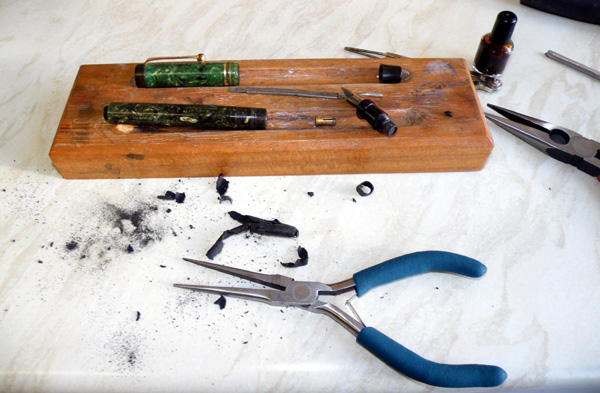
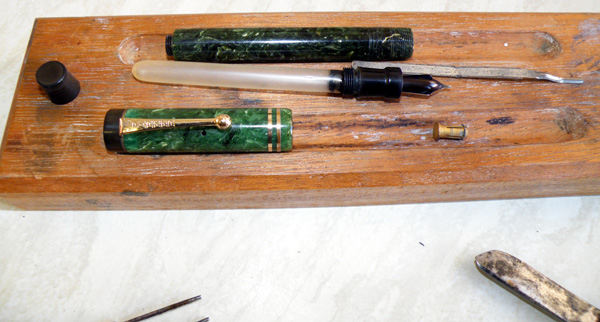
There are very few pens I don’t enjoy working on. There are some, however, that are an especial pleasure and this Duofold Special would be high on that list. Late twenties/early thirties Duofolds are at the very peak of quality. There is no skimping of effort to achieve the best possible result in the manufacturing process. Apart from the slight barrel discolouration due to the decomposition of the sac, and a little wear on the plating, this pen is almost like new and that’s because of the original attention to quality.

There’s a routine to restoring a pen – assess, disassemble, clean, assess again, re-assemble. The only part that needs replaced here is the sac. I use a silicone one to prevent any further discolouration of the jade. It’s important to clean the inside of the barrel thoroughly; any fragment of the old latex sac that remains will continue to discolour the barrel. As it’s a screw-in section, sac size is critical. It has to be as large as possible to contain the optimum amount of ink, but narrow enough to clear the walls of the barrel. Then it’s time for reassembly and a gentle polish, and the pen is ready for write-testing.

I have read that the Duofold Special, or JL (for Junior Long) as it’s also known, was not listed in Parker’s catalogues of the time, but was made to meet popular demand for a Duofold the length of the Senior and the thickness of the Junior. Actually, it’s a tiny bit shorter than the Senior and a little thicker than the Junior – but near enough! From the first black hard rubber model in 1922 the Special was very popular in Britain, and survives in moderately high numbers. This two-ring green jade version was made in 1928 and 1929, and is not so often seen.

Black Is Black.

From the 1930s to the late 1950s, pen manufacturers produced pens in a stunning range of colours and patterns that has never since been equalled. There were marbled patterns in all the colours of the rainbow, candy-stripes, herringbones, lapis lazuli, jade, snake-skin and cracked ice, to name but a few. So which of those glorious colour-schemes was the most popular? None of them. In Britain, at least up until the introduction of self-coloured injection-moulded plastic in the sixties, black was king.

Why should it be that black pens were vastly more popular with pen buyers than any other colour? It wasn’t price. Coloured pens and black pens cost the same. To a large degree, I think, it was what people were accustomed to. Before celluloid and casein became commonly used, pens were made from vulcanised rubber, and that mostly came in black. Yes, there were red hard rubber pens and the various versions of mottled hard rubber. There were overlays in gold and silver too, but these were the exceptions. Most pens were black, and it was accepted that black was the colour for fountain pens in the same way as refrigerators were white or later, desk-top computers were beige. Then again, I think, there was the implication that if you were a person to be taken seriously, you would use a black pen. This intensified in the post-World War II period, when men (and it mostly was men) avoided colours in their dress and accoutrements. Suits were black. Shirts were white. Any deviation from that pattern reflected badly on the wearer. Even cars were black.

Things have changed today. If we had the full nineteen-fifties range of the original Conway Stewart company available to us now, we’d all be buying cracked ice, tiger’s eye and red herringbone. Instead, the majority of Conway Stewarts that appear on eBay are black. They’re beautifully designed and excellent writers, but we may feel justified in wishing that the buying patterns of their original owners had been different.

Summit

Though their quality is consistently high Summits can usually be had for bargain prices. Partly, perhaps, that’s because they’re seen as quite dull. Their design, though practically and ergonomically excellent, was conservative. They’re most often seen in black chased celluloid and the nibs, though very good writers, are generally firm.

There’s more to the company than that, though. Just on the basis of the pens I’ve seen, Summit began life in the last years of the 19th century as, I believe, Curzon, Lang and MacGregor. Examples of their early output are rare now, but they marketed the Angloamer pen. In, perhaps, the early nineteen-twenties, the company became Curzon’s. Lang continued to manufacture the pens. They produced a range of handsome BHR flat-top lever fillers with riveted clips during the twenties and by the end of that decade had moved on to celluloid. Just before the Second World War the company became Summit. They produced many beautiful pens in lizard-skin patterns, in moire and in the full range of marbled celluloids. At the peak (I almost said summit!) of their popularity, from the thirties to the early fifties, they were a very big player indeed, as can be seen by the number of Summits that still appear on eBay.

Something that appears admirable in retrospect – though it was doubtless not done by intention – is the way the company ended. Faced with the post-war decline in sales due to the advent of the ballpoint, other companies reacted with unfortunate new designs and saved costs by reducing quality. Summit continued with its well-made, traditional design until 1954, then closed its doors.

From a collector’s perspective, the various versions of the company produced a range of pens over the years, many now rare and costly, some exceptionally beautiful. For the writer who likes a firm or only slightly flexible nib, the later Summits provide excellent, well-made, comfortable writing instruments.

Tools: Sac Fitting.

Most sacs can be slipped on only using your fingers, without any other assistance, but there are some awkward sections where you need a bit of help – necked sacs, for instance, or where the section protrudes a long way, or when there’s a breather tube.

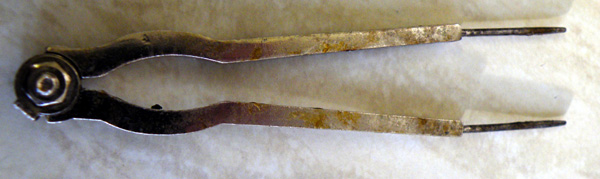
When I began repairing pens (it was quite a while ago!) there were no specialist sellers of tools for the fountain pen repair-person. Then, you adapted tools made for other purposes – still a good solution for pen repairing. I found a pair of dividers in an old geometry set, snapped the points off and filed the rough edges away so they wouldn’t tear the sacs. It worked very well and I used nothing else for many years.

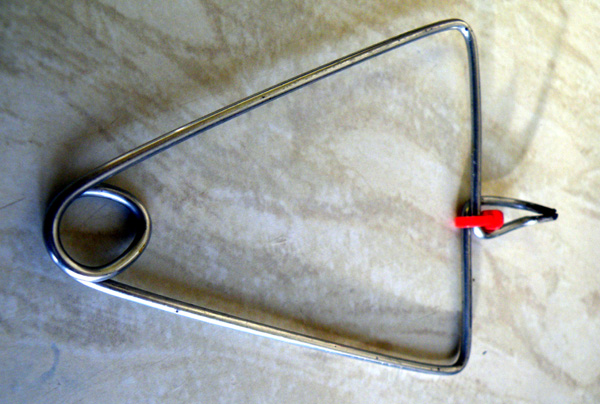
More recently, I bought this handy gadget:

Actually, it’s more clumsy in use than my dividers, but there are occasions where the wider sac opening it gives can be useful, like when an especially thick section protrudes well beyond the nipple.

Restoration.

Restoration is a thorny issue within the fountain pen community. For discussion of the ethical problems involved, I refer you to Fountain Pen Network and especially Lion & Pen, where this subject has been thoroughly debated.

I restore conservatively, and I think it’s worth going into a little detail of what that means to me so that you will know what to expect if you buy a pen from me.

The pens I sell almost all date from before 1970 and they are usually in need of repair when they come to me. It is my aim to do no more than return them to good working order and an acceptable cosmetic condition. Perhaps I should clarify that by saying what it is that I don’t do.

I don’t use a buffing wheel or strong abrasive polishes. I clean the pen thoroughly and polish it lightly. I don’t try to disguise its age or remove the surface scratches that it has accumulated over time. Sometimes heat will make tooth marks pop out and I do that, but I don’t grind indentations or scratches out.

I don’t replate metal trim. I will polish trim but make potential buyers aware of plating loss.

I don’t re-black faded black hard rubber pens.

Replacement sacs are new, of course, as are pressure-bars when the original is damaged. I will replace damaged nibs, levers, clips, feeds or sections with spares from pens of the same model and date.

My aim is to present a good honest pen that doesn’t pretend to be what it’s not. Old pens that are found in an unused, perfect condition naturally fetch a premium price from the collector. Over-restoring a well-worn pen to resemble one that hasn’t been used is, in my opinion, a fraud on the buyer. Further, if a pen has been well-used for many years, its scratches and wear have been honourably come by, and are, to some at least, part of the attraction of owning the pen.

There are collectors who go further and believe that you should do nothing at all to an old pen. It is a collector’s item and should remain in the condition in which it was found. I don’t agree with that. I think people should have the option of using old pens, which write quite differently from modern ones and are an especial pleasure in themselves. After all, collectors can choose, if they wish, to buy the unrestored pens before I get my repairing hands on them.

Less Common British Pens – The Wyvern.

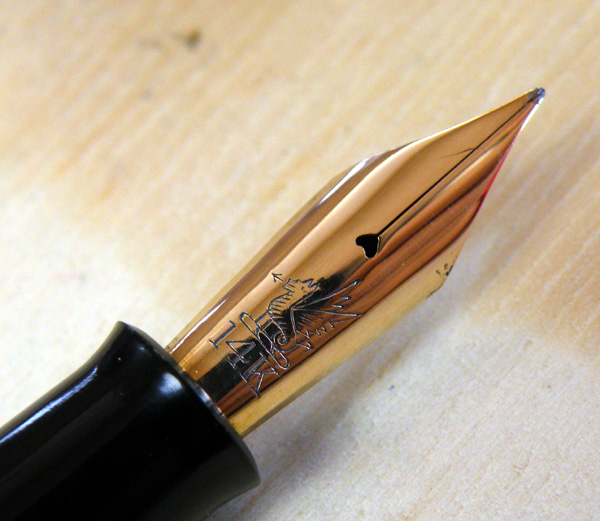
The Leicester Dragon on a Wyvern De Luxe Nib

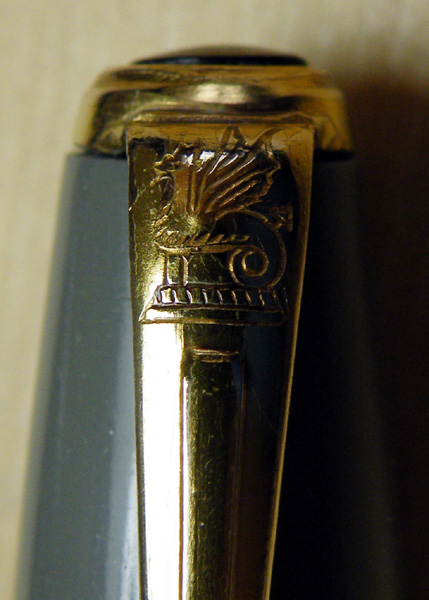
Despite being one of the oldest British pen companies, and producing a variety of high-quality pens, Wyvern does not have a strong following these days. From the 1880s onwards, the company went through various stages of development, importing pens, buying them in from outside contractors, assembling pens from parts and finally going into full production. By the late nineteen-twenties they had their own nib plant and as well as producing their own-branded nibs bearing the Wyvern logo, they made nibs for other manufacturers and warranted 14ct gold nibs for the wider industry. You may have bought a Wyvern without realising it, as they made entire pens for other companies and produced a great many promotional pens.

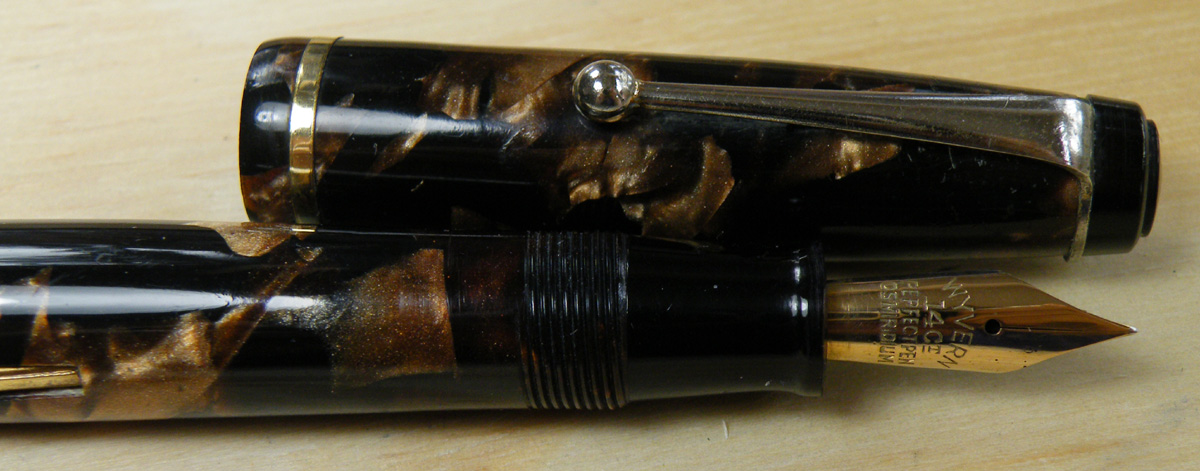
An Early Fifties Wyvern De Luxe

Though not often seen now, their early eyedroppers and safety pens are excellent examples of the period. More commonly offered now are their pens from the nineteen-forties and fifties. These range from the Wyvern Perfect Pen – a good economy-priced student pen – through their larger numbered models like the 60c to the crocodile-skin, lizard-skin and pigskin-covered pens at the top of the range. These pens were highly esteemed and the company enjoyed royal patronage during this period. The weakness of the middle-range Wyverns lies in the gold plating, which is often little more than a gold-wash and wears away easily, especially on the clips. Their great strength are the nibs which are of consistently high quality and among the very best of the time. They are usually firm or semi-flexible, but the occasional full flex Wyvern turns up and is a true delight.

A "Perfect Pen" No 81. Low Cost With A Great Nib

An innovative and progressive company, Wyvern made such a wide range of pens over the decades of their existence that they offer good opportunities for the collector. For the writer looking for an excellent and characterful pen to use, Wyverns still offer great savings over comparable Swans and Conway Stewarts.

The Wyvern Logo on a 1950s Ambassador

Tools: The Knock-Out Block.

Pen restorers have a tools problem in the way others might have a drinking problem or a heroin problem, and sometimes family interventions become necessary as the furtively-purchased tools continue to multiply. You can never have enough pliers, for instance, or angled dental probes. Faced with the array of tools on display in a hardware store, most restorers could find a use for them all. Every one.

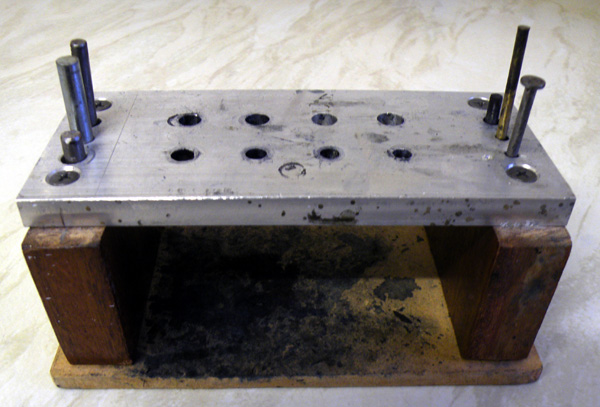
There are some standbys that are unique to the pen mechanic, though, and the knock-out block is one of them. Over the years I’ve had three. The first one was a simple wood block with a metal top and various sizes of holes drilled through. It worked but it wasn’t very stable. I then got one of the cylindrical metal type. Better, but still not what I wanted – it was too small and fussy. Then an older restorer retired from the craft and sold off a mountain of tools and spares which I managed to snag. Among them was this knock-out block:

It’s stable, roomy and holds a range of punches at the sides. It has good open clearance underneath to let the nib and feed drop clear. Perfect!

At least two-thirds of my pens never touch the knock-out block, though. Some restorers will proudly tell you that they totally disassemble all the pens that they repair but that’s not my way. Fitting a nib and feed accurately is no trivial matter. Unless it’s essential it’s better not to have to do it. After all, despite their age, most old pens have retained their original factory settings. If the nib and feed are in good order and well aligned, it’s best to leave them alone. Flushing them with a lot of water clears dried-ink blockages and ensures good future ink flow. On those rare occasions when that’s not enough, or when the nib is damaged and needs to be worked on or replaced, or when a nib is stuck in a rotated position, that’s when the knock-out block comes into its own.

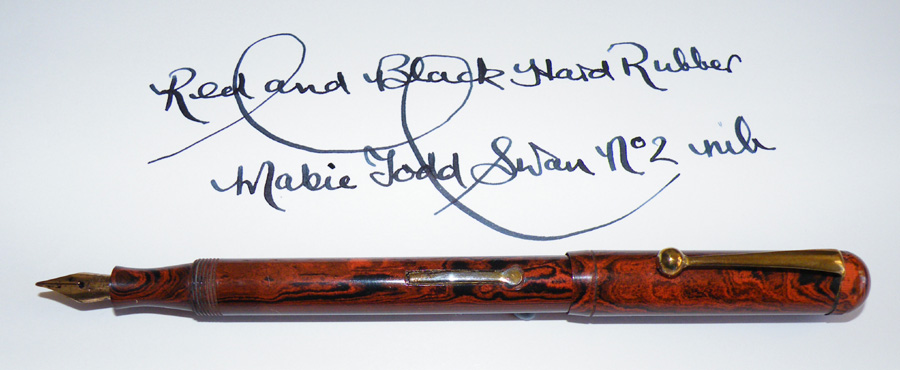
Red And Black Hard Rubber

This is my current daily user.  I keep a pen for a few weeks until something even better comes along, but I’m really enjoying this one.  It’s one of those well-made no-name mottled hard rubber pens that turn up fairly frequently, probably dating to the early thirties.  All these years later, it’s impossible to guess who made it, with any degree of certainty.  The machining is good, the parts fit together very well and it’s a very useable pen.  On the other hand, the plating on the metal parts is little more than a gold wash, and the nib it had when  it came to me was an un-tipped steel one which had worn down to a paper-cutter edge.  I replaced it with a Swan No2 from the parts box as a temporary measure until a suitable warranted nib comes along.

As you might guess from my eBay account name, I’m fond of red and black hard rubber, whether in the Waterman Ripple style, or in this very pleasing woodgrain.  Though I suppose they might have been a little brighter when the pen was new, the colours are mellow and the material is warm to the touch and pleasant to handle.  I have seen red and black hard rubber described as fragile and I suppose it may be where the pen parts are delicate, but in general I’ve found it pretty robust – more so than some of the celluloids that Waterman and Eversharp used a few years later.

The pen is quite substantial and thick enough to give a comfortable grip.  The nib is semi-flexible and the line variation is easily invoked.  I keep a full flex pen for those special jobs like invitations and place-settings, but for everyday use a semi-flex suits me better.