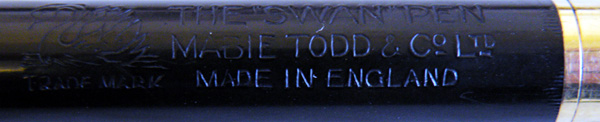
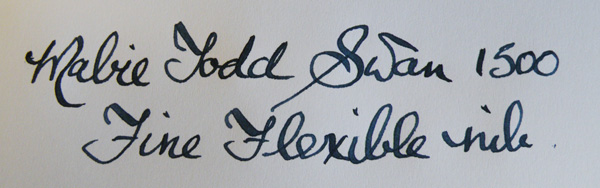
Mabie Todd’s Swan Leverless

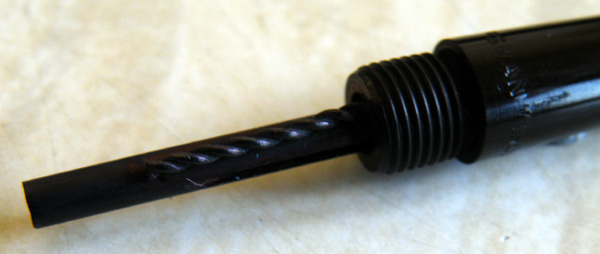
Mabie Todd’s Swan Leverless pens have a poor reputation in some quarters, due not to any intrinsic fault of the pens, but because they have been incompetently re-sacced. The bar in a Leverless does not flatten the sac as does the pressure bar in a lever or button filler. It entangles the sac and compresses it with a “wringing out” action. For this to work well – or indeed at all – the sac has to pretty well fill the barrel. As many Leverlesses have a comparatively small nipple, a necked sac is often needed. Re-sacced properly, a Leverless will hold a good quantity of ink. It is true that it holds less than a similar-sized lever-filler, but it will still hold a lot more than, for instance, a modern international cartridge. You’ll get quite a few pages from it.

The unskilled repairer fits a comparatively slender sac, as he would in a conventional lever or button filler, and the entangling bar compresses the sac poorly, or just rotates around it without compressing it at all. As you might imagine, fitting a sac that fills the barrel is nowhere near as straightforward, and a different method has to be used.

The Leverless has the advantage that it is one of the easiest pens to fill. Simply place the pen in the ink, rotate the turn-button anti-clockwise, then clockwise, give it a few seconds to complete filling and you’re done, and it’s all carried out at the end of the pen away from that messy ink-bottle. In addition, though there were economy Leverlesses, most were designed to be prestige pens, with two or three cap rings and the No 4 or larger nibs. They were the most successful Swan range for decades, and as long as there were skilled repairers to fit new sacs they gave no trouble as the design is strong and durable.

Conway Stewart Conundrums

Like many another pen topic, Conway Stewart is too large a subject to be covered in one post, but it’s always a pleasure to write about this company which produced perhaps a more varied range of colourful pens than any other.

Despite being among the most written about of British pen manufacturers, many mysteries remain, none more impenetrable than their numbering system. I have heard several speculative explanations but none seems to hold up. Except my one, which is as follows: In the immediately post-war period, one of the company’s most prestigious pens was the Duro-nibbed 55, with its narrow-medium-narrow cap bands. The 388 is a smaller version of the 55, following the same pattern. What connection could there be between these numbers? Well, you see, you must subtract 55 from 388, which gives you 333. The 333 is a simple 1930s Scribe, so we’ll ignore that but if you multiply the numbers together, ie 3x3x3, you get 27, which is another prestigious pen of a slightly later period…

Are we onto something here? Is this the solution to Conway Stewart numbering?

No. It’s not. But it makes as much sense as some of the others.

Their business model – which worked well most of the time – is another mystery. Most pen manufacturers limited their range to a few models at any one time, but Conway Stewart, both before and after World War II, had a tremendous array of different models. That must have been a costly business. Though some nibs, clips, levers and sections would have been interchangeable between a few models, there must have been a huge number of different parts to be made in total. Each model had its colour range. Some patterns were used by several models, some were unique to one. That’s a lot of celluloid rod stock!

For most of their history, Conway Stewart was a successful company. It was a well-respected brand, the pricing was right and their pens were well-presented in cards of the various models in all those patterns we search for now – cracked ice, herringbone, tiger’s eye, autumn leaves, blue rock face – in the best stationers and newsagents. Though the gold plating may have worn a little now, these pens survive in their thousands, a testimony to their popularity and good quality.

Hard Rubber Ramblings

Though it’s mostly only used for feeds on the better pens nowadays, hard rubber is a wonderful substance ideally suited to making pens. It’s light, durable, warm to the touch and easily machined to a fine tolerance. That being the case, why did it give way so rapidly and completely to celluloid? A large part of the answer, I think, lies in its lack of versatility. Once you’ve made red hard rubber, the various Waterman Ripples, Wahl Eversharp’s delightful Rosewood and the array of machined patterns, where do you go? It’s often repeated that machining curves into hard rubber was difficult and this was another reason for change, but I think that’s just one of the perpetuated myths of pen history. The black hard rubber torpedo-shaped pens that Swan made in the nineteen-forties have as extreme curves as anything ever made in celluloid. No, I think the search for a new material was driven by the lack of options hard rubber offered, especially in colour.

Celluloid really was the answer. Any colour in the spectrum, any pattern that could be designed was possible using celluloid. It, too, machined well, and took a wonderful polish. The lustrous marbles of the the nineteen-thirties cannot be bettered, even using today’s acrylics. It is true that it had a tendency to burn near-explosively and it required many months of curing in a controlled atmosphere, but these were difficulties that the industry was prepared to deal with. A few manufacturers like Waterman, Wahl-Eversharp and De La Rue persisted with hard rubber for a while because they had made a substantial investment in it, but the clock could not be turned back. In a few short years celluloid was king.

It doesn’t do to be too radical, though, especially in the British pen market. You may lose the more conservative among your customer base. Though celluloid was welcomed, there was continuity with the old hard rubber designs. The machined patterns that were applied to black hard rubber pens were copied on celluloid models. In some cases, like Conway Stewart’s No 479 Universal Pen, it takes more than a cursory glance to decide which examples are black hard rubber and which are celluloid.

Which brings me to this pen:

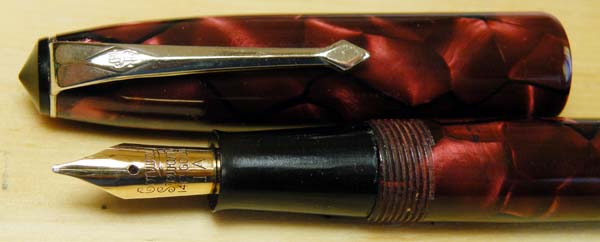
It was advertised as a mottled hard rubber pen, and at first glance appears to be so, but it’s actually celluloid in a pattern that fairly faithfully replicates MHR. In shape, if you ignore the Art Deco stepped clip, it’s vaguely Duofold-ish, and was probably made in the early nineteen-thirties. It’s an English pen called “The Britannic” and I suspect it’s really a Platignum. Why would Mentmore/Platignum, a very commercially astute company, produce such a backward-looking pattern if not to cater to the taste of their more traditional customers?

Though it has never regained its earlier preeminence, hard rubber has never quite gone away. It remained in use for clip screws, sections and feeds on most pens, and it was revived by Mabie Todd for a range of lever fillers and leverlesses in the nineteen-forties. Some European companies have experimented with it in modern times and it has remained popular in India. I’m very fond of it myself and my small collection of user pens includes several hard rubber examples, favourite among them a Mabie Todd Swan Leverless 4461.

A Working Tool

Our view of fountain pens has changed enormously in the years since they ceased to be the main writing instrument. Today, very few of us truly need to use a fountain pen. It’s a luxury or hobby item, and whether new or old, is priced accordingly. Fifty or more years ago, a fountain pen was essential for work, if you were in a clerical, administrative or managerial job and even if you weren’t, you probably needed one for everyday correspondence. The price in those days reflected what the market would bear. A mid-fifties, middle-of-the-market pen that I have at the moment bears a label with the price of 18/6d, including purchase tax. A little googling around assures me that at the end of that decade the average weekly wage was £7.15/-, so a moderately-priced pen cost an appreciable lump of income. For most people, then, a pen was working tool that you expected, accidents aside, to last for a long time. It was a serious investment.

So how long could a pen last, heavily used every working day?

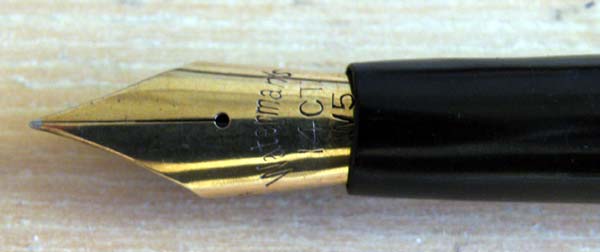
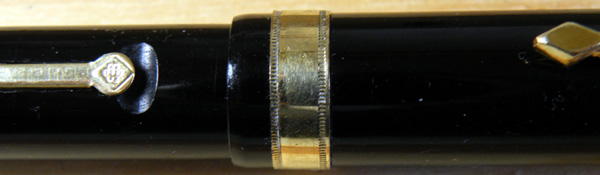
This is the most worn pen I’ve had pass through my hands. It’s an American Waterman 12. The cone cap has long gone, donated to a No12 that was in more saleable condition. Not only has the gold been worn off the barrel bands, the base metal itself is worn down. Even the black hard rubber itself is subtly indented where the user’s fingers gripped the pen. That’s serious use! Waterman 12s were in production up to the early 1920s, but the slightly rounded barrel end of this one marks it as an early example, before 1910. It has a replacement nib, a Waterman W5 that dates to around 1945. When I disassembled the pen, the staining on the shank of the nib indicated that it had been in place for a long time. Could it be that the original nib had worn out after thirty-five years of use and been replaced with whatever was handy and vaguely appropriate by a repairman?

Given the barrel wear, I think that scenario isn’t entirely beyond the realms of possibility. Would the original nib have survived thirty-odd years of use? I think it’s quite likely. Waterman No2 nibs were well made with a generous amount of tipping material, and they were often flexible, requiring a light touch in use. My own experience of pens that I bought twenty or more years ago (and were far from new then) and have had extensive use without visible wear bears that out.

In any case, that old Waterman 12 served its owner well and didn’t owe him or her anything when it was finally laid aside in a drawer. It’s exceptional, though, and that’s a very good thing, or we wouldn’t have all the old pens in very good condition that we do. In a way, that’s even more of a mystery. Why were excellent and usable pens set aside and forgotten when they represented a considerable investment to the average buyer? In the case of eyedropper fillers, I suppose convenience dictated that they be replaced with one of those snazzy new lever fillers. What about all the excellent 1920s and 1930s pens, though? They were too early to be superseded by ballpoints. Perhaps their owners were given a new pen for Christmas. Maybe they couldn’t resist the advertising for a state-of-the-art Swan Leverless or a colourful Conway Stewart.

All I can say is thank goodness those old pens were laid aside in good condition, and that they come to me to be restored and sent on their way out into the world for many more years of use.

Problems With Your Pen

If you have a problem with your old pen, would like to know more about it or want advice on a repair, use the “Leave A Comment” button to ask and I’ll try to help.

My main area of knowledge is British pens before 1970, but I have worked on most American and European pens too. I’m not an expert on fountain pen history but I can usually place a pen in its historical context and at least take a stab at the date.

Feel free to ask and I’ll do my best to give you a useful answer.

Casein

Casein found more favour as a material for pens in Britain than elsewhere. Sheaffer used it briefly in America, but otherwise, so far as I know, pens were not made from it there. In Britain, Burnham and Conway Stewart used it extensively.

From 1900, casein was sold under the commercial names such as Galalith and Erinoid and was used to manufacture buttons, such household items as clock cases and desk sets and, of course, pens. Though it did not mould well, it could be machined with ease and its main attraction was how well it took colouring, whether as a surface dye or throughout the material. The colours were strong and the material appeared to have exceptional depth of pattern as well as taking a high polish.

It was supplanted by celluloid which was, in almost all respects, a better material, but memory of the lustrous colours that could only be achieved by the use of casein led to its revival. Conway Stewart used it for several ranges of brightly coloured pens both before and after the war, and Burnham made much use of it in the post-war period.

It is well known that casein and water don’t mix. Immersion in water for a few hours will ruin such a pen. It will expand by about 10% and soften, and it will distort on drying out. That’s not to say that we should overreact about it. A wipe with a damp cloth won’t harm a casein pen, but there is good evidence that use in a highly humid climate can lead to deterioration.

Related to the above is another major problem with casein – crazing. This surface cracking is a result of exposure over a long period to light and dampness. The cracking goes quite deep and cannot be polished out. It is unsightly and spoils the lustre of the pen. Jonathan Donahaye, the late, great Conway Stewart collector, believed that those casein pens that we now find in perfect condition are the ones that were forgotten in the back of drawers. There’s every indication that he was right, and therein lies the clue to keeping your casein pen in good condition. Keep it out of bright sunlight, keep it dry, and store it in a dark, dry place when it is not in use. Otherwise, use it and enjoy it – that’s what it was intended for!

Casein Conway Stewart 15 Plum with Black Veins

How do you know whether your pen is celluloid or casein? Dump it in a basin of water and wait for two hours. No! Really! Don’t do that! Supposedly, casein smells of formaldehyde whereas celluloid smells of camphor. Also, if you rub casein briskly, it gives off a milky smell. I have to say that these tests don’t work very well for me. If you have a brightly coloured post-war Burnham, chances are it’s casein. Several ranges of Conway Stewarts, including the 475, 15, 759 and several Dinkies and Dandies (by no means a comprehensive list!) contain casein models. If the colours are strong and the pattern appears to reflect light from the depths, chances are it’s casein. Against that, remember that even among Conway Stewarts, celluloid is much more common than casein. Perhaps the best answer is to treat all your Conway Stewarts and Burnhams as if they were casein. Then you’re safe!

Flexibility

Nib flexibility is a big topic and it’s likely that I will return to it again, but this is an outline of the subject.

The most rigid nibs are those that contain the most gold, quite simply. They’re made from thicker material, and include, for example, Conway Stewart’s Duro nibs, Mabie Todd’s Eternal and most Parker Duofold nibs. Those nibs were often housed in more prestigious pens, with a price to match. Though perfectly suitable for general writing, those rigid nibs were suitable for use with multi-part forms.

Next is the semi-flex. In my book, that’s a nib that expands by one nib-width with pressure, e.g. fine to medium or medium to broad. Semi-flexes are the commonest type of British post and pre-war nib. Most Conway Stewart nibs, I find, are semi-flex.

Flexible, to my mind, is a nib that expands two nib-widths with pressure – fine to broad or medium to double-broad. I most often find flexible nibs in Swans, Watermans and De La Rue Onotos.

The Super-Flex, then, expands more than two nib-widths. They’re not common, but in my experience they occur most frequently in Swans, Blackbirds and Watermans. My most flexible nib is a fine Whytwarth which will safely expand to five times its unflexed width.

Of course there’s more to flexibility than the width of the line that can be induced. There’s “return” – the alacrity with which the nib snaps back to its unflexed state when the pressure is eased. Without good return you can’t really achieve good calligraphic effects. Then there’s the amount of pressure that can be safely applied to induce flexing. Some of the larger Swans take quite a bit, others need a very delicate touch. It takes a lot of careful experimentation to explore the flex of your pen. Some excellent nibs can be easily cracked or sprung with too enthusiastic pressure – Waterman Juniors, Blackbirds and the thinner of the post-war Conway Stewarts fall into this category. Such damage can be repaired but as it’s expensive, it’s best avoided.

The ultimate, for many calligraphers, is the pen that is extremely flexible and takes little or no pressure to get there. Jocularly known as a “Wet Noodle”, such a pen can produce wonderful effects, if you have the ability to control it. I confess that I find it difficult. I use a fairly stiff full flex, slowly, for special calligraphic effects, and for daily use a semi-flex is enough. My current daily user is a Conway Stewart 85 that flexes from medium to broad with very little pressure, and it’s a real pleasure to use and imparts interest and character to my writing.

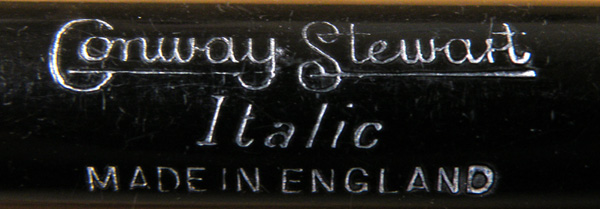
The Conway Stewart Italic

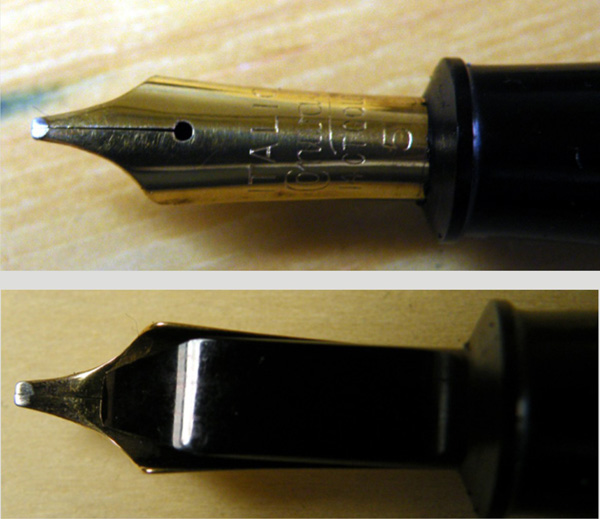
Here’s one you won’t see often – a Conway Stewart Italic. This pen went into production in 1958, which was a peak period in Conway Stewart’s post-war business. The strictures and shortages of wartime and the subsequent era of difficult recovery were over. Their new torpedo-shaped design was selling well and they were expanding the model range.


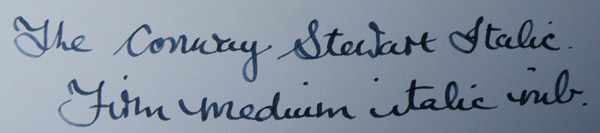
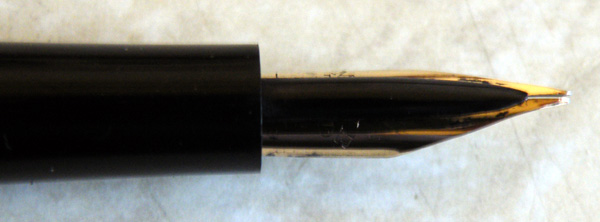
The pen is similar in shape and dimensions to an 85L, but the metallic blue clip stud and medium cap band with milled edges indicate that this is something special. The nib is special, too. First of all, it’s a thing of beauty. Then, in use, it’s a pleasure to write with. Unlike more modern italics which are often sharp-edged, this one is quite stub-like, a little rounded at the corners and on the leading edge of the nib. It’s quite easy to write cursively with it, something that can be difficult with, say, the Sheaffer No Nonsense Italic. It gives very considerable line variation.

So far as I’m aware, this pen was only available in black and various herringbone colours. It wasn’t a very big seller, as it anticipated the vogue for calligraphy by quite a few years. As a result, it’s decidedly uncommon now, which is a pity, as it’s an exceptional pen.


Tools: The Inner Cap Puller.

Most people wouldn’t even consider a pen with a broken clip. Even when it’s otherwise fine, that’s such a serious fault that the pen ceases to be an object of desire. If it has a washer clip and you can find a replacement, the job’s pretty straightforward and the pen goes from junk to jewel in a matter of minutes. If it’s one of the several types of inserted clip that penetrates the body of the cap, it’s quite another matter. Some Swan clips are heat-inserted straight into the plastic. They can be removed and replaced without special tools – other than a heat source – but it takes time and care and success is not guaranteed. Worse still are those that are held or covered by the inner cap, because you have to get the inner cap out of there, and that can be very tricky. Help is at hand, however, in the shape of the Inner Cap Puller:

Most pen repair tools can be picked up in any hardware store but there are one or two that are specialist, and this is one of them. As there is a low volume of sales and it’s a high-precision tool, it doesn’t exactly come cheap, but a few repairs that otherwise couldn’t have been done will pay for it. There are a couple of versions out there. Mine came from Tryphon Enterprises, who sell a wide range of pen repair tools and consumables and are very helpful and obliging people to deal with.

Even with the puller, removing an inner cap isn’t a trivial business. It was doubtless mechanically pressed into the cap, it’s been in there a long time and it will be encrusted with decades of ink. All that adds up to a great reluctance to come out. Removal needs extended and perhaps repeated soaking, heat and a lot of care and patience. A pen cap is a very fragile thing and the force that a puller can bring to bear is considerable. Breaking a good cap will really spoil your day.

Inner caps themselves are generally not interesting, being just short cylinders of plastic. They’re useful, though, in that they provide the means by which screw caps close securely, they may hold or protect the clip and they reinforce the cap. Sometimes, especially in Watermans, they’re made from sections of scrapped pen barrels, and you may be surprised to fined a marbled-pattern inner cap hidden away inside your pen.

Inserted-clip repairs can be among the most difficult restoration tasks, but successfully done, it brings a pen back from a fate as a spares donor to one that someone will be proud to own, and that’s very satisfying.

The Mabie Todd Swan 1500 Eyedropper Pen

By the time the 1500 came along – probably around 1910 – Mabie Todd had been making fountain pens for quite a while. There seems to be real confidence and assurance with this model. No longer was the company trying to get a pen to work reliably and well. That has been done, and now it could concentrate on meeting the various needs of users, so the pen was presented with all the possible nib options – fine, medium and broad, oblique and stub, flexible, semi-flexible and, less usually, firm. Though the rest of the pen was British made (with the exception of a period during World War I, when production switched to America) the nibs were still made in New York.

1500s are perhaps the most commonly seen eyedropper pen now, and that gives an idea of how successful this model was and how well it was made. It remained in production for at least a decade, and survived competition with more technically advanced pens at the end of that period. Quite simply, its reputation was so high that people saw no reason to change. It remains a perfectly practical pen to this day and because of the superb quality of the nibs it is an especial pleasure to use.

By this time, other manufacturers had begun to drop the over-and-under feed. Though it successfully delivered ink from the barrel to the tip of the nib, it didn’t regulate it well. Too much or too little ink might arrive on the paper, and blobbing was a problem. The 1500 doesn’t suffer from these deficiencies. Perhaps the inclusion of the twisted silver wire at the back of the feed helps to regulate flow, but a well-set-up 1500 writes as well as any pen fitted with a spoon or ladder feed.

Like most pens made at that time, the 1500 is a slender pen. Most of its original purchasers would have been used to dip pens, so this would not have been seen as a disadvantage. The lack of a clip, however, was a nuisance, and Swan addressed this lack with the Swan Metal Pocket and a range of after-market clips. Though the slip cap fits securely, I suspect that clipping the pen to a pocket was never a very comfortable solution and there must have been accidents. It was only with the introduction of the Safety Screw Cap this issue was finally dealt with.


The 1500 comes in several guises. The most common version is the simple black chased hard rubber model, but more expensive 1500s had gold-filled barrel bands or even full overlays. This is the pen that helped to establish Mabie Todd’s early British market dominance, and it is said that fountain pens were referred to as Swans, in the same way as all vacuum cleaners were known as Hoovers.

For me, a flexible 1500 is one of my daily users. It requires no noticeable pressure to invoke a broad down-stroke, and transports me back to the days when light upstrokes and heavy descenders were just how people wrote, rather than a calligraphic technique.