Macniven & Cameron 308

Plagiarism has always been rife in the fountain pen industry. Sometimes it was mere emulation, but often the copying was close enough to lead to litigation. Perhaps no pen gave rise to as many copies as the Parker Duofold, both in the USA and abroad. Here’s a strange example:

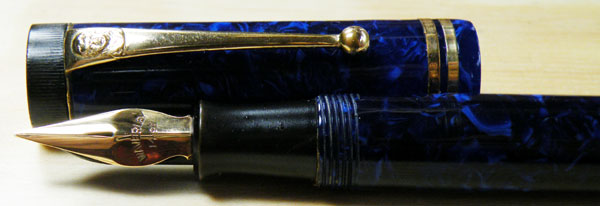
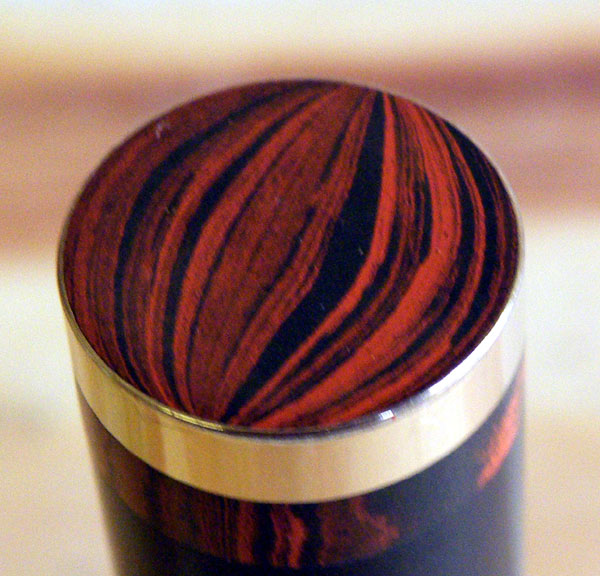
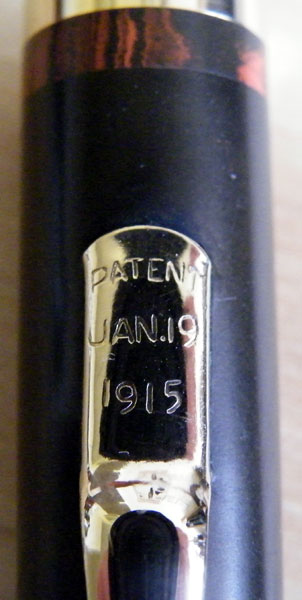
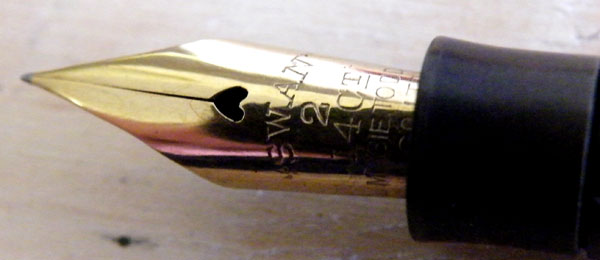
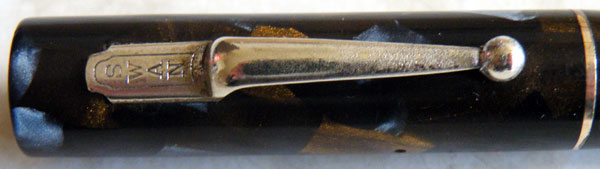
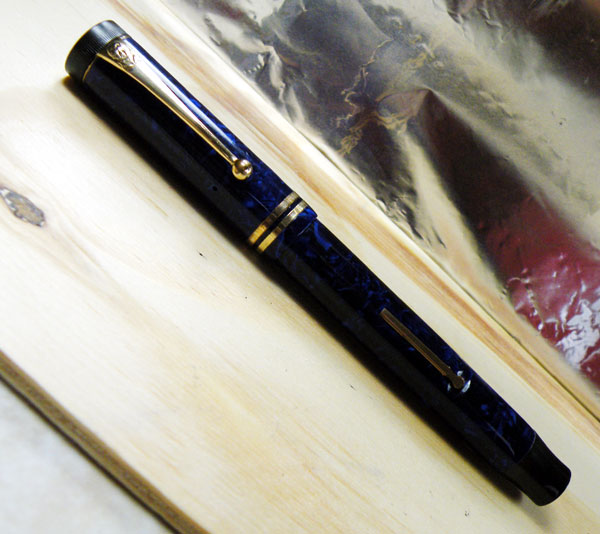
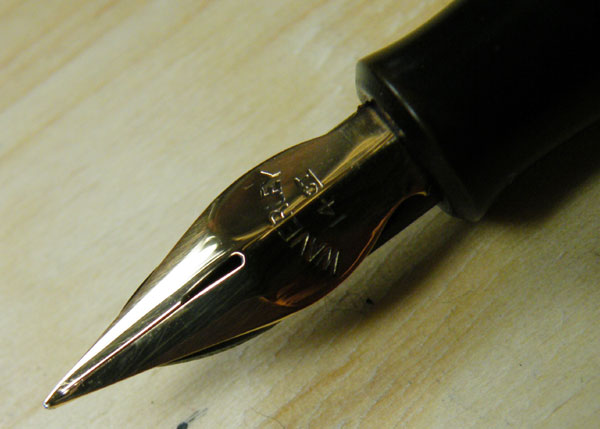
This is a Macniven and Cameron Waverley 308. It ticks just about all the Duofold boxes – size, proportion, milled clip screw, cap ring placement, even a Duofold-type blind cap on a pen that doesn’t need one because it’s a lever filler. Closed, it’s almost a lapis lazuli two ring Duofold of around 1928. Once you see the nib, of course, the game is up!

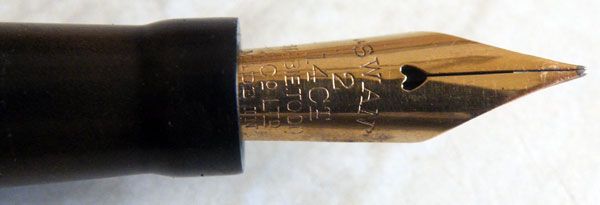
It’s strange that they should have copied the Duofold so closely, then made it instantly clear that it was a Macniven and Cameron by using their unique and characteristic leaf-shaped nib. They did make pens with more conventional nibs but chose not to use one here.

The biggest surprise about this pen is that M&C would choose to emulate anyone else. Always an individualistic company, they usually did things their own way, with little reference to what the rest of the industry was doing. Perhaps the chance to cash in on the Duofold’s popularity was too tempting, but pride made them use their own nib.

I came very close to keeping this pen. I admire lapis lazuli, the quality was impressive, the size and balance was right. And I love that Waverley nib! It was the nib that decided me against it, though, in the end, Unlike all the other Waverley nibs I’ve had, this one was rigid, perhaps in the best Duofold tradition. I couldn’t write well with it, so it had to go.

My apologies for the quality of these photographs. When I took these I was experimenting with artificial light and reflective metal foil. You can see how well it worked – all harsh contrast and heavy shadows. Oh well.

Under Pressure

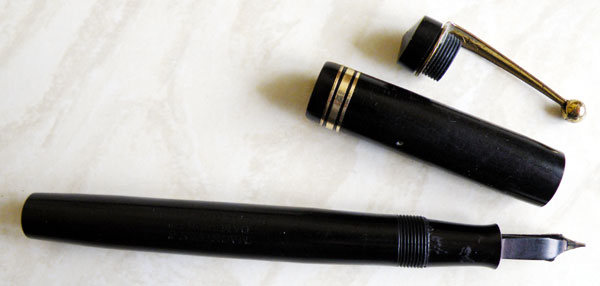
Pressure bars. Or, as some people call them, presser bars. I always thought that was a spelling mistake but… well… they press, so one’s as good as the other. If I’d been prepared to do this right, I would have had the full complement of pressure bars, of which there are many, but this is what I have. Conspicuously absent are the Swan Leverless angle bar and Parker’s anchor bar. The rest are really just variations on the theme of these three.
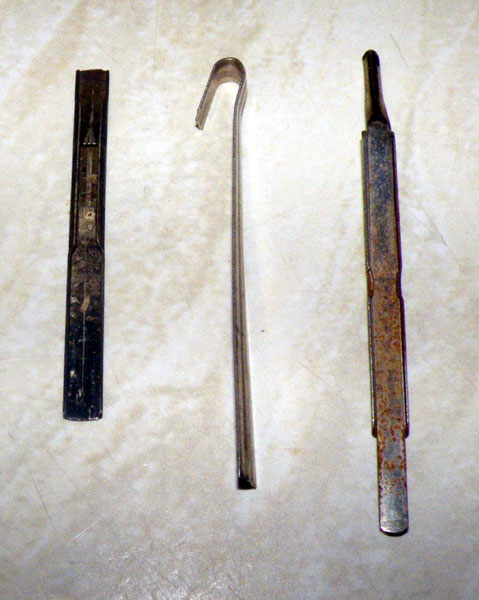
Exciting, aren’t they? Well, no, perhaps not, but for anyone interested in how their pen works, pressure bars aren’t entirely dull either. On the left is the slide bar, which you’ll find in most Conway Stewarts and some Watermans and Eversharps. In the middle is the j-bar which you’ll find in most other lever fillers, and on the right is a button bar for, as you’d expect, most button-fillers.

Slide bars are tricky to fit the first couple of times, then you have the knack of doing it. They slip onto lugs on the bottom of the lever and work very efficiently, because they descend completely flat on the sac. Sometimes these lugs can become flattened or break off, and it’s often suggested that a j-bar be substituted. Don’t do it! This is a bad repair. From a collector’s point of view, it makes the pen non-original. Practically – and more importantly – it can damage the pen. Waterman lever boxes have a tendency to break anyway, and if you add the stress of an inappropriate j-bar, the box is sure to crack. Similarly with Conway Stewart levers, which are notoriously fragile. They will deal with the resistance of a sac, but a sac and a piece of sprung metal is likely to prove too much. Certainly, there are Conway Stewarts that have j-bars – all Dinkies (so far as I know) 12s, 14s, 15s, 36s, 475s and 759s – but they were designed to resist the additional pressure. It’s far better, faced with a lever with broken lugs, to replace the lever. I know that’s a pain but you’ll thank me in the long run. Really. You will.

J-bars in their own place are absolutely fine, and many excellent pens use them. They might not be quite such efficient sac squeezers because the bend at the end can mean there’s an short length of sac that’s not fully compressed, but it’s marginal. They can suffer from metal fatigue and weaken or break and need to be replaced. The modern replacements you can buy, I find, are rather rigid and hard to flex. I don’t use them, but salvage j-bars from scrap pens. Try to find a j-bar as similar as possible to the broken one, and take care in lining it up.

Button bars are very efficient, because, again, they move parallel to the sac and squeeze it flat. In theory, all pens that use button bars should have screw-in sections to resist the downward pressure of operating the filling system. In practice, many are friction fit and none the worse for it. Obviously, if the joint between the section and barrel becomes too loose, this would be a problem, hence the glued sections we sometimes find. Friction fit is cheaper to make than threaded, so many go with it. Wishing to reduce costs by replacing threaded sections with friction ones, Parker developed its clever anchor bar, a three-piece pressure bar that hangs from the button opening and so applies no pressure on the section. It’s also very efficient in getting ink into the pen. You’ll find it on Televisors and some Duofolds.

Finally (for brevity!) there’s the Leverless angle bar, a sort of Neanderthal among pressure bars. It’s a non-springy hunk of metal that rotates and gathers up the sac, wrings it out and squashes it against the barrel wall. Efficiency of Leverlesses depends greatly on how well they’re re-sacced, and even a well-fettled Leverless will draw less ink than an equivalent lever-filler, but again, it’s at the margins.
The Standard British Pen

In my last post, about the Ingersoll pen, I mentioned how British-looking it was. Most British pens are pretty instantly recognisable as such, from the beginning of the thirties right up to the fifties, though of course many took new forms in the post-war period. By the latter end of the twenties a Standard British Pen was developing, and thereafter we see it among the output of most manufacturers.

It’s straight-sided or only slightly tapered. Lever and button fillers both conform to the pattern. The clip is a washer type and it’s retained by a black hard rubber clip screw. Sections are also BHR and more often than not they will be either slightly stepped or concave. There will be either a ladder feed or some version of the spoon feed, always made from BHR. Almost all the common pens of the period conform to this pattern. Think of, for example, the Conway Stewart 286 or 475, a Stephens Leverfill or a Mentmore Autoflow. Though the filling system was different, even the De La Rue Onoto of the period had the same profile. In the fifties, Mentmore, Summit and Stephens were still producing pens like this, though they had more modern-looking models and some others, like Conway Stewart, had transformed their range except for the odd anachronism like the 388.

Why, when pen manufacturers elsewhere were enjoying success with more adventurous shapes of pen did the British trade remain so loyal to this pen type? The answer must be, simply that that was what the market demanded. The traditional shape sold. There were exceptions, of course, pens with visualated areas, and the odd rebellious baguette-shaped pen like the short-lived Croxley example. Then there was the biggest exception of all, the exception that proved the rule golden: Mabie Todd. They never produced a Standard British Pen, though they came close with some of their early Leverless pens. Not quite, though. Those pens had a washer clip of sorts, but it was manufactured as a unit with the clip. For the most part, Swan used inserted clips of one kind or another, and from the thirties on their pens were distinctly streamlined.

The Ingersoll No30

Ingersoll pens can be thoroughly confusing. For a start there were two American pen makers called Ingersoll, one producing the bakelite twist-filler dollar pens, the other Redipoint pens. US Ingersolls not infrequently found their way across the Atlantic and sometimes appear in eBay listings. Then there was a UK Ingersoll pen company, apparently independent of its US namesakes, producing very British-looking pens.

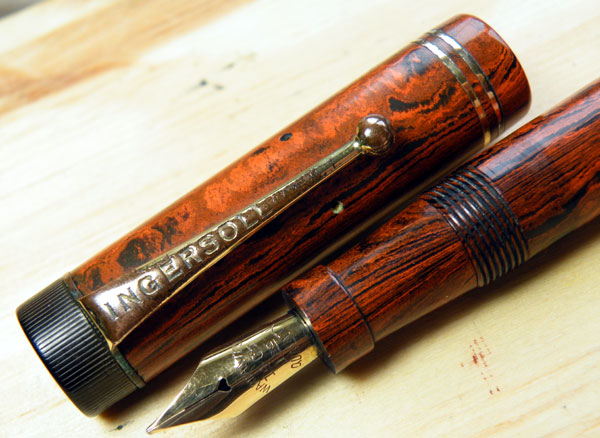
It has to be said that most British Ingersoll pens seem to have been aimed at the lower end of the market, often with steel nibs. I pass on these, but there are also occasional Ingersolls that are very much better quality, like this Ingersoll No30.

This is a big pen – 16.7cm posted – in an especially richly-coloured mottled hard rubber. The shape would suggest that it’s a mid-thirties pen, and it bears a strong resemblance to a variety of no-name hard rubber pens common at that time. The milled clip screw, especially, looks similar.

The barrel and particularly the section, with its pronounced step, look very like those of the MHR Burnham of the time. Perhaps the Ingersoll company bought in its pens from one of the majors, and Burnham looks like a likely candidate to me, though I have seen Wyvern suggested as a possible manufacturer of their later pens. All this is speculation. What is important, I think, is that beauty can appear in the most unexpected of places. It’s a pleasant surprise to find that a company I would normally give little consideration to produced such a gem as this one.

Fountain Pen Books – Andreas Lambrou: Fountain Pens

This book was first published in 2000. It’s still available and is priced at £42.08, new, in Amazon. It’s quite often available second-hand.

Subtitled “United States of America and United Kingdom”, it’s very ambitious in scope, trying to cover these two enormous pen industries in a modestly-sized volume. The surprise is the degree to which it succeeds. Many smaller manufacturers are ignored and others are touched on only lightly, but Lambrou’s judgement is good about which marques and models to cover. There’s a lot of bling in here, as with all pen books, but the pens you and I will commonly see and want to know about are well covered. The photography is excellent, and really useful for identification purposes. There are also excellent line drawings and intelligent use of period advertising.

More than just a comprehensive introduction to the pens of the USA and Britain and a really good read, this book makes a useful reference as it’s logically organised and has a good index. I’ve had my copy for about three years, and already the jacket is tattered from much handling – the best sign of approval for a book of this kind!

Lambrou does repeat the story about there only having been 200 Conway Stewart 22 (Floral) pens made, but perhaps this can be forgiven as it was widely believed to be true, back when this book was written. He’s at variance with some other authors over a few dates, but I’m not able to say who’s right and who’s wrong.

Taken all in all, this is one of the best fountain pen books, and one that deserves a place on every enthusiast’s bookshelf.

Weasel Words

Today, brethren and sistren, I am going to moan, grumble and groan about the language of our hobby. If this doesn’t appeal to you, pass on by. I expect the next post will have returned to the pens.

Those of you who are aware of my eBay listings as well as this blog may have noted that I never use the word “vintage” in my descriptions. Vintage, as I’m sure you are aware, originally referred to the annual crop of wine and on its own carried no note of approval or disapproval. However, if one were to say “Bordeaux, vintage of 1956” (I don’t know my wines from my Coca-Cola), those in the know would be able to determine whether in that context I was speaking with approval or disapproval. Then the word was hijacked by the old car hobby. First of all, they determined that cars that fell within a certain period were “veteran” cars. As time went on, this left another whole selection of not-quite-so-old cars that were also admired for their age and engineering quality. The hobby then sat down and decided that cars of a certain age could be legally described as “vintage”. If you tell me you have a vintage car, I will know exactly what you are talking about.

On the other hand if you tell me you have a vintage pen, the adjective carries no real burden of meaning because our hobby has avoided defining “vintage”. All I can take from it is that you have an old pen and the fact that you use that word suggests you want to sell it to me. Without definition it remains a junk word so far as our hobby is concerned. What I restore and what we all love are old pens. Mostly they are admirable old pens and often they are wonderful old pens, but that’s what they are. Old pens.

Even more appalling is the term “mint” and its variants, which we often see used to praise some piece of old tat. If it were to be defined as it is in numismatics, it would mean “completely unused and in perfect, unmarked condition”, but this is rarely the case with the pens that are described as mint. Then there’s “near-mint” which descends into the realm of utter meaninglessness. And worst of all, “minty”. What does that mean? Did the seller polish the pen with Colgate toothpaste?

Then (and this really gets my goat) there’s the habit of calling every mottled hard rubber pen “red ripple”. Red ripple applies to a particular flow patterning of the red and black hard rubber and in old pens, it’s confined to Watermans. It’s highly regarded, and red ripple Watermans tend to sell for more than mottled hard rubber Watermans, or, in most cases, mottled hard rubber pens by other manufacturers. Calling everyday mottled hard rubber or woodgrain red ripple comes very close to attempting to defraud the unwary buyer. “Woodgrain” is, quite simply, mottled hard rubber designed to look like wood. The best example is Wahl Eversharp’s wonderful rosewood pattern, but most later mottled hard rubber is in a woodgrain pattern. It carries no especial cachet or value.

I could get into “New Old Stock” but I won’t. That’s enough grumbling for today.

The Swan SF230


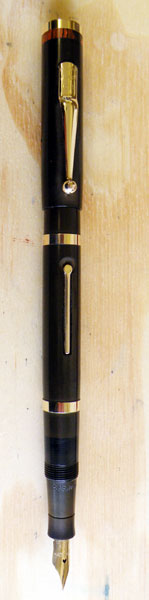
When I think of Swans, this is the pen that comes to mind. This is THE Swan for me, the epitome of the brand. The SF230 also came in mottled hard rubber and, a little later, in a variety of celluloid patterns including green jade and lapis lazuli. They are very attractive, but the black hard rubber version is the one that works best for me, as there’s nothing to distract from the splendid design. It’s a big pen -17.5cm posted – and it’s designed to impress, with its three bands and large gold-filled clip. It isn’t the most expensive pen in the range. There were very highly-priced overlay pens, pens with very much larger nibs – this has a No2 – and the ETN range with their Eternal nibs was higher priced.


This was the pen that the company pushed hardest, though, and it featured in many advertisements, especially in Britain and France. I think Mabie Todd recognised that they had a winner in this one, with its perfect proportions and harmonious design. Always the writer’s pen, practicality was never sacrificed to aesthetics in Swans, and this pen is no exception. Though the cap may look large and imposing, the pen is perfectly balanced in the hand. This nib is fine, and it has a little flexibility. As always with Swans, it’s a delight to write with.


There is a case that can be made for saying that fountain pens reached their peak in the 1920s. The technology of nibs, feeds and filling systems was mature. The ergonomics of a comfortable writing instrument were well understood. Many of the “improvements” that followed were illusory, and from a purely practical point of view we would have lost little or nothing if pen development had frozen here. I’m not saying that would have been a good thing. There are so many delightful pens that we would not have had. What I am saying, though, is that it would be hard to find an objectively better pen than this.

Restored Swan Minor SM2-57

Here’s the restored Swan Minor SM2-57, which I posted about yesterday.


Both as a repairer and a writer, Swans are my first choice of pen, and of all the Swans, I like Minors, whether SM1 or SM2, best of all. They’re an adequate size and the design is very pleasing, with the flat-topped (or in this case very slightly domed) cap, the inserted clip and the hard rubber lever, which breaks up the line of the barrel much less than the usual metal one. And then there’s the nibs… Minors almost always have exceptional nibs. Far more often than in any other model, Minors have oblique, stub or very flexible nibs. Perhaps it was the real “writer’s pen” of the Swan range. I haven’t tested this pen yet, but it seems to be at least semi-flexible.


The pattern of this pen is very beautiful, with bronze and blue in different shades mixed with black. The colours are muted and there are quite large areas of each colour. Most unusual. I haven’t seen this pattern before.

Swan Minor Clip Replacement

I bought a Mabie Todd Swan Minor 2-57 with a missing clip. Luckily, there was no damage done to the cap when the old clip failed, and luckily also, I had a spare clip. These are superbly beautiful pens with a chunky pattern in muted colours – a perfect example of Swan’s understatement! This one was well worth the painstaking business of replacing the clip.

First the cap gets a good session in the ultrasonic cleaner to remove encrusted ink and get the water to penetrate behind the inner cap. Then heat is applied. Another ultrasonic bath and yet more heat. Then the inner cap puller is brought into play, with continual heat playing on the cap. With this preparation, it takes little effort to remove the inner cap – always preferable. You can apply a lot of pull with these things comparatively safely, but the less effort needed the safer the process is.

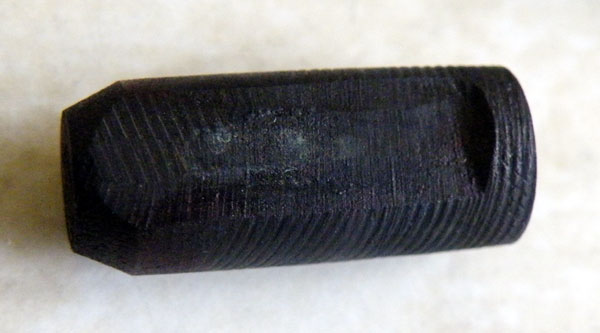
I love working on Swans because the quality is so good, and the hand-finished inner cap is just another example of that. To ensure proper clearance of the inside of the clip assembly, the craftsman has filed away a few strokes more, and you can see the file-marks there on the flat of the inner cap.


The part of the clip that goes inside the cap has shallow lips, and the little metal tab you see there is forced between them to lock the clip in place. That’s a tricky job, a bit like threading a needle while wearing mittens. And doing it through the keyhole. It gets done (eventually) and all that’s left to do is to refit the inner cap, so it’s back to heating the cap again, and tapping it in to the correct depth with an appropriately-sized piece of dowelling.

I’ll maybe get a picture of the restored and cleaned up pen tomorrow.

The Eversharp Kingswood Pen

For some years, I ignored Kingswoods. Somehow, in that echoing void I call my mind, I had confused Kingswoods with Queensways. The Queensway, it must be said, is a pen well worth ignoring, as it has all the writing capability and aesthetic appeal of a pointy stick. In truth, however, there is no connection between the two, except in my muddled inability to discern the difference between two royal titles. So I missed a lot of good pens for a while.

I’ve made up for it since and grab Kingswoods whenever I can. The pens are well made, decorative and bear an excellent Eversharp nib. In reality they’re a Parker production, made by them at Newhaven after they had bought up the remnants of the failed Wahl Eversharp company. At one time I thought Kingswoods had been created to use up an overstock of Eversharp nibs. I suppose that could be the case, but there must have been a tremendous amount of nibs as the Kingswood proved a good seller and survived long enough to go through a re-design.

Celluloid pens, they share the colours and pattern of the post-war Duofolds and Victories that were produced in Newhaven. The earliest, and most common, Kingswoods are only slightly streamlined and have a stepped clip. Like the later ones, they appear either with a plain or pierced cap band. The later, more torpedo-shaped pens also have a stepped clip, but now incorporating a shallow ‘S’-curve from front to back.

They have a tendency to lose the thin gold plating on clips and levers, though it usually remains on the rings rather better. This can be forgiven, I think, because of the superb Eversharp nib, still as fine an instrument as it was in the company’s glory years. The pens themselves are reliable and straightforward lever fillers. They will continue to give excellent service for many years to come.