Stephen Hull: Fountain Pens for the Millions – The History of Conway Stewart 1905 – 2005

At £65.00 plus postage, this is an expensive book, but in my estimation it’s worth the money. This is the kind of book that reflects where the fountain pen hobby is now. We’ve had all the general works we need; now’s the time for the well-researched monograph on a single manufacturer or aspect of fountain pen history. That’s what Stephen Hull has achieved here, and while such a large and complicated subject as the history of Conway Stewart pens will never be definitively and finally completed, much new information has been brought forward and compiled into a satisfyingly logical narrative. The company’s trading history is covered, the main characters are introduced, some aspects of the production are explained and there’s a lot on the pens themselves, perhaps the most important aspect of the book to most of us.

The illustrations of the pens are superb, and many pens are shown that we would be unlikely to see because of their rarity. Over the years, I’ve seen many retail advertisements for Conway Stewart pens, but here we are presented with trade adverts which are new to me. This kind of company literature is invaluable, as it takes the guess-work out of dating pens, and indicates how the company viewed their own product range.

While the book is logically laid out and well indexed, it doesn’t really lend itself to use as a reference. There are some tables of model numbers and names but in the absence of fuller descriptions and dates, these are not especially useful. Thankfully we have the late Jonathan Donahaye’s web site

http://jonathandonahaye.conwaystewart.info/

to act as a first reference for Conway Stewart pens, while this book fills out much of the other information we need.

£65.00 is a lot of money which might otherwise be spent on pens, but for anyone who has a real interest in Conway Stewart fountain pens, or more generally in British pens, this book thoroughly merits a place on the bookshelf.

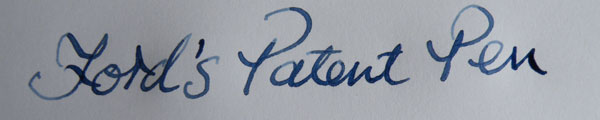
Ford’s Patent Pen

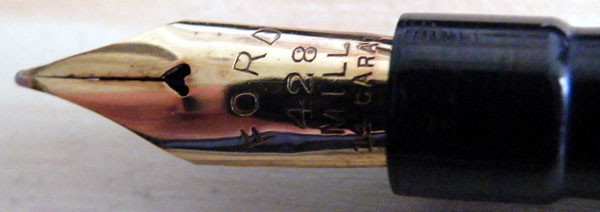
By any standards, the Ford Patent Pen is a mighty beast. I have a Standard, and it measures 14.7cm capped and has a considerable girth. The Magnum version is 15.9cm long. Unlike the Sheaffer Vacuum-Fill or the De La Rue Onoto Plunger Fill, the pen fills on the upstroke and the ink is transferred past the seal to the ink chamber on the downstroke. The “valve” (actually part of the seal) remains open in use to allow passage of ink to the nib and the long breather tube allows air in to equalise the pressure. Because it was recognised that pens which held ink in the barrel were particularly subject to blobbing because of the transfer of heat from the hand, the whole assembly is housed in a sleeve. This makes it a thick pen and it’s quite heavy when filled with its large capacity of ink but it feels quite comfortable in use.

T.B. Ford Ltd. made blotting paper, and had no previous experience of making fountain pens. George Stewart Vivian, who had previously worked for Valentine, was employed by Ford and developed this pen in 1930, bringing it to the market in 1931. There is some debate about who actually manufactured the pen. It may have been Wyvern or Valentine and even De La Rue has been suggested. In any case, the standard of workmanship is very high. For a large and expensive pen, it was a sales success and these pens are not uncommon. They do have some failings, though, and parts are extremely scarce, with the result that a good Ford in working condition fetches a high price. The earliest ink chambers, like my one, were made from celluloid, and they have proved durable. Later ones were made from perspex and they tend to craze and crack. Cap lips are thin and fragile, and some of the internal parts can also break.

Most Ford nibs are rigid but my one has some softness. There’s a little flexibility and enough “give” to make it a pleasant writer.

Weighty Matters

I’m returning to quality today, specifically the common modern equation of weight with quality.

First, to get it out of the way, I prefer a light pen. It seems to me that a pen should be as light as is reasonably possible, and that weight confers no benefit to the writer. That pen manufacturers agree is borne out by the fact that all pens made when they were the primary writing instrument were light, and the default writing instrument today, the Bic pen, weighs next to nothing. That said, many people today prefer a heavy pen. That’s fine. Why shouldn’t they? It’s not the preference for heavy pens I’m arguing with, it’s rather the assumption that a high quality pen will weigh more than a low quality one. Clearly, the reverse is often true, and in fact weight is an irrelevance in the assessment of quality.

To go straight to the extreme, some of the heaviest pens around are cheaply made in China, Dukes, for instance. Not all Dukes are heavy but many are, and in those, the weight comes from a brass barrel and sometimes a brass cap, too. These are just bits of tubing, not unlike the tubing used in a domestic heating system. They’re not expressive of high quality manufacturing, nor are they high quality materials. In fact, these are very poor quality materials used in a (at best) so-so pen.

Taking a less extreme example, which is better, a 1930s Sheaffer Balance or a Sheaffer Intrigue? I don’t have an Intrigue to hand, so I can’t give you their respective weights, but the Intrigue is very much heavier. Taken purely from the point of view of utility, the Intrigue was hardly an unalloyed success. From the outset, many buyers complained of the weight. Many were hard starters or did not write at all without work being done on the nib. The parts did not fit together very well, and the end button which opened the pen to put in a cartridge and doubled as a filling button when the captive converter was used was often offset to a noticeable degree. The weight came from the (mostly) metal construction and the complexity of the filling system. By contrast, the lever-fill Balance was feather-light, extremely well made and remains very popular and useful today. I would suggest that the old Balance is an immeasurably better pen than the Intrigue. Weight may confer the idea of quality in the minds of some, but the reality is a little different!

Quality lies in elegance of design, excellence of manufacture and usefulness. In a primary writing instrument, good design will aim to reduce weight, not increase it. However, fountain pens are no longer primary writing instruments. Most data entry is by computer these days, and letters and memos are written in word processing programs. No-one has a pen in their hand for the duration of a working day, as they once did. For some, at least, the modern fountain pen is an indicator of status, and once it has been noticed it has done its job. It doesn’t even need to be uncapped! For others, it’s an occasional note-taker. In these circumstances weight (though by no means an indication of quality) is an irrelevance.

The Mabie Todd Blackbird 52– Range

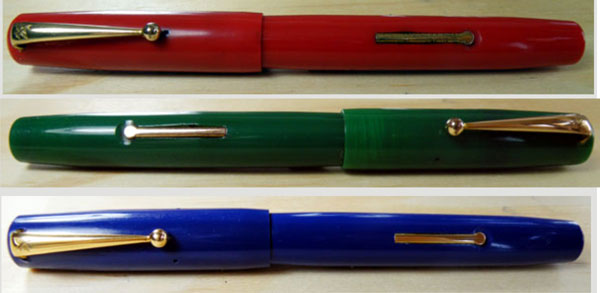
In a way that is similar to Parker’s development of the the Thrift Pens, Mabie Todd expanded their Blackbird Self-Filler range in the mid to late thirties. These were good, cheap (and often cheerful) low-priced pens. They’re average-sized (about 12.5cm capped), flat-topped, slightly tapered, bandless and have a heat-inserted clip set very high on the cap. Some vary in having a slightly pointed top. The trim is gold – quite thin – and the sections are black. They appear in black (5262 and 5260), red (5277), blue (5275), green (5276) and marbled blue (5242). That’s not a comprehensive list of models, but it’s enough to suggest the number ranges allocated to this pen.

The bright self-coloured red, blue and green pens are deceptively modern-looking, and at a glance one might take them for a seventies rather than a thirties pen. The dates usually assigned to these pens are 1936 to 1938. Either they sold very well in those three years or they remained in production longer, as these pens are very common. No doubt they were well-priced to meet the reduced spending power in the Hungry Thirties and were a success, especially as a school pen. They were built to a price, and unusually for Mabie Todd pens, they can suffer from barrel or cap distortion. Nonetheless, a good one (and they’re mostly good, despite slightly wonky barrels) is a great daily user. The nibs are often flexible, from slight to considerable in degree.

A Burnham Opus

As you may remember from an earlier post I made on the subject, I’m not a big Burnham fan. That said, Burnham holds an important place in British fountain pen history, and the best of their pens – especially the earlier ones – are pretty good. They could always make a good nib, and their casein pens employ some of the most beautiful patterns ever seen in a pen.

In case you haven’t already seen a reference to it in the pen forums, I thought I would bring this to your attention:

The Burnhamography http://www.pengrauncher.co.uk/

Alan Charlton has created a fascinating and informative history, not of the company but of the pens they produced. He has disentangled the ties between the various British companies Burnham was associated with at different periods. The confusing Burnham numbering system is clarified, too. There are many Burnham pens here that I haven’t seen before.

This is the first major work on the output of a British pen manufacturer to appear on the internet for many years, and it will provide a fine reference for those interested in Burnhams and in the wider history of British fountain pens. I commend it to you and I am thoroughly grateful to Mr Charlton for his scholarship and generosity.

Back To Work!

I took a break from pen repair and pen sales for about six weeks. Sales tend to fall away a bit in the spring, for some reason, so it’s a good opportunity for me to get the garden in good shape after the ravages of the winter. It meant that I could spend a bit more time on this blog too, so the frequency of posts has been a bit higher of late. Also, I needed to build up stock again, which I have done. I have a pile of pens to repair. I’m itching to get at them, so I expect I’ll be posting a little less, but who knows what interesting things may turn up among my pile of pens!

Pen Books: The Chronicle Of The Fountain Pen

There wasn’t room to list the authors in the title above, but here they are: João Pavão Martins, Luis Leite and António Gagean.

This book, published in 2007, is still in print and is available from different sources. Prices vary a lot, so it’s worth shopping around. One passed through eBay recently and sold for £34.88 plus postage of £8.00. Andy’s Pens (http://www.andys-pens.co.uk/books.shtml) offers it at £79.00 plus postage, and Amazon lists it at £44.86 new or, bizarrely, £77.56 used.

I can’t praise this book highly enough. I’ve had mine for about two and a half years, and it’s severely tattered and in danger of falling apart, which is a good indication of how useful I have found it to be. It’s a large (and heavy!) book of 352 pages, profusely and beautifully illustrated, laid out in the chronicle format, a year by year account of the history of the fountain pen. No general pen book can ever be totally comprehensive but this one gets close. All the major companies are covered well, and you’ll find a great many pens that are less common. This makes the book an excellent research tool, and the profusion of excellent photographs is very useful for identification.

This is an entirely different type of fountain pen book from most of the others I have, several of which are, frankly, lightweight and exploitative. This one was written by people with serious intent, and it is a marvel of unstinting research and rigorous scholarship.

Putting a date on a particular pen is always difficult, and the authors state that, having studied the available dating information, they have, in many cases, made a best estimate. Generally, I find their dates credible.

The book is well indexed and there is a fascinating and informative bibliography.

To my mind, this book is essential for anyone who has a serious interest in fountain pens. Though comparatively expensive, it is worth every penny and will soon repay itself in the ease of research that it provides.

The Gilbert Duplicate Posting Manifold Pen

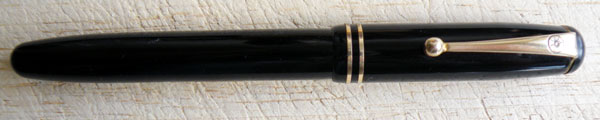
Like the Kenrick and Jefferson range of pens, this Gilbert Duplicate Posting Manifold Pen was produced by a stationery seller for use with their multi-part forms. Gilbert pens are nowhere near as common as Kenrick and Jeffersons, though, and they only turn up once in a blue moon.

The sunburst logo on the shoulder of the clip, together with the general style of the pen, strongly hints that it was made by De La Rue for Gilbert. The plating of the trim and manufacturing quality is comparable with the very best of De La Rue’s non-Onoto output. It’s in a very traditional style, the only point of note being the shallow domed clip screw. A very handsome pen, nonetheless.

I suspect that the Alfred Gilbert company, which was based in Edgware Road, London, is long gone. Their main claim to fame was a simple and efficient pre-computer-age accounting system. Not being an accountant myself, I can only work up a limited amount of enthusiasm for that particular achievement, but I will remember them for this very nice pen.

Soaking

Removing sections from barrels is one of the more difficult jobs restorers do. More than any other operation, it’s the one where you can ruin a pen in an instant. You have to be careful – you don’t necessarily know how that section is fitted in there. Is it a friction fit or a screw-in? Might it even be a left-hand thread? At the same time, you have to exert a considerable amount of pressure on that delicate joint. And then there are the sections that don’t want to let go, the ones that feel like they’re welded in.

“How do I remove this section?” is a regular enquiry on the fountain pen forums. One of the common responses is to soak the pen at the area of the section/barrel joint. Personally, I would never do this. I have done, in the long ago, and soon learned that it didn’t slacken the joint and, if the section was made of hard rubber as they usually are in pens of the period I deal with, the HR was often faded by the soaking.

What is it that the soaking is supposed to achieve? Is it believed that the water will penetrate the joint and lubricate it? Frankly, it doesn’t. Water isn’t penetrating oil. It doesn’t find its way into every nook and cranny. Perhaps it’s intended to dissolve any adhesives used. Actually, it’s quite uncommon to find sections stuck in with adhesives (1940s Watermans excepted) and where they are, water is unlikely to dissolve most adhesives. How about warm water, then? Well, it might be a little more penetrative, but only marginally, whereas it’s guaranteed to discolour BHR in the worst way. Add a few drops of dish soap, some say. Again, it might make it a little more penetrating but it’s excessively harmful to HR. Try this. Take a piece of scrap BHR and soak it in warm, slightly soapy water for a couple of hours. Dry it with a kitchen towel as best you can. You’ll find that it doesn’t really dry at once, and has a slightly slimy feel for a while. The surface of the BHR has been penetrated by the soap solution, with what long-term effects I know not, but I suspect it ain’t good.

From my own experience over the years, I would say don’t soak sections. There’s no evidence that it does anything useful and it can do harm. Use dry heat instead. It doesn’t take a lot – a hair drier will do. Heat softens the material a little, making it less brittle and so less prone to breakage. Even when both section and barrel are made from the same material, there will be a tiny bit of differential expansion, breaking the seal. On those few occasions when the section is glued in, heat will soften the adhesive. As I always say (and it’s worth repeating again) patience and persistence are the watchwords. Some pens – plastic Watermans, some Wahl-Eversharps and lizard or snakeskin-patterned Swans among them – may take days of repetitions of the application of moderate heat and careful force to separate the barrel and section, but if that’s what it takes, that’s what it takes. Impatience will break the barrel.

For sac-filler or eyedropper pens, I’d say soaking should play no part in repair. Plunger filler or piston-filler pens are another matter, but I don’t intend to discuss them today. “How about ink-encrusted cap interiors?” I hear you ask. “Don’t they need soaked?” If they’re hard rubber, black or coloured, absolutely not. Get to work with cotton buds and do the best you can. If they’re plastic, a short spell in the ultrasonic cleaner followed by more cotton bud work will do a great job. In my opinion, it’s best to avoid the soap here, too. Pen caps are designed to handle a certain amount of liquid, but soap will leave a residue that will do no good, especially to metal parts like clip fitments.

Remove the most of the water with the hair drier and leave the cap to air-dry for a few hours.

If you’re going to knock out the feed and nib, it’s essential to get water through the section to dissolve hardened ink deposits. No need for extended soaking here either, though. Run it under the tap until water is passing through the section and that’s all you need. Dry off a hard rubber section at once, before you knock out the feed and nib, to protect the colour.

Thoughts On This Blog

When I began this blog, a large part of my intention was to get some information about British pen brands out onto the Web. Our American colleagues have been much more successful in making brand information available online than we have on this side of the Atlantic. All the US major brands are very well covered and there are many sites devoted to lesser manufacturers. If you want to know about a Wearever, you can find quite a bit of information. If your interest is in a Nova, you can pretty well forget it. Sadly, for the Nova, I can’t add a thing to the sum total of human knowledge; it’s a total mystery to me, but I have managed to at least put together a few words about some of the other minor brands.

It is a sad fact that for British pens we only have two authoritative sites. For Conway Stewart there is the late lamented Jonathan Donahaye’s superb list: http://jonathandonahaye.conwaystewart.info/

The Parker pens made at Newhaven are well covered in Tony Fischier’s wonderful Parker site:

http://parkercollector.com/index.shtml

That’s more or less it. If you want comprehensive web-based information on such industry giants as De La Rue, Mabie Todd, Burnham or Mentmore – never mind the host of smaller firms – you won’t find it. Why should that be? Why are we so far behind in celebrating our great fountain pen industry online?

I’m sure there are many reasons. It’s not that the information isn’t available. It is, but it’s locked up in an earlier paradigm of hobby activity: the magazine. I hesitate to be critical of The Writing Equipment Society, an estimable organisation much loved by a large and wide membership. The best British research and writing on pens goes into their magazine, and there it sits, in dead print. The only way to access the wealth of knowledge that the WES has accrued over the years would be to buy all the back issues, an impossibly expensive exercise. How much better served would we all be if that treasure-house of knowledge was web-based!

I cannot compete with the historical rigour of Donahaye or Fischier, nor with the breadth and depth of scholarship in the WES Journal, but I am not discouraged. I am no historian but I have maintained an interest in fountain pens for several decades. It would be nice if I could cite sound sources for every statement I make, but usually I can’t. The snippets of information I string together about the various pen manufacturers come in part from my reading, but much more from the pens themselves and from discussions with other collectors and repairers. I try to be accurate but sometimes I have to speculate, though I try to do so responsibly. In the end, if what I have written here will give someone a clue about their recently-acquired old pen I am satisfied. If my statements give rise to discussion that furthers our knowledge, I will be delighted.