The Pen Repair Fitness Plan

You might well imagine that pen repair is a sedentary occupation but that’s far from the truth. I’m sure there are people in training for the London Olympics whose regime is less rigorous than mine.

Some tasks need to be carried out at the bench where there’s very strong light and lots of magnification available. That’s where each pens starts as I assess its condition and what needs to be done to it. Then it’s over to the work area next to the sink where all the tools I might need for disassembly are laid out. A little further away from the sink I have the hair drier plugged in to help me release uncooperative sections and clip screws. I find it’s quite beneficial to separate electrics and water. The occasional good shock does keep one alert but it does nothing for the coiffure.

But you do need water. A lot of it. I’m glad our water isn’t metered because I’d have a hefty bill. Ink is great on the page. Elsewhere it’s a major nuisance, and it’s amazing how much ink is contained in a little pen that hasn’t been used in my lifetime! As well as removing the ink, water is useful in loosening the nib and feed in the section. I don’t soak things, but I encourage a little water to get through the section. If it doesn’t become free-flowing, then I encourage a lot of water to pass through the section. Then, if necessary, it’s over to another work surface to drift out the nib and feed. Does the nib need work? Back to the bench to work under the strong light and the magnification stand.

That done, it’s over to the shelves to select an appropriate sac, and back to my first work area to fit it. Then back to the bench for final assembly and detailing.

That’s one pen done. Multiply that by however many I can get through in a good, long day – maybe twelve or fifteen – and I must have covered quite a few miles. Add in the cooking and the cleaning and the laundry…

An Early Conway Stewart 479.

I picked this old 479 up in eBay, if not exactly for a song, at least not for a high price, which was a Good Thing. Examining it properly on the bench, I found a crack at the lever opening. Though the crack appears stable the pen’s not saleable like that. Usually, I would just contact the seller and arrange to return it for a refund but I hesitated with this one and in the end I decided I would just keep it.


There’s no repair for something like that. Hard rubber doesn’t take welding and in any case, a repair would be as bad as the crack, running through that prominent engine turning. If I returned this pen to the seller it would be scrapped or put in the parts bin, a sad end for a good pen.


I have an especial liking for Conway Stewarts of the early thirties. Domed cap, flanged lever, fixed clip, deep engine chasing; it adds up to what I see as the finest style of pen that Conway Stewart ever made. This, for me, is a better pen than all their glories of the forties or their colourful beauties of the fifties and sixties. You may disagree with me, of course, and I expect that most people will, but that’s how I see it. It’s just the right collection of attributes that adds up to be harmonious design. Like some Swans of the same period, it’s a perfect pen, not to be excelled.

As luck would have it, it has a very nice nib, a warranted which must be wrong for this date, but has a measure more flexibility than the correct nib would have had. The pen’s restored and filled and sitting in my desk set, awaiting use. I’ll keep an eye on the crack but I think it will be all right.

Flexibility And Me

When I learned to write in the long, long ago (Methuselah was a mere child compared with me) it was first with wooden pencil, then with dip pen and finally with fountain pen. Some time later, ballpoints became allowed though I never really took to them myself.

Many fountain pens, even the cheap, steel-nibbed ones that I had, will give some flexibility. Whenever I could find it I was glad of it. Nowadays, when people have generally lost the ability to write in what used to be the normal cursive style, I’m regarded as a good writer. Those many years ago when I was a kid, it was not so. Many was the stern talking-to I got from the teacher and there was the occasional clip round the ear. Trouble was, I was an imprecise writer, leaving unintended loops wherever my pen changed direction. Inducing a thicker line at those points covered up a multitude of sins, and a good thing it was too, poor writing being regarded in those days as only slightly less heinous than high treason.

In truth, that’s what flexibility still does for me. I write as I have always written, but the variable line-width enhances my scrawl. It makes it look stylish, as if I was in control of this writing instrument which actually only obeys me when it wants. That encourages me and I make a greater effort, so that over the many years there has actually been some real improvement in my writing, on good days at least. We’re not talking an excessive amount of flexibility here; a lively semi-flex nib on the right shape of pen is all I need. Somewhere in my withered soul there is a longing to really write well with a fine-pointed, rigid nibbed pen but I suspect that will remain an unfulfilled ambition. Yes, I occasionally persevere with a Sheaffer or unforgiving Duofold for a while but it’s not a success. Soon I’m looking for my Swan Leverless or pre-war Conway Stewart.

As you may imagine, oblique stubs have a similar effect on my writing and I do enjoy them, but there is a machine-like regularity to their line variation that I dislike. A pleasant compromise is the flexible oblique, a not at all uncommon nib type in British pens. As I intimated above, the deluded regard me as a good writer and over the years I’ve often been asked to produce place-cards and the like. I’m no calligrapher but I can produce a moderately attractive exaggeration of my own writing style, replete with curlicues and flourishes which seems to satisfy those who know no better. I enjoy it; though it’s laborious and more like painting than writing, it gives my very flexible pens an outing and I really enjoy deploying that elastic, paint-brush-like line.

There seems to be a wish among those who practice or aspire to real calligraphy to use fountain pens. It doesn’t work well, or at least not in the cursive styles like copperplate or Spencerian. For italic styles fountain pens may work well enough, but when serious line variation is called for, dip pens work better. They’re cheap, so little loss if a nib is broken before it was quite worn out – unlike a fountain pen nib. Dip nibs are capable of – generally – greater line variation, and the necessary pause to re-ink the pen is no disadvantage in calligraphy. The calligrapher isn’t in a hurry to cover the paper. He just wants to do it right, and the time taken is not a major concern. No call for a reservoir pen here! As a footnote, Osmiroid with their copperplate nibs and Esterbrook with their various supposedly flexible nibs encouraged calligraphers to go the way of the fountain pen, but it was a blind alley. It’s about as easy to flex a crowbar as an Osmiroid copperplate nib.

So that’s my relationship with flexibility, and an uncomplicated one it is. In my heart of hearts I love its Dionysian departure from the dry and regimented course of precisely perfect writing. Though I’m not sure that the pen is mightier than the sword – indeed I sincerely doubt it – there is something of the romance of sword-play in the well-handled varying line and the sweep of an enjoyable flourish!

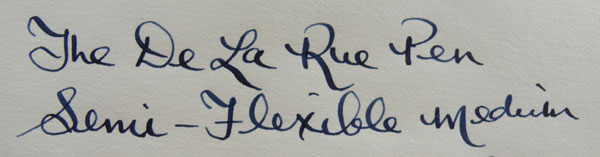
The De La Rue Pen

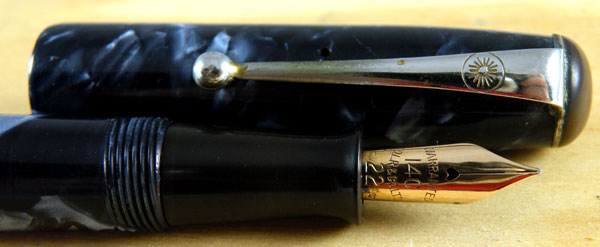
I can generally estimate the age of a De La Rue Onoto fairly closely, but I confess I’m all at sea with their non-Onoto pens.


This is The De La Rue Pen and it’s my guess that it’s immediately post-war, but I could be wrong. I say that because I have it in the back of my mind that De La Rue made these pens with black ends before WWII too. I must have read it somewhere but the source is long gone.


These pens with black ends are among the best of the non-Onoto output. They’re really well made, and so they’re a pleasure to restore. This one needed a new sac and a polish. That was it, and ready to go again. The black ends are memorable, in that the one at the base of the barrel is a piece of black celluloid grafted on to the patterned barrel, in much the way that Waterman and Mentmore did. Waterman’s and Mentmore’s examples generally ended in disaster with the ends cracking, fragmenting and falling off. I’ve never seen that happen to a De La Rue Pen. The other end, the top of the cap, is a shallow-domed clip screw made out of black hard rubber. Most have faded to brown now, so the black ends effect is a little spoiled.


The worst failing in De La Rues – Onotos too – is poor plating and this one’s no exception. A tiny vestige of gold clings to the clip just above the ball end, but the underlying metal polished up well.

These pens make a decent price, but they’re much cheaper than the Onotos. What’s in a name? After all, quite a few later Onotos are lever fillers too, and despite having something different engraved on the nib, they write the same – that is, superbly! If you care about the plunger filler, or if the name means a lot to you, then you have to have the Onoto. Otherwise, you might decide to settle for the De La Rue Pen – a splendid and beautiful pen in its own right – and have all the value and quality of its more prestigious brother for half the price.

The Swan SF2 Revisited

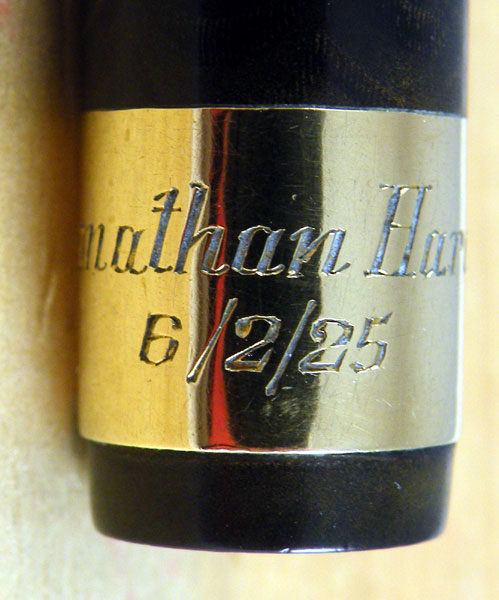
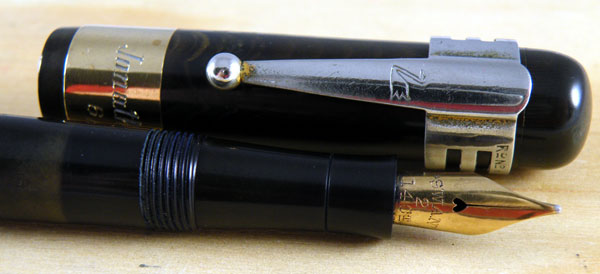
The Swan SF2 is a big pen by any standards. It’s 14.3cm capped and a magnificent 17.7cm posted! Being black hard rubber it isn’t heavy, but the addition of a very broad 18ct cap band and an accommodation clip overbalance this old fellow slightly.

As you can see, there’s no difficulty about dating this one. That’s only one of the reasons why I enjoy personalisations, especially when they’re as well engraved as this one. Sad to say I don’t know who Jonathan Hardy was. There’s the New Zealander actor, but I don’t think he’s old enough.

As you can also see, this one’s Mabie Todd through and through, with the patented Swan Clip attached. You might notice that once upon a time the clip was gold plated but there’s very little left. I think we can forgive them that, as the one bit of plating on the pen, the lever, is in good order.

Still a great writer.

I must remember not to wear a red shirt when photographing shiny pens…

Testing And Adjusting

Today I’ve been testing pens, making the necessary adjustments to regulate flow and eliminate scratchiness. For flexible pens, you have to allow for a little drag on the paper at full flex, but they should be smooth unflexed. Or, shall we say, as smooth as can be reasonably achieved. Older pens don’t have the big globular lump of tipping material that many modern pens have, so some, especially fines, often still retain a little residue of friction against the paper even when the tines are as they should be and the tip has been polished. That’s fine. It’s what users of older pens have experienced before and they like it; some call it feedback.

I have actually had complaints that a particular pen or two were too smooth and gave no feedback. That can be true of stiff-nibbed pens with plenty of tipping material like Mentmores and Parkers. Truth be told, there’s little that can be done about it. I could give it more feedback at the cost of misaligning a tine slightly but that really doesn’t seem right. Theoretically, you could roughen up the tipping material, though I’m not sure how it would be done and again, it would seem like an act of vandalism. Maybe it’s best to avoid those pens if you don’t like slippery-smooth.

Testing, refining and re-testing is when I get to know the pens I’ve bought. Handling them during restoration gives me some idea of how they will be, if the nib’s stiff, soft or flexible, how the pen balances with the cap on and off, how the gripping area feels in the hand and so on. It isn’t until I’ve written a few paragraphs that balance and nib performance begin to come together to show the pen’s character as a writing instrument. There are few – or possibly no – pens that I dislike to write with. They all have their qualities to which you can adapt. Some, though, are so well-made that they encourage you to write with a flair and dash that you couldn’t do with a more pedestrian pen. These pens aren’t uncommon, nor are they all flexible, though some are. My pens of the day today have been a very flexible International Safety Pen eyedropper, a lovely old long Swan SF1 and a De La Rue Pen, one that doesn’t come my way often. Each was completely different from the others, yet they all shared one characteristic: they were pens that make you want to write.

A 1937 Swan Advertisement

As I’ve said before, the pen is the primary source of the history of our hobby. It’s a great source – solid, three-dimensional and capable of being dismantled but it isn’t voluble. What you see is truly what you get and once you’ve examined it there is no more. Barring someone dropping all of Mabie Todd’s accounts, technical drawings and spec. sheets on my bench (and if one of you has them, c’moooooon!) adverts are the next best source. Even in a simple advertisement like this 1937 coronation example, there’s lots of information.

I’ve broken the advert up into three parts because it’s so long.


As well as Swan’s ever-present good design, there’s no false modesty here! This is a company at the top of its game. Associating oneself with royalty is rarely a bad move (in Britain, anyway!*) and linking their history to five reigns emphasises the length of time the company had been around. It makes their existence a historical era, rather than a simple span of years.


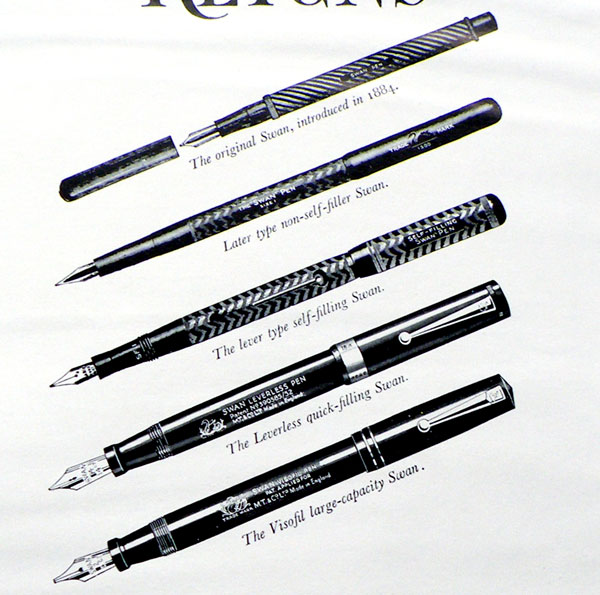
The selection of pens is interesting. The first one chooses itself, pretty much, because it is the first one. The second is the glorious 1500. The third isn’t readily identifiable; it’s one of the lower-priced early thirties pens that everyone seeing the advert would be familiar with. The Leverless appears to have at least a No4 nib, so it’s a big ‘un, and the Visofil was just relaunched as Mark II in that year.  There were so many other pens they could have included but didn’t.  Why would that be?  Discuss, in not more than 1500 words.


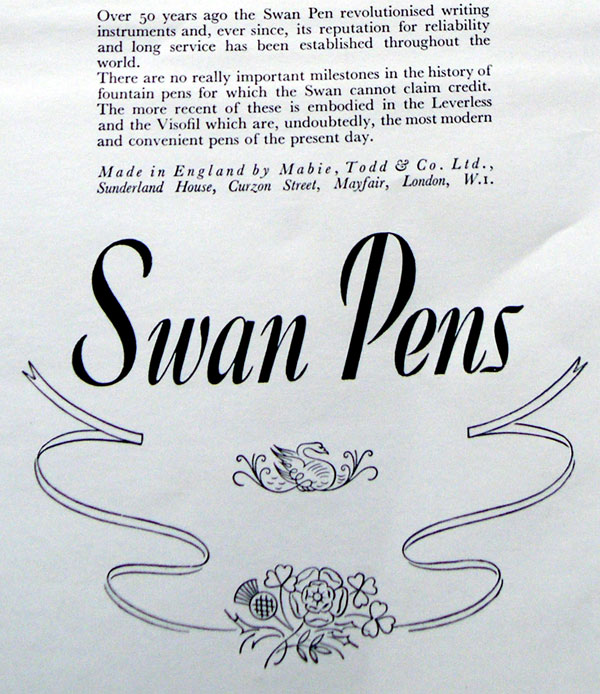
The carefully-prepared copy at the heart of the advertisement, with some flourishes and a very attractive version of the constantly ever-so-slightly changing Swan logo. The company seems here to be putting its hopes for the future in the Visofil, but it didn’t work out that way. Very attractive, a little fragile and quite high-priced, the Visofil never achieved the sales of the Leverlesses and Self-Fillers.

* In France in 1789 it wouldn’t have been nearly so clever…

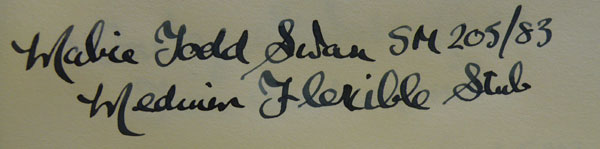
Mabie Todd Swan SM205/83

It was maybe bad timing, but who knew? Mabie Todd chose 1939 to launch a whole new range of pens including the lizardskin Leverlesses and the snakeskin Self-Fillers. Due to the exigencies of war, neither reptile is especially common now, the lizards less so because some of those plastics are reported to have proved unstable leading to splitting in barrels and caps.


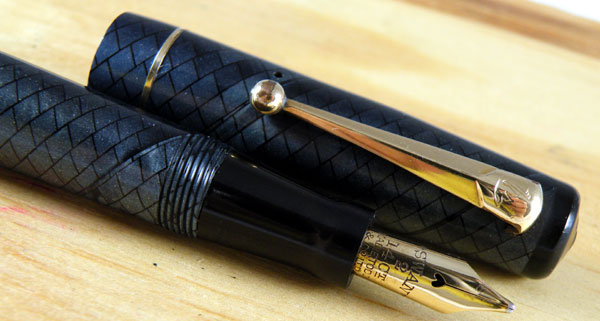
This one’s a blue snakeskin SM205/33 with a black hard rubber lever, black ends to cap and barrel and a black hard rubber section. Apart from a little chipping on the lever and a tiny loss of gold on the ball end of the clip, the pen’s in great condition. As is usually the way with snakeskins (I’ve had the good fortune to own quite a few, however temporarily) this pen has a exceptional nib, stubbish and flexible, conferring a lot of very easily accessed line variation.


I often try to evaluate the pens that pass through my hands on a scale of 1 – 10. Because I generally enjoy whichever pen I’m working with at the time, they mostly end up being 10s. However, being as objective as I can, being parsimonious with my admiration and allowing for its faults, on that 1 – 10 scale, this one’s a 15.

The Clipfill Pen

Today’s post is unusual in that pen I’m writing about is an American one and also in that the pen itself is quite technically unusual.


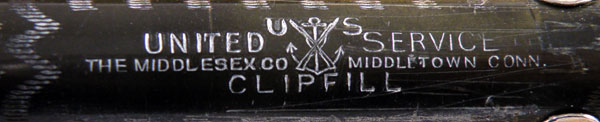
The cap imprint reads, ”US United Service The Middlesex Co Middletown Conn Clipfill”

All but the last word tells you who ordered the pen, not who made it. The US United Service organisation exists to provide morale and recreational services for serving soldiers, sailors and airmen. This may well have been a give-away pen for the organisation. “Clipfill” describes how the pen works but it doesn’t take us very far. Another example of this pen was discussed some time ago in Fountain Pen Network, where George Kovalenko refers to the 1913 patent for this type of filler. He believed that it might have been made by or licensed to Duryea, a company that is little known now but made contributions to various aspects of fountain pen development. George also refers to a discussion on similar pens in Lion & Pen where, on 29 June 2008, Pavlo Shevelo posted a picture of an Aiken Lambert matchstick filler that appears identical in every respect, except for the removable clip. (I believe the picture may have originated here: http://www.pen-site.com/vintagepens1.html ) Both my pen and the pen shown in FPN have an ALCo (Aiken Lambert) nib. Frankly, I believe we need look no further. Whatever the reason for the different name, I think this is an Aiken Lambert pen.


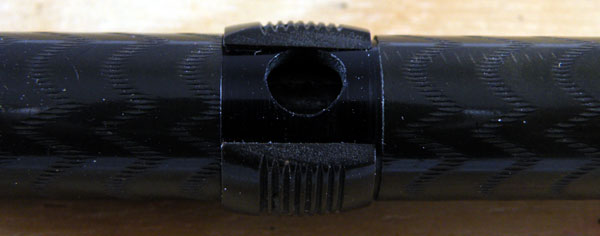
In case you miss the idea behind this pen, you turn the protective cover in the middle of the barrel to expose a hole through which you can see the pressure bar. You detach the clip, which slides off easily yet would hold the pen clipped to a pocket, and use the ball end to depress the pressure bar, to fill the pen. A matchstick filler for the non-smoker, perhaps!


So – flat top, deep-cut chasing, very concave section, tapering barrel? Before 1920, I’d say. In addition, I’d say that this is a very high quality pen, looking at the precision machining and enjoying the feel of the pen. The ALCo nib is a fine semi-flexible one, with enough flex to allow for a swashbuckling flourish, whenever the need or the urge arrives. I’m delighted with this pen. It will join my small collection of keepers.

Conway Stewart 306

This is, at first glance, a rather ordinary old pen, black hard rubber quite faded on the barrel and formerly chrome-plated trim now down to the bare metal. It’s more interesting than it seems, though. This is my oldest Conway Stewart, a 306. It’s old enough for there to be debate over whether this pen was bought in from America or made in-house. Except for the level of quality, which is precisely where you’d expect a Conway Stewart to be, i.e. very good but not quite the best, not much about this pen resembles the company’s later output. The inserted ball-ended clip does appear on a few other models like the 382 and 353 Pixie but they, too, are suspected of being made abroad. We’re not used to seeing Conway Stewarts with straight levers but that’s how they began. The nib is warranted and that’s correct for the model. This pen has a j-bar, something Conway Stewart never quite dropped though the much more efficient slide-bar was what they usually employed.  The concave section is something you do see on other Conway Stewarts of the period.


Near as I can work out this pen was introduced around 1920 and was still in the range in 1926, when it cost 11/6d. Not the most expensive of the company’s pens, then, but well-made with deeply-cut chasing which has lasted well. You will note that the imprint states “Made In England” and who are we to question those nice people at the Conway Stewart of eighty-five or ninety years ago?


So that’s it – the oldest Conway Stewart that has so far landed on my bench. I’m very glad to have had the opportunity to examine it.


This is its box. Not original for sure, and quite a strange thing, made out of very thick cardboard and held together with mighty staples. Perhaps it’s a repair box. I’ve certainly never seen one of these before.