A Reminder

We’ve had a number of emails/comments recently from people wishing to buy our pens. Of course, we retired from pen repair and sales two years ago and have no pens for sale but since there seems to be a bit of confusion we thought it better to clarify.

We can recommend http://www.writetime.co.uk – an excellent seller of very good pens at reasonable prices.

All Good Things Must Come To An End

You may have noticed that the blog has not been updated in some time. Really, it’s because I’ve said what I had to say. I’m sure there are a great many pens that I have not written about but I’m not buying pens in quantity anymore and, for me, a pen isn’t a pen unless I handle it.

I’m not looking for suggestions for ways to continue the blog. It really is complete. For those who are using it as a reference it’s best to read all blog entries that refer to a particular pen as mysteries were solved and questions answered, giving a clearer picture of the history of the pens in question.

There have been many people who have contributed valuable comments to the blog. Those include collectors who have been with me over the years offering their broad and profound knowledge of obscure brands. Equally valuable are those comments from people who wished to share their experience of using an individual pen. So many thanks to you all for your company on this long and occasionally bumpy ride.

There are those (Robalone comes to mind) who have contributed photographs and information about rare and interesting pens that they have come across. Always the plagiarist, I have been only too happy to make use of these, with thanks.

The blog will always remain available for reading or dipping into. It won’t go away in my lifetime or even thereafter.

The Crown Pen

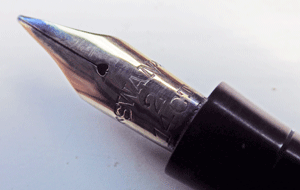
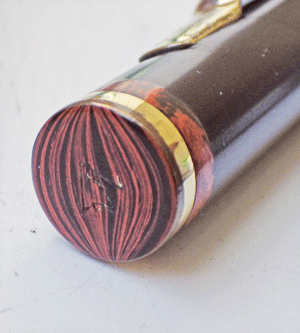
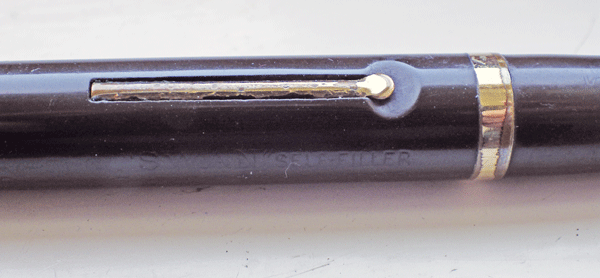
Thanks to Robert (stepshef-8) for permission to write about this elegant and interesting pen. It’s a mystery – to me, at any rate. Stephen Hull’s The English Fountain Pen Industry 1875 – 1975 shows a Crown pen but it dates to around 1901 and this is a much more modern pen. Its tapering cap and clip screw are very attractive. The lever bears a sunburst. Is it the sunburst lever that was bought in by several manufacturers?

The nib appears to be plated. It may or may not be original as nibs are so prone to accident and in the seventy or eighty years this pen has been around such an accident may have happened. It is sometimes the case that when I find a strange pen that isn’t in the British literature it turns out to be American. That seems very unlikely here as our US cousins aren’t all that keen on monarchs and their accoutrements. Also, the shape practically screams British.

These mystery pens turn up from time to time and that’s a very good thing as it gives us something to think about and discuss.

The sale can be found at https://www.ebay.co.uk/itm/395455475543

My Swan SF230/60

Of late, as well as my new pen holder (a work of art) I’ve been using my Swan SF230/60 for correspondence. It is an ideal pen – for me at least. I hold it just above the taper of the section and it is the perfect size for my arthritic hand – except when I have a flare-up and then no pen will do. There will be no writing.

It’s a moderately long pen so takes a long sac, holding a lot of ink. That’s a benefit to be sure. Less visits to the ink bottle and less inky fingers. The real gem of this pen is the nib. It’s a medium Swan No 2 with very good ink delivery and the nib is smooth but not glassy. There is the tiniest bit of feedback that helps me form the letters the way I want. There’s even quite noticeable flexibility, should I wish to invoke it though I rarely do.

In all this is my perfect pen. Why should I need another? To answer my own question, from a practical point of view I have little need of any other pen. Perhaps one or two for other colours and a fine nib for my diary. That’s what it comes down to but I have a drawerful of other pens and they tempt me. I need variety. It isn’t logical to use some other pen that isn’t quite as good (though very good in its own way) but logic isn’t necessarily the way we look at and enjoy our pens.

Anyway, there will be few months in the year when the SF230 isn’t inked up and in use. It’s a handsome pen that shows its age a little. The gold plate is worn in places and the black hard rubber isn’t quite as black as it used to be but that’s part of what makes it dear to me.

Simple Repairs and Other matters

I haven’t read FPN for years but I’m still a reader of Fountain Pen Geeks though even it has become less relevant for me. There’s much less discussion of vintage pens than there used to be and that’s my area of interest. We vintage people seem to be in decline everywhere. Why complain about the lack of vintage articles when you could write them yourself you say? The short answer is been there, done that, on several boards over many years.

This blog, though will always be predominantly about vintage matters. If I can advise you about your old pens, just ask. It occurs to me to remind you that there are restoring and re-saccing guides here, for lever, button and leverless fillers. It’s the kind of thing that most people can tackle themselves with a minimum of materials and equipment. If this is the one and only re-saccing you’re ever likely to need, save yourself the investment and send it to an expert. The same goes for more complicated repairs. I recommend Eric Wilson in the UK and Ron Zorn (Main Street Pens) in the US.

Reading and Writing

Or Reeling and Writhing, as Lewis Carroll said. I have often wondered how reading and writing relate to each other. Digging deep to when I was a four-year-old doesn’t really help. I remember what was done but not how it was done.

My mother taught me to read before I went to school. There was none of the slow method that came later in school, of studying the alphabet then moving on to schoolbooks with words of a single syllable. So far as I remember the process of learning to read, it was word recognition with a growing vocabulary. I didn’t learn to write at that point. That happened in school.

Looking back on it now it seems a convoluted process. We spent hours reproducing letters, but in something resembling their printed form rather than the cursive we later learned. I believe it was more difficult than learning to read. Once we had mastered drawing the twenty-six letters we abandoned that form and learned cursive instead. I don’t remember how easy or difficult that adjustment was. For the first two, maybe three years we practiced writing, first by pencil, later by dip pen. There was much emphasis on legibility and neatness.

As adults (perhaps I should say older adults) we deal with two written forms – almost two written languages. I know that’s excessive but I think the difference between the typefaces we read and the cursive we write is so great. We think nothing of it because our younger, more elastic brains learned to deal with it. Many children and younger adults cannot read cursive because they never learned it themselves. It seems almost a code that must be taught or it remains illegible.

It’s likely that this phenomenon of two scripts applies to other alphabets and means of written communication. Is there a cursive Arabic or Chinese script? Of the two, I think learning writing must be harder than reading. Of course many people never truly master either. In my experience quite a large number of people are never truly relaxed with either a book or a pen in the hand.

I have been assured that my handwriting is legible and acceptable but I don’t think anyone has ever suggested that it is beautiful. This is, I think, because I’m poor at an analogous skill: drawing. I can’t draw a cat and I can’t accurately draw copperplate letters either. Is this down to poor observation or poor manual dexterity? I don’t know and it’s a bit late to learn all over again even if I wished to. I don’t.

Beautifully Designed, Perfectly Executed

Those of you who are regular readers of this blog will know that as well as fountain pens I use dip pens. The nib that one chooses is important. For instance I don’t do well with pointed flexible nibs. I’m more at home with stubs and especially obliques. The holder is equally important. Those very thin holders used in times gone by give me vicious hand cramps. I need a holder of around the same thickness as an average fountain pen.

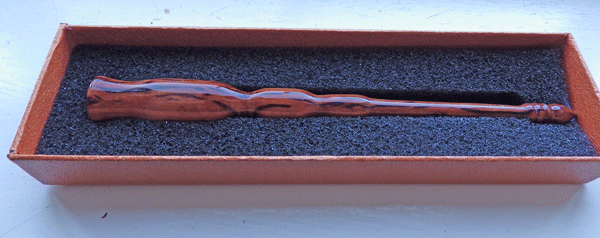
My friend James liked my correspondence written with a dip pen and decided to have a pen holder made by a friend of his who is a wood lathe expert. Using a beautiful wood called Australian Hairy Oak he made this gorgeous, unique holder for me. Many thanks, James. It will be used and treasured.

Conway Stewart

I find myself writing about Swans very often but I do use other pens! Over the years I’ve had many Conway Stewarts and I enjoy them too though they don’t usually have the variety of nibs that Swans have. Most Conway Stewart nibs are firm medium. All the other nib types occur, but not at all frequently. I’ve had the Conway Stewart Italic which is a named model in its own right, and a very nice pen. A little line variation can often be induced from Conway Stewart nibs though very flexible ones are uncommon. That’s okay by me; I don’t do flex.

Conway Stewarts are reliable. A few years ago I did a course which included a written exam at the end. Careful as always, I put four pens on the desk. The one I selected was a Conway Stewart 388. Three thousand words later I was still using it, the other three unused. I’ve used a Conway Stewart 286 in a similar situation and it was equally reliable.

Conway Stewart had their own type of button filler, a very efficient system. Then there’s the Speedy Phil which is another matter entirely! Most Conway Stewarts are lever fillers and very good ones, using the slide pressure bar, similar to the Waterman type. It’s more efficient at compressing the sac than the j-bar. Lever-fill Conway Stewarts are a pleasure to service.

Many Conway Stewarts passed over my workbench but I didn’t keep any of them. I should have hung on to a few, especially the pre-war ones (I just prefer the shape). The only one I have now is a black 85, the typical post-war Conway Stewart. It was a gift from a friend, his father’s pen. It is almost always inked. I don’t really regret not keeping any of the fancier patterns such as the cracked ice or herringbone. I can see gorgeous Conway Stewarts in the excellent books by Stephen Hull and Andy Russell so I don’t feel that I need to own them.

Like many other pen companies of all nationalities Conway Stewart suffered a sad decline. As a means of keeping the company alive it failed. Conway Stewart has been reborn several times. Those later companies and their pens don’t interest me.

My husband’s memory of Conway Stewart goes back much further than mine. He remembers colourful pens on cards in the newsagent’s and individual boxed pens being given as school prizes to the lucky few. He never owned a Conway Stewart pen when he was at school. His habit of breaking or losing fountain pens meant that he was limited to Osmiroid or Platignum pens.

It’s A Hobby Now

After we closed the sales site I did little with pens for several months. I wrote with them, of course, corresponding with friends. I have many good writers that I have accumulated over the years. A couple of months ago I began going through various drawers and boxes and found pens that I had set aside in the busy times, as either too time-consuming to repair, or even beyond repair.

My time is my own now so I don’t mind – or even enjoy – the more complicated repairs. And of course nothing is beyond repair. The main reason I gave up commercial restoration and repair was arthritis in my hands. I could no longer do a dozen pens a week but one or two is well within my capability and at that slow rate I enjoy it so much.

Some of those pens have the type of finicky problem that means they have to be taken apart a couple of times – skipping or hard starting for no apparent reason. A little tinkering with feeds and nibs and they’re writing beautifully again. That gives me such a feeling of satisfaction!

Then there’s cleaning and gentle polishing. Few pens will return to new condition without an electric polisher and I see no reason to do that. I want my pens to look as good as they can while still acknowledging their age. An 80 or 100 year old pen can still look lovely while retaining some of the evidence of the accumulated knocks and bumps of all those years. My husband says he believes he still looks presentable but he’s never going to be mistaken for a teenager! I aim for my pens to fall in that area between restoration and conservation.

How many ordinary everyday instruments are still useful and beautiful when they are 115 years old? I didn’t keep any of the more expensive pens; those with silver overlays or the most beautifully-patterned 1920s and 30s Swans. My pens are the workaday ordinary pens that weren’t bought to impress, they are the medium priced reliable Parkers, Swans and Onotos that people bought to use at work or for correspondence with family and friends. Those are the types of pens I especially love.

Swan Tinkering

I had several pens inked but none was a Swan so I thought I would amend that. I had a very pretty green marbled pre-war no-number Swan that I hadn’t used in a long time – if ever. I filled it and it was a disaster. The semi-flex nib would only write with pressure and not very well even then. It seemed very likely I would have to strip it down and find out what the trouble was but I thought I would try the soapy water trick first. One drop of Fairy Liquid in a small glass is enough, then a good flush followed by a rinse.

It gave me a good line for a paragraph then reverted to hard start and skip. I disassembled it, reset the nib and widened the nib slit a fraction. Success! It’s a perfect European fine with some flex.