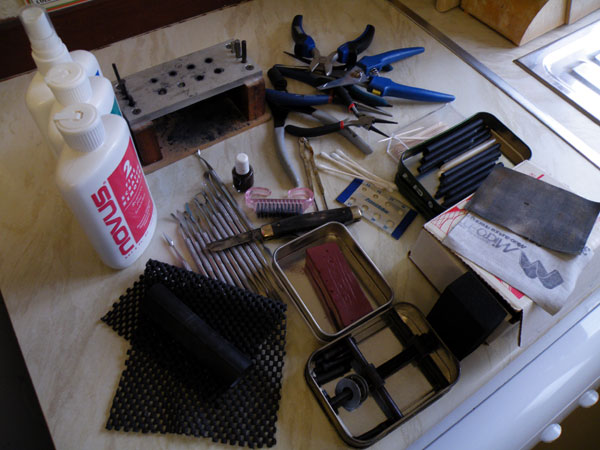
In recent days I’ve twice seen people asking for advice on restoring pens without any tools whatsoever. Really, that’s not going to fly. You have to have a basic tool-kit or you’re going to break pens.
If repairing a pen is something you’re going to do once in a blue moon, it’s probably cheaper and better to send it to a good repairer. If, however, you have an interest in bringing old pens back to life, your initial outlay is likely to be quite modest.
First you’ll need to examine the pen. A 30x21mm jeweller’s loupe is adequate and can be had for three or four pounds. If, as time goes on, you get deeper into repair and restoration, this is one of the areas you can spend quite a bit of money on as you acquire bench magnifiers and Donegan headsets, but an ordinary loupe is all you’ll really need for inspection.
Next you have to get the pen apart. Though there are occasions when there’s no alternative, such as with Lucky Curve Parkers and some old eyedroppers, it’s not good practice to try to pull the nib and/or feed out of a pen with your fingers. The likelihood of damaging the nib and even breaking the feed is quite high. Get a knock-out block. You can pay quite a bit of money for these but Penworkshop and Cathedral Pens both have them for under £20.00. Or you can make one to Ron Zorn’s plan: http://mainstreetpens.com/articles/cheaptools_1.htm In practice, it’s often unnecessary to remove the nib and feed from the section. Why do it unless you must?
Before you can get to the back of the feed, though, you have to separate the barrel and section. Some soak them, I use dry heat. A hair dryer will be enough and if you don’t have one (if you’re bald, f’rinstance) you can buy a perfectly good little travel hair drier for under a fiver! Even if you have soaked the barrel and section (and I would suggest that you don’t bother) always apply heat. It reduces the brittleness of the materials and makes breaking much less likely. For actually pulling them apart I generally say if you can’t do it with your fingers you shouldn’t be repairing pens, but that’s just me. You can improve your grip with latex gloves or rubber bicycle inner tubing. If you must be a wuss, you can buy section pliers. Personally, I never use them for this purpose and in the wrong hands they’re the worst pen-breakers of all, but with gentle heat and a lot of caution, they can do a good job. Caution really is the watchword here: between the squeezing action of the pliers and the greatly increased torque that the leverage of the handles gives you, you can break a pen surprisingly easily until you get a feel for the force you need to employ.
Another warning: even a hair drier can destroy a pen if it isn’t used with caution. It’s unlikely to set celluloid alight as a heat gun can do, but it can certainly apply enough heat to irreparably distort a barrel. A little practice will tell you how close to hold the nozzle and how long to apply the heat to free up a tight section or soften shellac.
So the section and barrel have been pulled apart. First thing you’ll see on the sort of pen you’re likely to tackle as a beginner is a perished sac. A pocket knife is good for scraping the remains of the sac off the nipple. Inside the barrel, the sac may have attached itself to the barrel and the pressure bar, and will need to be scraped out. A dental pick will do the job. A good 6-piece set of these with the various bends and twists that will let you get anywhere in the barrel will cost a fiver or less in eBay. Sometimes the sac has become very sticky and forceps are good for getting that out. Curved, angled or straight four or six-inch forceps cost very little – often only a couple of pounds.
For fitting a new sac you’ll need shellac. The eBay seller chillipea (among others) sells small bottles of shellac with a brush for around £6.00 in eBay. Pricey, perhaps, but convenient and the little bottle will fix hundreds of pens. If you want to be more economical, you can buy shellac in larger quantities or make it up yourself.
You’ve got the pen apart, removed the old sac and dealt with the nib and feed if it was necessary. Time to fit a new sac. How do you know which sac to fit? Penworkshop provide a sac gauge for £9.00. Seems a bit expensive for all it is, and there’s more to choosing a sac than determining which size of sac fits the nipple best. You want the biggest sac size that will not touch the sides of the barrel. Don’t buy sacs one at a time. Given today’s postage costs that’s fiendishly expensive. Buy one of the kits of several popular sac sizes that many vendors offer. You’ll soon work out which sacs you use most, given the type of pen that you collect. Sometimes the correct size of sac can be a little difficult to fit on the nipple. Some vendors (Ian Williamson of Cathedral Pens is one) provide a sac fitting tool. Myself, I use a set of dividers with the sharp points ground down and rounded off.
Apply some talc or French chalk to the sac, fit, and reassemble the pen. That’s about it for the most straightforward repair, sac replacement. You might want to brighten up your pen a bit. The Novus polishes are excellent, with No 1 being all you need for most pens. Jeweller’s rouge will shine the metalwork without being too abrasive.
You can buy a pen repair kit which includes all you’ll need for a start from Penworkshop for £45.00 which isn’t a bad price, but you might do better picking up the various tools wherever they’re cheapest. As you become more ambitious, you’ll want other things. There’s a variety of types of pliers that are useful in pen repair. Needle-nosed pliers are pretty much essential and you don’t want to scrimp on them. Get good quality, as the cheap ones don’t grip well. Your ultimate tool-kit is limited only by the repair jobs you’re prepared to tackle. You’ll begin to haunt the aisles of DIY shops.
Then there are the specialist tools, some of which you can buy. They’re not cheap, because the market is so small. Others you may make yourself, if you’re knacky that way, like a spanning screwdriver for Conway Stewart clip fixings, or a tool to remove the pressure bar from Swan Leverless pens.
Then there’s a vice, power tools, a workshop and …
You get the idea.


 Goodwriterspens's Blog