It seems only fair and right that Conway Stewart’s prestige range – the Duro – should be as confusing as the less expensive pens. There are pens with Duro nibs that aren’t imprinted as Duros, and there are Duro pens that don’t have Duro nibs. To be fair, these latter are among the earliest Duros, and they have CS6 nibs which are pretty much indistinguishable from Duro nibs.
Not all Duro nibs are made equal, either. Most commonly seen is the Duro 40, but I’ve also seen Duro 20s and Duro 26s, and yet others that are Duros without any number. Most are long-tined, but high-shouldered and even oblique Duros exist.
What seems to have happened is that Conway Stewart dropped the name “Duro” for their most prestigious pens sometime in the early forties, and thereafter those pens, including the 55, 45 and 47 – all bearing Duro nibs – became “The Conway Stewart”. The 55 is by far the most common of these and I’ve written about it before.


Today I have a much less common 45. It has a single cap ring instead of the the 55’s three, but it is still a large imposing pen, designed to impress. It had a comparatively short run, from 1943 to 1946, and it was then superseded by the more opulent 55.
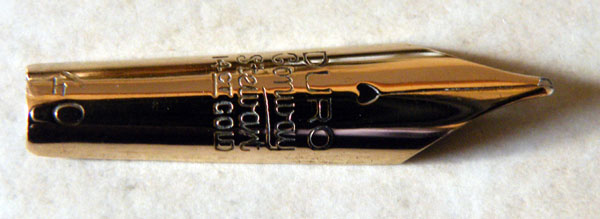
The Duro 40 is a large and impressive nib. Like most Duros, it’s rigid. Sometimes you’ll hear that the hard-as-a-nail Duros were produced to satisfy a need for a nib that would make an impression through several carbons, but that seems an unlikely explanation. The Duro is rigid because it was made from a thicker blank. There are other, less expensive ways to make stiff nibs, and the ones that would have been used to penetrate carbons were among the cheapest, like the Scribe range. No, the Duro, like Swan’s Eternal, is about status and conspicuous consumption. It was made to be noticed, and perhaps envied.
Funny how bling brings out the worst in us!


 Goodwriterspens's Blog