Initially, this book surprised me. Not to put too fine a point on it, it’s a very generalist, introductory publication, and the hobby is already well-served by books of this standard. I wondered why Mr. Twydle, a second-generation pen repairer with many years of experience, would choose to write such a book. The answer lies in the publisher: Crowood Collectors’ Series.
The Crowood Press publishes books on collectables, everything from British Army Cap Badges to Vintage Radios, some comprehensive, others introductory. No doubt they have a template for introductory works, and it is this format that Mr. Twydle has had to conform to. Given his background I feel sure that Peter Twydle has a great fountain pen book in him; sadly, this is not it.
The book has chapters on understanding the fountain pen, its history, brief notes on some of the manufacturers, guidance for collectors, pen care, and how to choose a pen to suit your hand and writing style. There is an appendix on Arthur Twydle, Peter Twydle’s father. He was a pioneering pen repairer who taught many of the current generation of British pen repairers and restorers.
With a list price of £19.95, it’s an inexpensive introduction to the hobby for an absolute beginner. It can be found deeply discounted at Amazon Marketplace and Abebooks. If you are completely new to the hobby and would like to see a general overview before you commit, this might provide an inexpensive entry for you. Otherwise, put the money towards something more specific and informative.
Those of you who have a WordPress blog will be aware that digging through the statistical information in the Dashboard page can throw up all sorts of interesting information. I was poking around there earlier tonight and I came upon a referrer. I traced it back and with a little sleuthing found that an entry of mine had been quoted in an eBay auction, essentially to authenticate that what the seller said about his/her pen was true.
I put information up here for public use. However, I do wish to strike a note of caution. When I began this blog, I said that I was no expert on the history of pens. I might get it wrong. I try not to, but better people than me make mistakes, even in the standard works on fountain pens.
So what I’m saying is this: if you sell someone a pen that you have “authenticated” by reference to this blog, and the buyer gets a little fractious about it because it’s something other than what you said it was, you’re on your own. I don’t give permission for my blog entries to be directly quoted or referred to to support sales.
For non-commercial purposes, I’ll be perfectly happy for anyone to refer to the blog or quote from it, provided it’s credited. After all, the information I put up here is for sharing within the hobby. I just feel that, given what has happened, I need to cover my back a little. I like my house and I really want to keep it…
There remains some debate over why Parker chose the name Victory for this series of pens. It is reasonable to assume that this was chosen as an aspirational name, looking forward to an allied victory in World War II. Against that, some have asserted that the first Victories were made as early as 1935, but this seems unlikely. Records appear to indicate that the first series began in 1941, and given what is known of Parker’s developing commercial relationship with Valentine at Newhaven, this seems to be the more convincing explanation.
From my own experience of selling Victories, interest is stronger in America than in Britain. Here, I believe, they are seen as cut-down, poor man’s Duofolds. That’s far from true, as they are clearly a separate design branch in their own right. They began looking somewhat Duofold-like, and the last, Aerometric version does resemble some of the lesser Duofold models, but in between the Victory develops into a unique and beautiful pen, practically and aesthetically as good as any pen produced by Parker at Newhaven.
The various versions take a little sorting out, and I’ve tried to make them easy to identify below. Unfortunately I don’t have photos of all the models.
Mark IMark I
1941 – 46
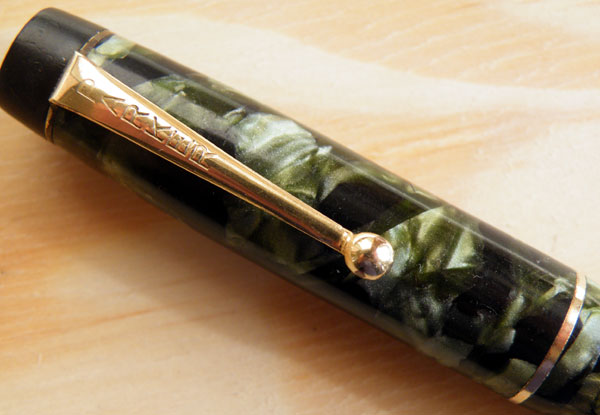
Not very common now, the Mark I is perhaps the most sought-after of the Victories, appearing in beautiful hatched and marbled patterns with a BHR clip screw and blind cap. The clip is of the Duofold ball-ended type and the cap has either one narrow cap band or none. These early Victories appeal especially to American collectors as they appear in colours that are not available in US-made Parkers.
1946 – 47
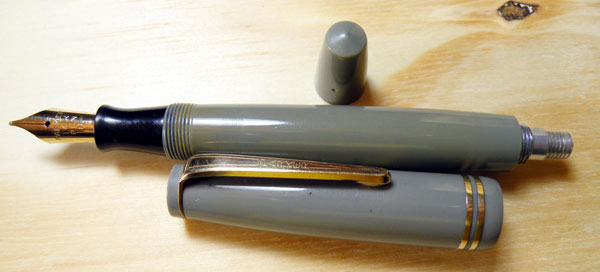
The Mark II is quite similar, but now the clip screw and blind cap are made from the same material as the rest of the pen, and it is more streamlined. These pens are self-coloured in burgundy, blue, grey, green and black. There are two slim cap bands on this model. The production run was short with the result that these pens are not especially common.
1947 – 48
The Mark III had a longer blind cap and a much shorter clip screw. It was offered in the same colours as the Mark II. It has two bands and a ball-ended clip. Again, because they were produced for a short period there aren’t many of these pens around.
Mark IVMark IVMark IV
1948 – 52
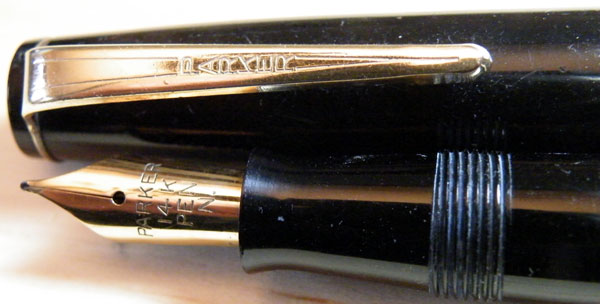
The Mark IV is often referred to as the “Victory AF” as it shared the aluminium filler with the Duofold. The clip had been redesigned to be more tapered, quite like the clip on the Challenger. This is a very aesthetically pleasing design, to my mind the most attractive of the self-coloured Victories. They’re probably the most common of the pre-aerometric Victories.
Mark VMark V
1953 – 1965
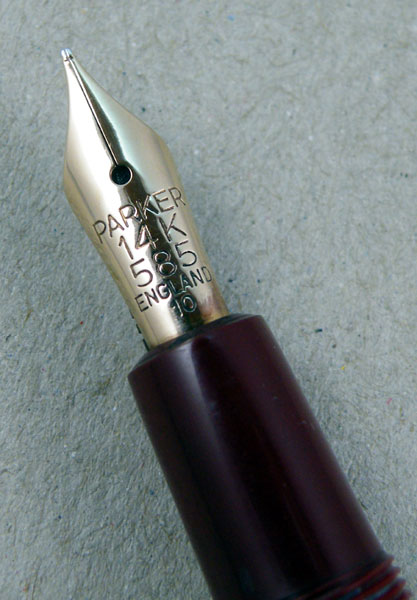
The Mark V is the final version of the Victory. Like the rest of the Newhaven Parkers, it’s now an Aerometric filler, and it’s insufficiently distinguished from the smaller pens in the Duofold range to attract much attention from collectors. It has a single chevroned cap band and appears in black, green, blue and burgundy.
Without exception, these are high-quality pens. They make excellent user pens and they are an interesting byway in Parker production. At the moment, they tend to sell for rather less than their true value. Snap them up while you can!



 Goodwriterspens's Blog