Lapis Lazuli

I’m having a lapis lazuli period at the moment. Months can go by without sight of a lapis pen, then they come flocking in. I’ve had four in the last three weeks, which is a record for me. I’m especially fond of lapis lazuli, in all its surprisingly varied forms.

In the 1920s, as the potential of celluloid began to be understood and more adventurously developed, a vogue for gemstone-themed patterns began. Jade and lapis lazuli, the earliest examples of this trend, were never very true to the appearance of the gemstone, but were more patterns in their own right. A little later, Waterman’s patterns such as Red Quartz or Onyx were very close to the original. Not just pretty patterns, these gemstone colours were at the heart of the spirit of the time. The use of gemstone in statuette bases, desk sets, clock cases, bookends and the like is very much an Art Deco expression, and these pens formed part of the same taste. By the late thirties the fashion was largely over, but in the intervening years some of the most beautiful and striking celluloid pens were produced. Lapis lazuli, along with the rest, disappeared from the pen catalogues until recently, when it was brought back as a revival by several modern pen companies, most notably by Kaweco and Cross.

Parker, I believe, began the fashion. They had two main patterns, one dark blue with light blue inclusions, the other dark blue with off white inclusions. A third one is sometimes seen, a more marbled dark blue/light blue pattern, as in this Lucky Curve Parker Lady:
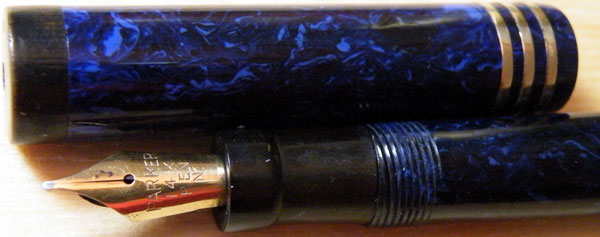
It was the one with the light blue inclusions that was copied most, and many manufacturers like Conway Stewart and Swan had versions. Here’s a classic example in an English Jewel pen:

Some, such as Swan, went for a blue and black streaked version, which seems to me pretty far from the gemstone original, but is nonetheless accepted as lapis lazuli:
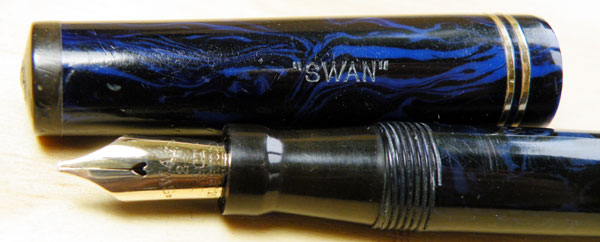
As I’d never seen an example, either illustrated or in reality, I long believed that Swan didn’t make lapis lazuli pens. They do, of course, both in Leverless form and in their self-fillers. A Swan 230 in a good lapis pattern would be pretty much my ideal pen.

The most authentic-looking pattern I have seen so far is in an English no-name lever-filler flat-top:
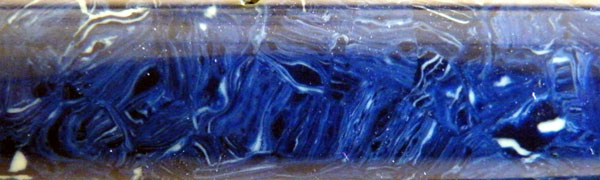
That really does evoke the gemstone.

Though it doesn’t discolour as readily or as badly as some other celluloid patterns, like jade, black and cream or onyx, lapis lazuli can be spoiled by an out-gassing rubber sac, and should always be repaired using a silicon sac.


The Conway Stewart 286

The Conway Stewart 286 had a long production run, from 1930 to 1945. For strict accuracy, one would have to say that it wasn’t quite the same pen throughout the whole period. There were a couple of redesigns. It was always the same type of pen, though, a quite large pen, in the middle of Conway Stewart’s price range, bearing a single narrow cap ring and a big No5 nib. It was always a big seller, probably the company’s biggest seller during the years it was in production. The 286s are well-made pens and they survive in large numbers. Of all the CS pens of that period, I find that these are the ones I have to do least remedial work on. Yes, there can be nib repair and replacement to be done, because people drop pens, but the main components survive better on this model than on most others. The lever, often a problem on Conway Stewarts, rarely is on the 286. It seems to be a little sturdier.

The 286 comes in wonderful colours, including the ever-desirable cracked ice, blue rock-face and the wonderful toffee swirl. Most 286s that turn up, though, are black. Much as I enjoy the colours, I like black pens too. With no distraction of pattern or colour, the proportions of a pen really show in black. I realise that it’s a personal preference, and there’s no mathematical or scientific formula that can be applied to back up what I say, but I think the 286 is the most handsomely proportioned of all Conway Stewarts. Barrel to cap length, clip to cap length, nib to the pen as a whole, all seem more satisfying than on any other Conway Stewart model of the time.

This harmony of proportion makes for a comfortable and well-balanced pen in the hand. Again, it’s a personal preference, but I find the 286 a better pen to use than, say, the 55, which is a little chunky and top-heavy when posted, or the very popular 388, which is just a bit too slender for extended periods of writing.

It’s a good thing, then, that 286s were so popular and have survived so well. For the time being, at least, there seems to be a near-endless supply of them.

Mottled Hard Rubber

I had my say about black hard rubber the other day. Now let’s look at mottled hard rubber in its various forms including red ripple and woodgrain. Visually, MHR tends to survive in a more pleasing condition than may be the case with BHR. Yes, the blacks can fade but the pattern always remains clear. Often the surface has become dull, but a gentle polish with one of the usual proprietary polishes like simichrome will improve things. Even that abrades the surface a little, as you’ll see if you look at your polishing cloth, which will have picked up some colour from the pen. Myself, I prefer a non-abrasive solution like museum wax. It would always be my choice to stop at that. Any fading of the pattern is a reflection of the pen’s age. Unless it has spent the intervening years enclosed in a box, it isn’t reasonable to expect the pen to look as it did when it was new in nineteen-twenty-whatever.

Not every collector, user or restorer will agree with me, though, and that’s where radical solutions that I would reject come in. I only discuss them here because it’s better to cause less damage rather than more.

Restoring the original strong colours of the pattern can only be achieved by abrading the surface away. Metal-work such as levers, rings and clips must be removed. Imprints must either be sacrificed or saved at the cost of showing a different pattern colour from the rest of the pen. The surface of the material is evenly planed away using a medium grade of micromesh. Once an unfaded layer has been reached, successively finer grades are used to restore a smooth finish, and the pen can be reassembled.

Don’t try to do this with proprietary polish. Yes, polish is an abrasive, but it is a comparatively inefficient one, which is why we can use it on something as delicate as a fountain pen without causing damage – or at least visible damage. It won’t reduce the surface of MHR evenly, as an efficient abrasive like micromesh will. Using polish, the softer black areas will be reduced more than the harder red ones, producing an ugly, uneven surface which can only be repaired by further abrasion with micromesh.

As a conservative restorer, all of this falls outside what I do. Nonetheless, people do many things in the name of restoration, whether it be of paintings, buildings, motorcars or pens. Better that it be done properly if it is to be done at all.

Hard rubber is not especially fragile, except in the Red Hard Rubber form, which does merit particular care. MHR is little different from BHR in terms of strength, but it does get used for quite delicate pens, like the half-sized Watermans. Treat it with the respect you’d give to any old pen and you’ll be fine. Also, despite the surface, aesthetic effects of oxidisation, hard rubber is comparatively stable, more so than many celluloids or caseins, which were often poorly cured, or early injection-moulded plastics which had a tendency to shrink. Oxidisation does not weaken a pen; “curing” oxidisation by reducing component thickness may do. Remember, too, that the moment you have finished returning the pen to its original colours, the process of fading begins all over again.

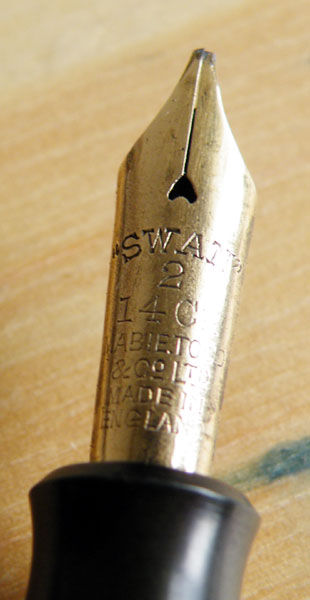
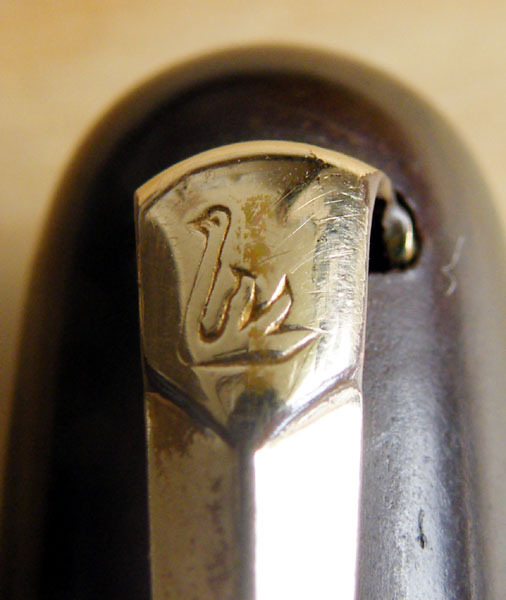
Mabie Todd Swan 3261

After World War II, Swan tooled up for a new product range and went from slightly streamlined, flat-topped pens to fully streamlined torpedo-shaped ones. These were self-coloured in black, dark red, dark blue, dark green and, strangely, black hard rubber. This material appears to have been reinstated after a gap of many years during which the company made celluloid pens. Beautifully machined and finished, the BHR has worn well, though by now most have faded to brown.

One may well wonder why Swan chose to revert to the long-superseded black hard rubber at this date. Perhaps it was to make up a shortfall in the supply of plastic that old stocks of ebonite were used up. Maybe someone felt that the time for BHR had come again, though this seems less likely. Most decisions in the wartime and immediately post-war years were driven more by shortages than style. For myself, I’m just glad they made them. I like black hard rubber, and these are good pens, often with exceptional nibs.

This one has a No2 oblique semi-flex stub, a very nice nib indeed. Throughout its history, Swan seemed to make a greater effort than other British manufacturers to supply customers with nibs that suited their writing style, hence the number of stubs, obliques and flexible nibs that turn up on Swan pens today.


These were the last really high-quality pens that Swan produced. Within a few years, competition from ballpoints laid the company open to takeover by Biro. Swans continued to be made, but the historic Mabie Todd name disappeared, and the pens showed the decline in investment. After a few years of poor sales of pens that would have been better not to have been produced, the Swan story was over.

You’ll notice that I resisted the temptation to make reference to Swan’s swansong. I’m so proud.