Here’s the restored Swan Minor SM2-57, which I posted about yesterday.


Both as a repairer and a writer, Swans are my first choice of pen, and of all the Swans, I like Minors, whether SM1 or SM2, best of all. They’re an adequate size and the design is very pleasing, with the flat-topped (or in this case very slightly domed) cap, the inserted clip and the hard rubber lever, which breaks up the line of the barrel much less than the usual metal one. And then there’s the nibs… Minors almost always have exceptional nibs. Far more often than in any other model, Minors have oblique, stub or very flexible nibs. Perhaps it was the real “writer’s pen” of the Swan range. I haven’t tested this pen yet, but it seems to be at least semi-flexible.
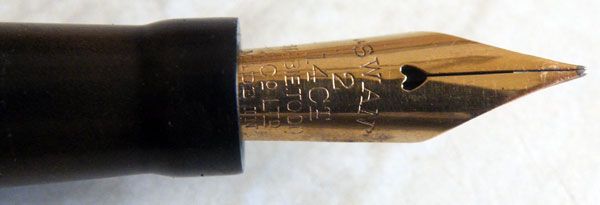
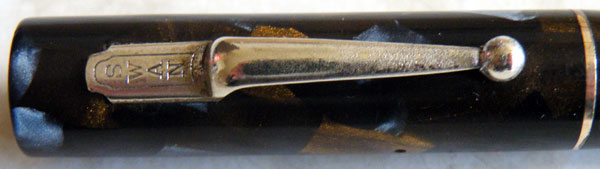
The pattern of this pen is very beautiful, with bronze and blue in different shades mixed with black. The colours are muted and there are quite large areas of each colour. Most unusual. I haven’t seen this pattern before.
Month: March 2011
Swan Minor Clip Replacement
I bought a Mabie Todd Swan Minor 2-57 with a missing clip. Luckily, there was no damage done to the cap when the old clip failed, and luckily also, I had a spare clip. These are superbly beautiful pens with a chunky pattern in muted colours – a perfect example of Swan’s understatement! This one was well worth the painstaking business of replacing the clip.

First the cap gets a good session in the ultrasonic cleaner to remove encrusted ink and get the water to penetrate behind the inner cap. Then heat is applied. Another ultrasonic bath and yet more heat. Then the inner cap puller is brought into play, with continual heat playing on the cap. With this preparation, it takes little effort to remove the inner cap – always preferable. You can apply a lot of pull with these things comparatively safely, but the less effort needed the safer the process is.
I love working on Swans because the quality is so good, and the hand-finished inner cap is just another example of that. To ensure proper clearance of the inside of the clip assembly, the craftsman has filed away a few strokes more, and you can see the file-marks there on the flat of the inner cap.
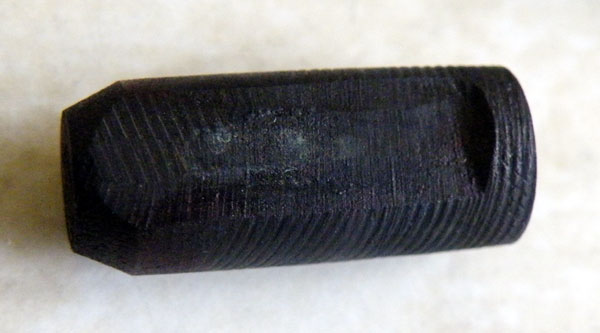

The part of the clip that goes inside the cap has shallow lips, and the little metal tab you see there is forced between them to lock the clip in place. That’s a tricky job, a bit like threading a needle while wearing mittens. And doing it through the keyhole. It gets done (eventually) and all that’s left to do is to refit the inner cap, so it’s back to heating the cap again, and tapping it in to the correct depth with an appropriately-sized piece of dowelling.
I’ll maybe get a picture of the restored and cleaned up pen tomorrow.
The Eversharp Kingswood Pen
For some years, I ignored Kingswoods. Somehow, in that echoing void I call my mind, I had confused Kingswoods with Queensways. The Queensway, it must be said, is a pen well worth ignoring, as it has all the writing capability and aesthetic appeal of a pointy stick. In truth, however, there is no connection between the two, except in my muddled inability to discern the difference between two royal titles. So I missed a lot of good pens for a while.
I’ve made up for it since and grab Kingswoods whenever I can. The pens are well made, decorative and bear an excellent Eversharp nib. In reality they’re a Parker production, made by them at Newhaven after they had bought up the remnants of the failed Wahl Eversharp company. At one time I thought Kingswoods had been created to use up an overstock of Eversharp nibs. I suppose that could be the case, but there must have been a tremendous amount of nibs as the Kingswood proved a good seller and survived long enough to go through a re-design.

Celluloid pens, they share the colours and pattern of the post-war Duofolds and Victories that were produced in Newhaven. The earliest, and most common, Kingswoods are only slightly streamlined and have a stepped clip. Like the later ones, they appear either with a plain or pierced cap band. The later, more torpedo-shaped pens also have a stepped clip, but now incorporating a shallow ‘S’-curve from front to back.

They have a tendency to lose the thin gold plating on clips and levers, though it usually remains on the rings rather better. This can be forgiven, I think, because of the superb Eversharp nib, still as fine an instrument as it was in the company’s glory years. The pens themselves are reliable and straightforward lever fillers. They will continue to give excellent service for many years to come.

Fountain Pen Books
Fountain pen books tend to be expensive. That’s understandable. They’re very often in the large “coffee-table” format, they’re usually profusely illustrated and they have a short and costly publishing run. In publishing terms, we fountain pen fanciers are a tiny and insignificant minority. Far from being best-sellers, many fountain pen books will sell in the hundreds rather than the thousands. No-one’s going to get rich producing books on our niche interest.
As they cost so much, it’s worth being choosy about which books you buy. Unfortunately, you can’t decide how useful a book will be until you’ve had a chance to study it. Most fountain pen books aren’t on offer in the bookshops and you can’t really assess them online. I’ve enjoyed reading all the fountain pen books I have, but there are some I wouldn’t have bought had I known what they would be like in advance. Over the coming weeks, time permitting, I’ll discuss some of the books I have, which may help others to find the ones they would like.
My ideal pen book – and I have a couple of those – is useful as a reference work and contains information I don’t already have. The information is accurate and reliable. That isn’t invariably the case. Pen authors have a tendency to repeat the old, long-ago disproved fables, like the one about Waterman losing a contract because his pen failed, or Conway Stewart only producing 200 of their floral pens. Then again, some authors equate bling with quality and disparage excellent pens because they’re not shiny enough. Other books fail because of the lack of a logical sequence or an index, which means you can never find what you’re looking for. Useful information may be there, but it’s no good if you can’t find it.
Some books list valuations, which seems a futile effort, as the prices go out of date so rapidly, and there is no real established market price for most old pens. They’re worth what someone will pay for them on the day. Yes, if you find a Pompeian Brown Duofold you’re in the money, but what’s a basic BHR Waterman 52 worth? Only the market can tell you, and it’ll give you one price today and another tomorrow. But I digress…
A few of the pen books are truly outstanding, the result of years of painstaking research, checked and re-checked for accuracy, well laid out and/or indexed. I have one or two of them, my first go-to research tools. They’re the noticeably well-thumbed volumes on my shelves, the ones I will have to replace when I wear them out.
Burnham
I have to confess that I’m not very well-informed about Burnham pens. This is because I suffered so many disappointments with them in the early years of my pen-buying that I’ve ignored them ever since. The post-war Burnhams were made in some of the most beautiful patterns ever produced, but they lacked durability due to a multiplicity of faults. Most appear to have been made from casein and many have suffered from the destructive cracking that material can be subject to. The material seems to accept stains readily, too. There are also shrinkage problems such as loose cap rings and ill-fitting caps. Conway Stewart pens were sometimes made of the same material but have survived the years much better. The gold plating on Burnhams is poor, too, being little more than a gold wash which is often entirely rubbed off clips and levers. Clips were fitted with a flat stud which seems to fail easily; many examples appear without clips.
Earlier Burnhams were rather better made, and the thirties range included a large mottled hard rubber pen with a washer-clip, elegant and well made. It is distinctly uncommon now, but the few examples I have seen have survived in good condition. Similarly-styled metal-covered pens were made in that period and they were quite robust too, but they are rare. The button-filler No 60 was a large and impressive celluloid pen and it turns up reasonably often, but it, too, suffers from poor plating, though not quite so bad as the later pens.
Burnham numbers can be confusing as they do not follow any logical sequence and were re-used for different pens. 1950s production included brightly-coloured pens with plated nibs, aimed at the school market, and calligraphic pens were offered too.
Given the variety of models and the beautiful colours, Burnhams are collectible, but because of their faults it pays to be a cautious buyer. There are good examples out there; try to ensure that those are the ones you buy. All post-war Burnhams are lever-fillers and repair is very straightforward. As the sections are screw-in, use a size smaller sac than you would use with a comparable push-in section, or you may end up with a twisted sac.
Oddities.
I picked this pen up this week.

I wasn’t sure what it was, other than that it was a very old Conway Stewart. The faint imprint helped a little and further investigation showed it to be a 206. I can’t find a start-date for its manufacture but it was on sale for Christmas 1928 priced at 10/6d without a clip and 11/6d with a rolled gold clip. This one was evidently bought without a clip and an accommodation clip was later fitted. Here it is posted:

That’s a strange nib! What is that thing?

Closer examination reveals it to be a Macniven & Cameron Waverley nib, with a strange device fitted over it. These things are sometimes referred to as over-feeds, but they don’t actually carry any ink supply. Rather, they prevent the ink in the nib and external part of the feed from drying out. They were not uncommon for a time; Mabie Todd also had a version.
The nib shouldn’t be in this pen, of course. It’s probably at least ten years older than the Conway Stewart, and was most likely fitted in an eyedropper filler. Looks like the first owner of this 206 damaged the nib and replaced it with the nib from his old pen.
I have yet to go to work on this pen, but I think I have a nib of the right date for it and maybe, some day, I’ll pick up a Waverley eyedropper that needs a nib. Wonderful thing to have, anyway.
Dismantling a Stephens Leverfill 76 today, I came upon an unorthodox repair! A strip of Elastoplast (If you’re American, think Band-Aid) had been used to attach a sac. It didn’t work, as was shown by the amount of ink that had permeated the Elastoplast and had coated the inside of the barrel. The nib was flattened, doubtless as a result of the pen being hurled at the wall in frustration! Some times I think, “I’ve seen it all now!” But no. I haven’t. Even more bizarre repairs will appear!
Flex Ramblings
In America, Parker and Sheaffer dispensed with flexible nibs early on. It’s sometimes suggested that this was to suit multi-part carbon forms, but it doesn’t seem likely that whole brands would become stiff-nibbed for that reason. I suspect that it was much more to do with lifetime warranties. Even in heavy hands, a rigid nib will survive when a flexible nib may crack or become sprung. Where the market leaders led, others followed, and flexible nibs became relatively uncommon in the USA, though there were exceptions such as Waterman and Wahl who still presented flexible nibs in their range.
In Britain, lifetime warranties never became a selling point, so most British nibs have some flexibility. Again, there are exceptions, like the Swan Eternal nib, Conway Stewart’s Duro and most Summits and Mentmores. Newhaven Parkers, too, are rigid, but I think that’s down to the influence of the American parent company.
As interest in writing with a variable line grows, people are increasingly turning to older, traditional pens, as contemporary pen makers seem unable to make a truly flexible nib. Even among those older pens, unless you are able to try before you buy or see a writing sample, it’s something of a lottery. Most Swan SM100/60s have some flexibility; many are very flexible indeed. Some are nails, though. Similarly, late forties Waterman 515s can be superbly flexible or rigid. This is why I include an example of the pen’s writing in my eBay listings – to eliminate the guesswork.
In the pen groups and on some websites you’ll see horror tales of cracked and sprung nibs, and the suggestion is regularly made that writing with flex is almost inhumanly difficult. It’s true that accidents will happen, and over-exuberance can destroy a valuable nib. I’ve done it myself. On the other hand, I have super-flex pens that I’ve used for years without any problem. With a little cautious experimentation you can find the reasonable limit of your nib. Thereafter, you stay away from that limit. As regards difficulty: perfect copperplate is difficult; enhancing your usual writing with a variable stroke isn’t. Practice makes perfect and it doesn’t take very much, either, before you begin to fall naturally into the rhythm of light up-strokes and bolder down-strokes. It’s how people have always written, until the advent of the rigid nib and the ballpoint pen. The quill was flexible, as were steel dip nibs.
Indeed, if you want to try inexpensive and reliable flexibility, try a dip nib.
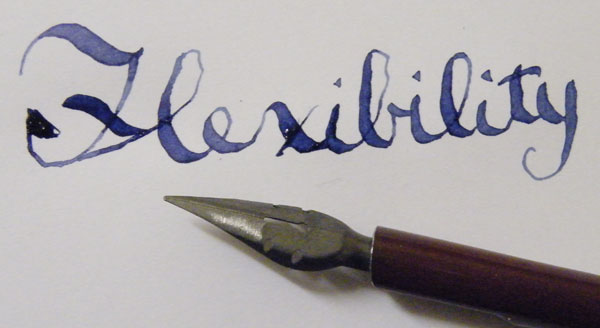
Excuse the scratching. I’m not at ease with a dip nib pen. In fact it’s not for me, with all that dipping and my unfortunate habit of digging into the paper with the steel nib! Good flex, though. This is a William Mitchell Panama No2 medium. I find it a bit of paper-cutter, but the Macniven and Cameron Waverley nib is more forgiving to a modern hand, in my experience.
The Biters, The Grippers and the Throwers Away
People do terrible things to fountain pens. When I examine a new arrival, the two things I look for are bite-marks and tool-marks. As a very general rule, with sadly too many exceptions, bite-marks tend to be on cheaper pens, the ones that were bought for school pupils. Chomping pens is a childish habit, though it isn’t entirely confined to children. If it’s no more than very shallow nibbles, I leave it alone. If the indentations are a bit deeper but there’s no savaging of the material, the application of heat can often work wonders. If it’s the “test the strength of my jaw muscles” gnawing, it’s time to look for another barrel.
Tool marks make me see red. They’re such an unnecessary piece of vandalism. If someone has used those old, worn pliers they had lying around, and the section moved easily, then there’s hope that heat will restore the section. That’s hardly ever the case, though. Usually, they seize the brand-new pliers they bought yesterday, the ones with razor-sharp jaws, and apply them with the grip of a demented gorilla. Nothing’s going to repair that, and there are only so many replacement sections. They’re not making them any more, for the pens I work on.
I’ve never used pliers on a section in my life. No, not even section pliers. Fingers are enough. We learn from an early age to control our fingers so as not to break things, but the moment we use something that will grip harder and apply more torque, we risk damage. Persistence, heat and judicious soaking (you don’t want to discolour black hard rubber sections) will eventually loosen all sections – even those glued-in Waterman Taperites or exceptionally-grippy lizard-skin Swans. Lest you imagine I do all this with the mighty power of my massive paws, I’m female, I have small hands and I don’t work out. I just have patience and perseverance. The section that doesn’t come out today will come out tomorrow. Or a week tomorrow. I do have a use for section pliers, but it’s not for sections. I use them to remove clip screws, where the thread is longer and deeper-seated and the part is not so fragile as a barrel. Even then, it’s with much preparation in the way of soaking and heating.
The other thing people will do is dismantle a pen they’re about to sell. That would be OK if they kept all the bits, but I not infrequently get button fillers with no pressure bar, and sometimes with no button either. I can only assume that they don’t like those nasty metal bits and they throw them away. I can usually find another button, but the loss of the pressure bar can be a problem. Modern replacement button-filler pressure bars aren’t very good. They are weak and don’t have the flexibility of the old ones. They have a tendency to stay bent when they should spring back. I’ve tried several sources but I think they must all be made by the same manufacturer. That means replacements have to be salvaged from somewhere else, and you can only do so much robbing Peter to pay Paul before you have a pile of inoperative button-fillers.
The Ty-Phoo Tea Pen
Someday, someone will write a history of the promotions of British tea companies – if someone hasn’t done it already, that is. Collectable cards of all kinds, die-cast car models, The Tetley Tea Folk, tea towels, ornaments – all sorts of things have been offered as inducements to choose one brand of tea rather than another. Perhaps tea companies feel that their products don’t stand out enough in their own right or maybe it’s that there are so many brands in the field. In any case, it’s an odd phenomenon, and it gave us the Ty-Phoo Tea pen, one of the more interesting good quality pens of the twenties and thirties.

The first one (so far as I can tell) was a black chased hard rubber lever filler with a threaded end to the barrel for posting the cap. This is the basic promotional pen of the time, adequately well made with a warranted 14ct nib, but it doesn’t stand out, and the threaded barrel end is almost a diagnostic sign for an economy pen. No-one appears to know who turned out these pens, ready to be stamped with the advertiser’s name. Not many of this first version of the Ty-Phoo pen survive. They’re actually pretty durable, so it’s reasonable to assume that this first promotion wasn’t all that successful and there were never very many of the BCHR Ty-Phoo pens.
Having had a re-think, Ty-Phoo ordered a much better pen, the mottled hard rubber one we are more familiar with.
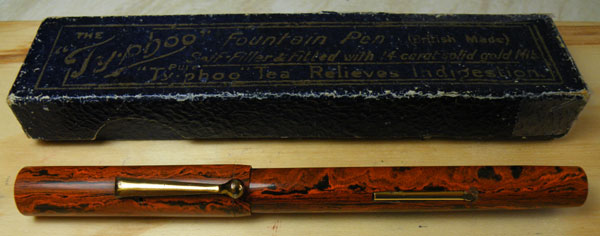
Though the trim is, I suspect, gold-tone rather than gold, in other respects this is a very high quality pen indeed. The design is good, the wood-grain MHR is pleasing to the eye, the machining and finish are first class and they have good warranted nibs. An altogether better pen than the first offering. Some claim that this pen was made by Conway Stewart, others suggest Wyvern as the manufacturer. I have to say that it doesn’t look like Conway Stewart work to me. Their associated pens always resemble their own output, and this pen is very different. Wyvern seems more possible, but the truth is that the manufacturer is unknown. Maybe I should say manufacturers, because there are minor differences between examples of this pen – different clips, slightly different sections and some boxes are blue, while most are orange.
Offered for two shillings and seven pence together with proofs of purchase of the tea, the market value of the pen was said to be eight shillings and sixpence. A real bargain, the offer was taken up with enthusiasm, as can be seen by the number of these pens still around after all these years.
The Parker 51

One of the most popular pens of all time, the Parker 51 remained in production for over thirty years and sold in huge numbers. The barrel and hood were made of Du Pont Lucite, a tough early acrylic. The later Aerometric fillers are often ready to write without service even today. It is a tough, durable, practical pen which has an immensely strong following today. Many people wax enthusiastic about their 51s. Some get quite fanatical!
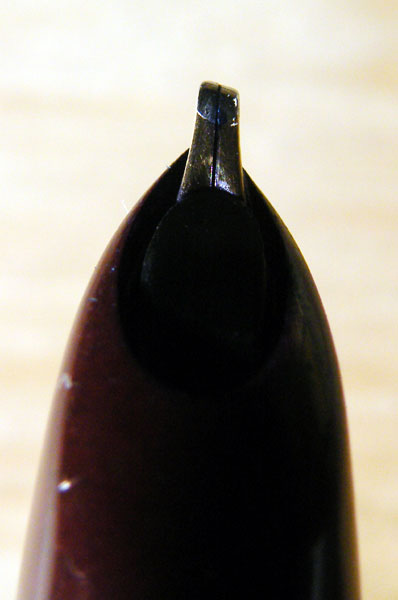
At this point, I should say that I’m not one of them. In the last two years, I’ve sold one Parker 51, and that was only because it had an oblique stub nib.
I have several objections to the Parker 51, and some of those would apply to the 61, the 21 and the various clones made by other manufacturers. First off, I dislike hooded nibs. Much of the beauty of a fountain pen, for me, lies in a well-designed exposed nib. Also, I dislike pens that taper towards the writing point. It feels like your fingers are slipping forward all the time, and it forces a strong and ultimately painful grip. This is a problem common to all pens of that shape, especially Parker’s flighter ballpoints. It’s possible to create a tapered pen with a good grip, like, for instance, the Sheaffer Balance. The Parker 51 is just plain ergonomically wrong.
The early ones are Vacumatics. I’m forced to say that the Vacumatic is an unfortunate filling system, an unnecessarily high-maintenance bulb-filler with a baroque complexity that adds no advantages to the simple original. Novelty was perceived to be a selling point in American pens in those years, and the consequence has been that we have an inheritance of grossly over-engineered filling systems that have a short time between failures and are finicky to repair. The later Aerometric is an infinitely superior filling system.
My oblique stub nib was a considerable rarity. Most Parker 51s, whether fine, medium or broad, have a rounded nib. Taken together with the nib’s stiffness and the relentlessly measured feeding of ink by the collector, the effect is very similar to writing with a ballpoint, hence, I believe, their popularity among those who have never used a traditional fountain pen with its beauties of line variation and shaded ink delivery.
Your view may vary, of course 🙂
 Goodwriterspens's Blog