Empire Pens

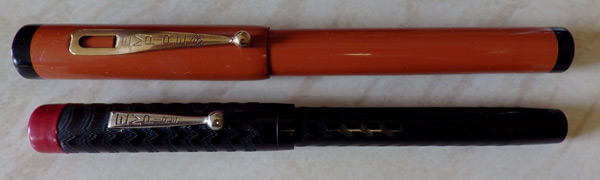
I don’t usually go in for lesser-known American pens but this pair caught my eye.
IMGP7428
The fountain pen industry has had a long affair with the name “Empire”.  Parker, Sheaffer, Conway Stewart and DuPont have all used it at one time or another and there are modern examples too, like the Piper and the Conklin.  Perhaps the concept of empire reflects their corporate ambitions.  Be that as it may, this particular Empire is a sub brand of Eclipse.  I don’t think it was around very long but some handsome flat tops were made.

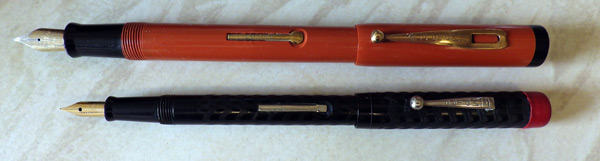
The orange, oversized pen has a Sengbusch nib, probably a replacement for the original.  These nibs were made by the Sengbusch Self-Closing Inkstand Company of Milwaukee, Wisconsin.  Now there’s a name to conjure with!

The black pen with the red top may be black hard rubber but I think it’s more likely that it’s celluloid.  It has a beautifully crisp engined chased pattern.
IMGP7430
Both of these pens are in superb condition and appear to have been used little if at all.  It’s unusual to see pens that some would call “third tier” in such pristine condition.  Though they may not be the equal of the Parkers and Sheaffers of the day, they are not all that far behind and they are extremely attractive and useful pens.

Edit To Add:  Doubt has been cast on the idea that Empire is an Eclipse product.  No indication has been offered as to what else they might be.

Onoto Numbers

Not content with creating his immense Mabie Todd list, John Brindle has given me another list, this one the result of his observations of Onotos over a period.  I think it’s fair to say that though mysteries remain, the Mabie Todd numbering system is no longer the impenetrable puzzle it once was.  There are some rare colours and numbers to be matched up.  An explanation is needed for those pens that start with 6.  The combined efforts of a number of individuals over a couple of years  have shown the way the numbers work.  It’s a pair of fairly simple codes, in effect, with the odd anomaly. Once you get a hang of how it works, the mystery blows away like a morning mist.

Studying the Onoto list, no such consistency leaps out at me.  If you can see a coherent whole in this pot-pourri of numbers, you’re a better man than I am, Gunga Din (allowing for the fact that I’m not a man and nor really, for that matter, is the fictional Gunga Din), as Kipling repeatedly said.  The low two-digit models like 14 and 16  could be part of a design run, but then it leaps to 30 and we discover that these  higher numbers were made in Australia, some as late as 1960.  And what about the 4-figure numbers; what do they denote?  The last digit sometimes seems to relate to the number of cap rings; other times it clearly doesn’t.  And, of course, many have no number at all.

It’s perfectly possible that there is no crackable (is that a word?  It is now) code, but just numbers that relate only to entries in a long-ago destroyed book, a bit like Conway Stewart.  Or it may be a bit of both, some code, some merely reference.

Deb, awaiting enlightenment.

The De La Rue Pen No 1332

IMGP2496

Remember this little guy:  http://wp.me/p17T6K-yP ?  Well, here’s its close relative.  The last one I had was without identifying numbers; this ones a 1332, which makes it mid to late thirties.
IMGP2500
That’s the same nib as some of the Onotos, so you know it has to write well.  And so it does.  I tried it and it writes beautifully, a semi-flexible medium.  If you were rigidly practical, that’s all you need to know – that the pen writes well.  But of course none of us are entirely practical or we wouldn’t be deep into the world of fountain pens.  So it doesn’t hurt that it’s beautiful, that the blue latticework throws the light back at you with an almost metallic shine, that the mottled hard rubber finds some kind of absolutely right harmony with the latticework and the overall design of the pen is that of an object intended to work, but also to please.
IMGP2499
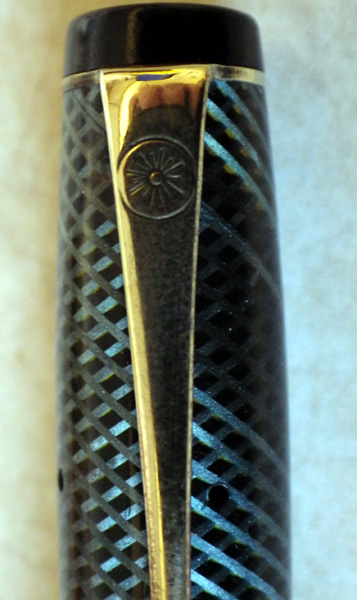
As pen makers, De La Rue were early in the field and could have chosen any logo that they wanted.  What did they choose?  A sunburst, a very common image.  Many years later this caused confusion because jobbing parts makers turned out levers with sunbursts on, just to convince puzzled pen collectors that all sorts of cheap pens were made by the prestigious De La Rue.
IMGP2498
Anyway, the pen’s the important thing.  Isn’t it a beauty?

Onotos

Going back more years than I care to admit, I’ve always had at least one Onoto in my stable of thoroughbreds.  For many years my everyday user was a long black hard rubber Onoto from around 1915 and since then I’ve had a 4601 long enough to have it resealed twice, the last time by the estimable Eric Wilson.  They vie with Swans for being my favourite pens of all.  Purely in terms of quality the pre-war Onoto exceeds any other pen that I’m aware of.  The venerable plunger filler is superior to any other filling system and Onoto and all De La Rue nibs are quite wonderful.  Having said all that, I remain woefully ignorant about their history and the sequence of models.
IMGP2479
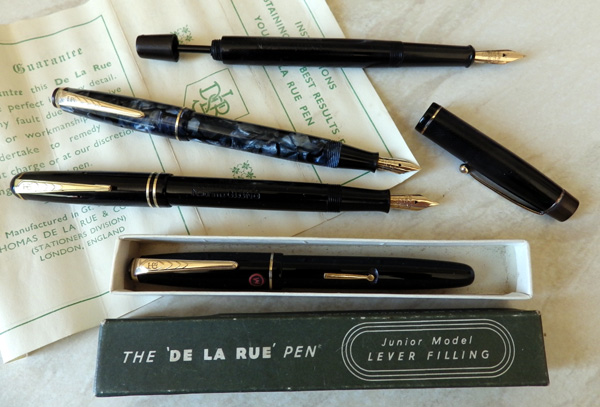
This seems to be the De La Rue week for me.  I picked up these fine examples and there’s another one in the post.  The top pen is, obviously, a plunger filler, probably from the late thirties.  As so often with Onotos, this one doesn’t have a number.  Strangely, it seems to have been the practice to imprint the number on the turn-button before it was drilled to pin the shaft.  Thus the number is often obliterated.

Below that is a charming blue pearl De La Rue Junior with a superb Onoto 22 nib.  Late fifties, I’m guessing, though it could go a few years either side. These pens share so many of the characteristics of the Onoto that you couldn’t put a razor blade between them.

The next one down, looking large and solid, is a lever filling Onoto of the same period.  It has a semi-flexible medium Onoto 33 nib.  I confess to being more than a little tempted by this pen.  I don’t really need it but, well…  look at it!

Last, in its olive green box is another De La Rue Junior with a De La Rue 22 nib, still with its “M” for medium sticker.  The last three of these pens are pristine and would be regarded as New Old Stock had they not been re-sacced.   That’s no bad thing, though, as these pens were meant to be used.  As it says on the side of the box, “the pen that’s sure to suit your hand!”

While we’re on the subject of De La Rue Pens, some of you may remember this post: http://wp.me/p17T6K-yP where there was some doubt as to whether the woodgrain section was original.  Having since seen a couple of other examples, I can confirm that it is original.

The Dickinson Croxley Button Filler

Dickinson Croxley had a short life (1947 – 1949) but, judging by the number of their pens out there, a very successful one.  I’ve heard it said that because of their outdated styling and the absence of an alternative filling system (Croxleys are generally lever fillers) there was no future for the brand and Dickinson wound it up.

This has never struck me as being a satisfactory explanation of the demise of the company.  After all, Conway Stewart got another couple of decades out of the lever filling system.  Moreover, in 1948 Croxley made a streamlined pen that broke away from the admittedly staid line of their previous production.
DSCF1972
As if that wasn’t enough, here’s a Croxley button-filler with a metal cap, in a very modern style for 1948.  It seems that Croxley’s designers had a good look at what was happening in the rest of the market before they came out with this pen.  The clip’s fitting is similar to what Conway Stewart were doing, but simpler and better.  The shallow-cowled washer clip is held by a plastic stud that has a slot for a normal screwdriver on the inside end. No aluminium nut or spanning screwdriver! DSCF1985

The beautifully machined button and its housing bear a debt of gratitude to the Parker Duofold AF which was introduced in the same year.  The pen caps with a Parker-like clutch.  Taken all in all, this remarkable pen is evidence that whatever other reason there was for Dickinson to bring an end to the Croxley range of pens, lack of new ideas wasn’t the cause.

The one failing that mars this otherwise pristine pen are plier marks on the section, evidence of the drooling cretin at work once more.  Thankfully they are shallow and relatively unobtrusive, as I am prevented from minimising them further by the ribbing on the section.
DSCF1974
This example was produced, probably as a giveaway for members, for the Manchester Unity Of Odd Fellows.  You will know, of course, that the Odd Fellows were a benevolent society whose origins are lost in the depths of time, and also that the Manchester Unity broke away from the parent body in 1810 to become a most effective and innovative Friendly Society, providing such benefits for its members as health care provision in pre-National Health Service times.  I think they’re still around but they’re not getting their pen back!

DSCF1976

The Boots Chatsworth – De La Rue Version

Not all high quality pens leap out at you and announce their presence with fanfares and 21-gun salutes; there are hidden gems out there. The Boots Chatsworth is one of these, though you have to be sure of which Chatsworth you’re buying. There’s one made by Burnham for Boots. Though quite an attractive pen, it’s of the quality of the middle-of-the-range post-war Burnhams, i.e. not especially high. The real jewel is the one made by Thomas De La Rue & Co.


It’s easily identified. It’s the one with the sunburst logo on the clip and a warranted nib that has “TDLR & Co Ltd” near the section. (As an aside, a sunburst logo on the clip always identifies De La Rue, but not on the lever. Their ubiquity suggests that these sunburst levers were mass-produced parts available to anyone who wanted to buy them.) This Chatsworth pen is a re-badged and slightly cut down version of the De La Rue pen and the quality is very good despite the slightly smaller size and the smaller nib.


For those who don’t know Boots The Chemist was and is a pharmacy with elements of a chain-store. Back in the day they had a stationery department where they sold their own-branded pens among other items. “Chatsworth” is one of those aggrandising names sometimes chosen by pen sellers for their products. It refers to Chatsworth House in Derbyshire, the seat of the Dukes of Devonshire. It’s all a bit of an excessive embellishment for a modest if worthy pen. Of course the born-again Conway Stewart company has now taken the name for one of their productions – possibly more suitably as like Chatsworth House it’s an overblown lump of pomposity designed for those with more money than taste.

Be that as it may, it’s well worth looking out for the Boots Chatsworth which appears in eBay not infrequently, usually at a good price. I snap ’em up myself whenever I can.

A Nineteen-Twenties De La Rue Pen

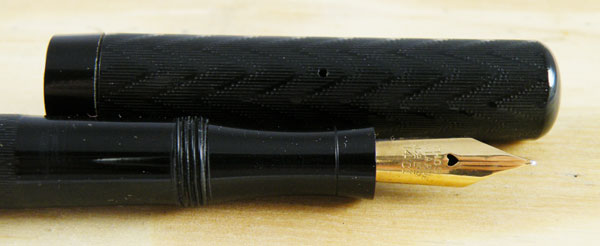
I’m afraid my photographs don’t really do justice to this stunning pen. I’ve lightened them a little to show the chasing better.


Going by its style, it dates to the early nineteen-twenties but in terms of condition it could have been made yesterday. I have nothing to compare this with as I’m not really familiar with non-Onoto De La Rue pens of this quite early date. All I can say is that this is a very, very high quality pen. The machining is so good it’s invisible, the fit of the parts is superb, the chasing is deep-cut and beautiful and the design is pleasing. Later De La Rue pens can be inconsistent; some are excellent, others can be surprisingly average, but they got off to a good start with this one.


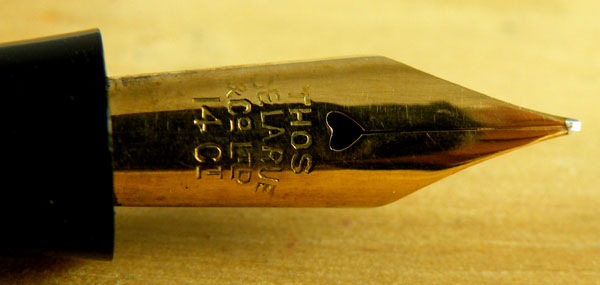
Nib stamps are interesting. The best, I think, are on Sheaffers – deeply imprinted, clear and artistically laid out. Swans are good too. Conway Stewarts have nice cursive writing but they’re stamped quite shallow, and old ones can be very faint. De La Rues, including Onotos, often have a messy and indistinct stamp.


Don’t judge the nib by the stamp, however. De La Rue nibs are superb, among the very best you’ll ever find.

It’s when you find a pristine black chased hard rubber pen like this that the difference between the real thing and re-blacked pens leaps out at you. There are no painted-over dings and scratches here, nor is the surface roughened by soaking in bleach. A BCHR pen that is like new is a very special thing and it can’t be replicated by chicanery.

The De La Rue Onoto

If the self-filling pen hadn’t been invented yet and you were considering ways this might be done, it’s likely that you would think about the syringe. It’s a method that has been used from the earliest times right up to the present. It has its failings and it’s hardly an elegant solution, but it does work. What you would be extremely unlikely to come up with, I would suggest, is a syringe-in-reverse, a filling system where the pen fills on the down-stroke of a plunger, but that’s exactly the method that De La Rue developed for their Onoto pen in 1905. It’s a stroke of counter-intuitive genius. Not only does it arrange to have the handle of the syringe in the tidy “down” position, thus eradicating the main objection to syringe fillers, it’s done in such a way that little barrel space is wasted and the pen holds a large charge of ink. In addition, a secure cut-off valve is built in, which also allows for regulation of the ink flow. It’s a complete solution to the problem of getting ink into a pen, which leapt fully-formed from the mind of the ingenious engineer George Sweetser and was perfectly implemented by De La Rue.

De La Rue were well aware that they had an exceptional design and they went on to make the Onoto the most prestigious and esteemed pen in the British market. Huge world-wide sales followed and the Onoto plunger-filler remained in production in the UK until 1955 and for a few years longer in Australia. It was succeeded for a few years by the K-Series open and covered nib piston-filling Onotos, nice pens but hardly to be compared with the plunger-filler. There were also some handsome lever-filler Onotos, much sought-after now but not accorded the same respect by the purists. De La Rue also made non-Onoto lever-fillers. Perhaps I’ve been unlucky in the ones that have come my way but the quality of these pens seems much poorer to me.

Whereas Sheaffer’s later implementation of the plunger-filler, the Vacuum-Fil, was never intended to be serviced and requires fairly major surgery to be restored, the Onoto was designed to be easily disassembled for replacement of the seals. Actually, provided the seals aren’t allowed to dry out for long periods, and filling system isn’t abused, there is a very long interval between seal replacements. I have an Onoto that I bought in working condition twenty years ago that’s still filling perfectly with the same seals. I’ve restored a few, mostly for my own use, but I don’t do Onoto restoration commercially. There’s a surprising variety of models, which makes for a very large spares holding, and spares are extremely hard to source and very expensive. Too much of an overhead for me, but there are several excellent restorers out there and I’ll be happy to recommend one if you need some work done.

The Onoto plunger filling system remains one of the cleanest and most efficient to this day. Onoto nibs are a delight. The pen was made in many styles and patterns over the years, so there’s something for everyone. The manufacturing quality is always impeccable. The Onoto is one of the best pens ever made and if you will forgive my own personal bias, THE best!