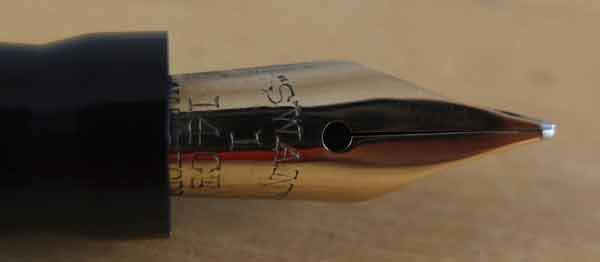
Mabie Todd Swan 3160

The post-war 31– range of Swans is often deprecated because of the small size of the nib.  Quite strange really, because the Swan No 1 is no smaller than many nibs that meet with approval, such as the bulk of the medium to lower-cost Conway Stewarts but I have seen people say that they avoid them because of their quality.  In truth, the build quality of the pen is same as that of its bigger siblings and the fact that so many of them have survived in very good condition supports that.
DSCF2667
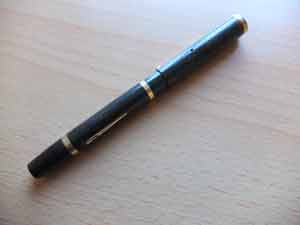
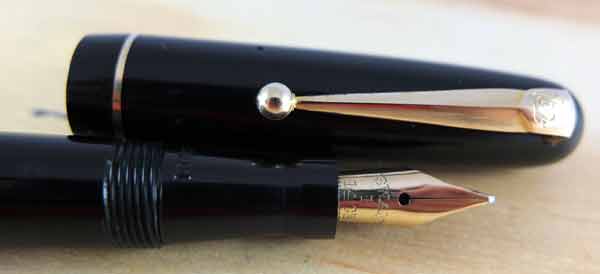
Judging by the very good condition of the gold plating, this 3160 hasn’t seen much use.  The plastic, too, has much less in the way of marks of everyday use than you would expect to see in a pen of this age.

DSCF2670

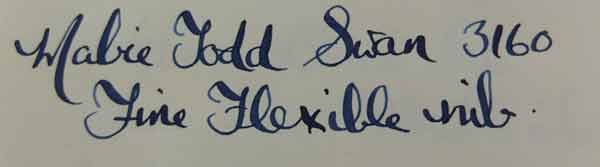
Like so many in the 31– range, this pen has an absolutely outstanding nib.  Its appearance gives no clue that this is one of the best flexible nibs to come my way in a long time.  It expands easily from fine to triple broad and the snap-back to its usual shape is instant.  The ladder feed supplies enough ink to meet the demands the nib makes.  I had some fun testing this pen after re-saccing.  Here’s a writing sample to give an idea of its capabilities:

DSCF2677

Repairing A Lever Fill Pen

DSCF2704

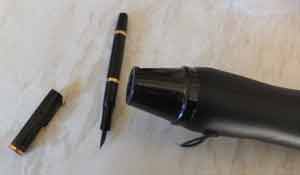
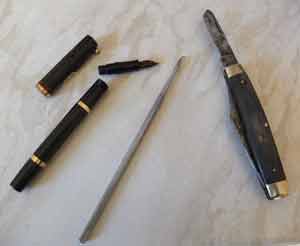
I keep being asked questions about fitting a new sac in a lever fill pen, so here goes: this is a Swan SF230 in need of repair.

DSCF2705

For a start, the section has to come out.  This is a black hard rubber pen so don’t soak it.  Personally, I never soak any pen to take the section out.  Dry heat is the way to go, and I’d say always use heat.    It expands things and softens them a little, and makes a cracked barrel much less likely.  These Swans are friction fit.  I just pull the section out with my fingers.  Latex or nitrile gloves help by giving you a better grip.  Some people use section pliers.

DSCF2707

The section’s out and you’ll need some tools to remove the remains of the old sac.  I use a dental pick to get into the barrel and a pocket knife to chip the old sac off the peg.  Mostly, sacs are desiccated and crumble at a touch but sometimes they can assume the consistency of part-dried glue or very stiff chewing gum.  Clearing the barrel takes longer with a sac like that.

DSCF2714

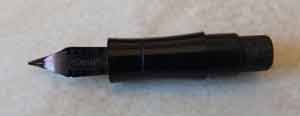
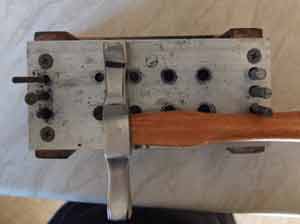
Once you have the barrel and peg cleaned up, the next move depends on the state of the nib and section.  If the nib is badly offset or damaged, you will have to drift it out.  That’s where the knock-out block comes in.  Most of those you get to buy are fiddly little things that tend to be unstable.  It’s best to make one yourself if you can.

DSCF2717

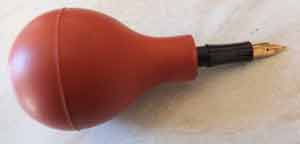
In this case there’s no need to remove the nib, and it’s best not to take it out unless you have to, as re-setting a nib isn’t a trivial task.  It needs a good flush to remove old ink, and that’s where this bulb is so useful.

DSCF2716

When that’s done and you’ve dried the exterior of the section, you’ll need an appropriate size of sac – 18 in this case – and some shellac.   A sac spreader is optional.  I like this pair of old dividers with the points cut off and ground smooth.

DSCF2719

Measure the sac and cut it to the correct length.

DSCF2720

Get a good coating of shellac on the peg and fit the sac.  Then apply some pure talc.  I see a lot of “repaired” pens where this step has been missed out.  Don’t.  It’s significant.  Without a covering of talc the latex sac will stick to the pressure bar and it will shorten the sac’s life considerably.

DSCF2725

Let it dry.  Half an hour will do it.  Then reassemble and give the pen a good clean up.

DSCF2728

You’re done!

Mystery Pens!

DSCF2404

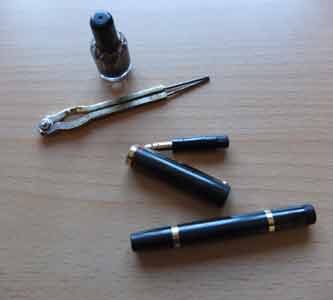
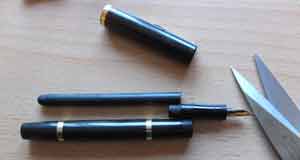
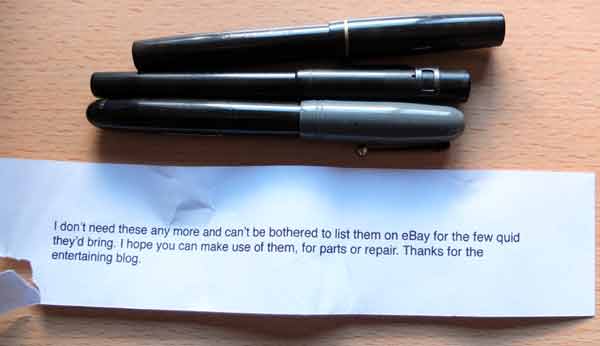
An anonymous benefactor sent me these pens which arrived yesterday.  I can’t even guess at who it was  who gave me these pens.  One will provide useful parts and the other two can be restored to working condition.

Thank you very much, unknown donor!

English Duofolds

DSCF2386

English Parkers remain among the most underrated pens around.  Not so much the the 51s and 61s, at least partly because our American cousins recognise them, but the whole English Duofold range remains a mystery to overseas buyers.  Maximas and Seniors do somewhat better because they cater to the modern taste for large pens, but the more usual standard Duofolds, Demis, Slimfolds and Juniors sell poorly in comparison with other pens, many of them of considerably less quality.  Though the market has picked up a little recently, I still see Slimfolds, Juniors and the similar Victory Mark V passing through ebay without a bid.

My own favourite is the Duofold AF.  It has a lot going for it.  The splendid Duofold nib – usually firm but not quite as rigid as the American counterpart – remains consistent throughout the Newhaven production.  The aluminium filler looks a lot better than the traditional button.  It’s  finely machined and has a very modern look about it, as though it might be a part for a moon rocket or at the very least a snazzy sports car.  It’s an easy fix when it needs a sac and it holds a decent quantity of ink.  Externally, the Aerometric Duofold is the same pen with the same writing characteristics and many people like it but I think of it as Parker’s first step back from ingenious filling solutions.  Having to take the barrel off to fill the pen is not an advance in convenience.  Having done so, you’re faced with a bulb filler with a protective metal surround – nineteen thirties technology in a nineteen fifties pen.  Thereafter came the descent to Parker pens being mere holders for cartridges, which ensured that the buyer handed the company large profits in perpetuity.

That doesn’t mean that the Aerometric was worse than other pens that were being produced at the time.  The reverse is true.  Despite the dated technology the quality was so high that the pen sold in huge numbers, even at a time when the ballpoint was beginning to dominate the industry.  Though a little subject to cap lip cracks, Aerometrics otherwise just don’t fail.  They’ve kept on going until today with no servicing and indications are that they’ll see all of us off.  Though the plastic they’re made from is soft enough that barrel imprints can wear off, it’s thick and robust.  The sac is so durable that today hardly one in fifty needs replacing.  The sac protector may dull and discolour with age but it remains completely sound, unlike, for instance, many of Conway Stewart’s Pressac protectors.  The nib has a good lump of tipping material, and the pens continue to write as they did when new.

That quality extends throughout the range.  The Junior was cheaper only because it was smaller and had less gold in the nib, not because the quality was less.  That’s shown by the vast numbers of Juniors and Slimfolds that continue to appear in ebay, just in need of a flush and a wipe with the polishing cloth to look as good as new.

Try one, from the first Newhaven Duofolds, through the New Style, Aluminium Filler and Aerometric.  There’s plenty to choose from.

Mabie Todd & Bard Overlay Eyedropper Filler

DSCF2388

Unusually, I was aware of this pen before I had the opportunity to buy it.  The previous owner wrote about it in Fountain Pen Network and I would reference that post if I could.  However, FPN’s search facility, which is never very good, is grindingly slow today and I had to give up.

DSCF2391

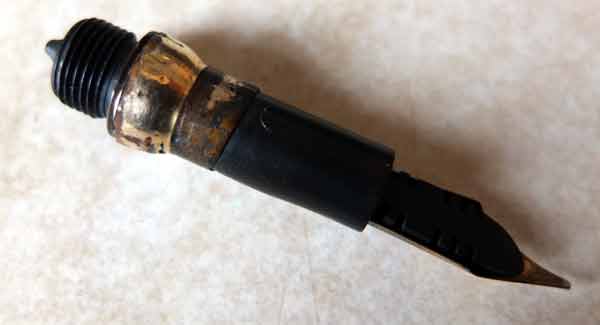
The pen is in worn condition and it’s almost an exercise in unoriginality but that’s neither here nor there with a pen of this quality.  The seller said the cap was not original.  Nor is the No3 nib or the ladder feed, both of which are replacements.  I may well have a nib that suits the pen better but I will leave the ladder feed.  It may be an anachronism but it’s also an improvement.

DSCF2399

I had a look through my reference files to see if I could discover which pen it actually is.

DSCF2400DSCF2401
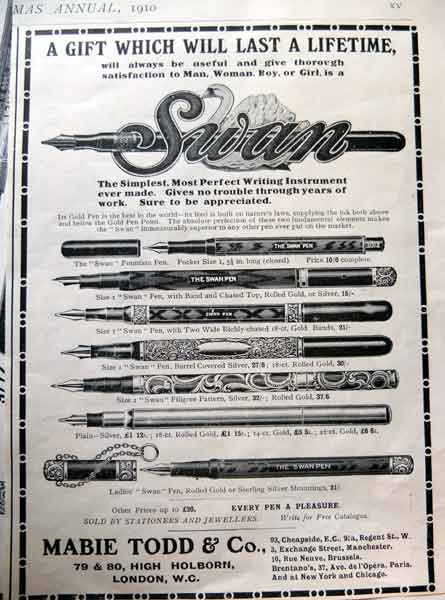
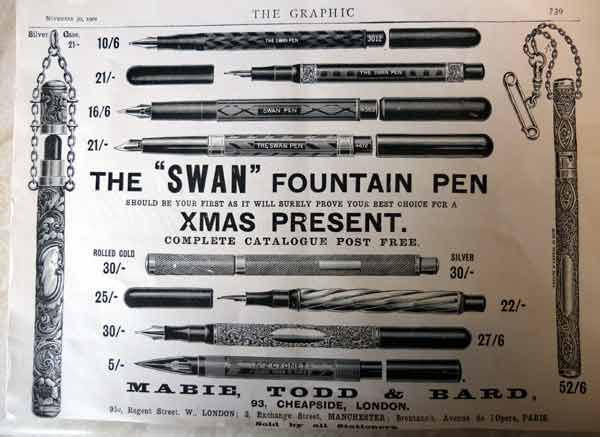
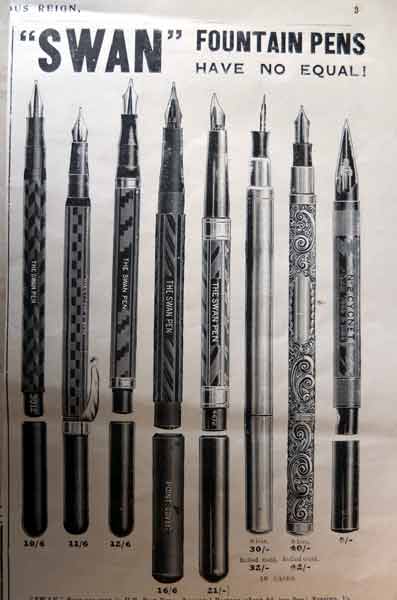
There were pens with overlay barrels and plain BHR caps as these advertisements show, but these are not this pen.

DSCF2402

I think the pen second from the right in this 1911 advert is the closest to this pen, if you look at the metal partially covering the section.  That’s the type though the date of the pen is impossible for me to determine exactly.

DSCF2393

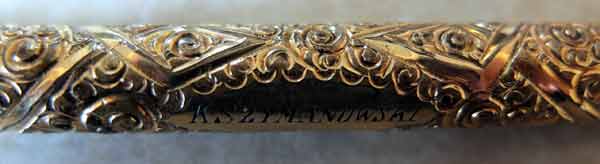
Could this pen have belonged to the Polish composer Karol Szymanowski?  I can find no good biography of  Szymanowski.  It is said that he travelled widely, but I can’t tell if he ever set foot on these shores.  Of course, there are a variety of other ways his pen might have arrived here, some more likely than others.  Perhaps Szymanowski is as common a name in Poland as Smith is here.  I don’t know.  The dates give no difficulty.  Szymanowski  lived from 1882 – 1937, so it would not be stretching things too far to say that he bought this pen in the early years of the twentieth century, then discarded it in later years when better designs came along.  It’s not unlikely, either, that a successful composer and musical director with a good sense of amour propre would buy a very expensive pen and have his name engraved on it.

Could this have been the pen he used to write the operas Król Roger and Hagith?  We’ll never know, but it can’t easily be disproved either.

The Yaltec Flashlight

I’ve employed a wide variety of flashlights and penlights to peer into the barrel of pens in search of dislodged pressure bars and sacs that have turned to a particularly repulsive version of chewing gum.  I haven’t been especially pleased with any of them, and about a month ago I went trawling the internet for something better.

DSCF2376

I found that a whole new generation of flashlights had grown up while I was looking the other way, probably missing this event through lack of light.  I picked out the Yaltec because it wasn’t too wildly expensive and the copy wasn’t as melodramatic as some of the others.  Two of the things that  were said are that it is “The Brightest Pocket Sized Torch in the UK “ and that it produces “1300 Lumens per square metre (at one metre) CREE XM-L U2 LED”.  I confess I have no idea what the second boast means but the first one may well be true.  It’s certainly BRIGHT!  Scary bright, like if you shone it upon yourself it might drill right through you.  Peering into fountain pen barrels has never been easier.

It uses those stocky little CR123A batteries, and though it’s not as demanding as I had anticipated, it does scamper through them quite quickly.  However, you can get rechargeable ones, though you’d almost certainly have to buy yet another charger, as I did.  I have chargers for two different types of camera batteries, a supposedly universal charger (hah!) and two other chargers for our ebooks.  That’s not counting the dedicated chargers for hedge trimmers, screwdrivers and so on through an interminable list.

All that aside, though, my life has definitely become a little brighter.  And when I sit in this room (which is north-facing and quite dim) staring hopelessly at all those Parker and Swan pens in very, very dark blues and greens and reds which look black in any but the strongest light, I only have to flick the switch on my Yaltec and all is revealed.  Oh, the sense of power!

Kaweco Sport

DSCF2025

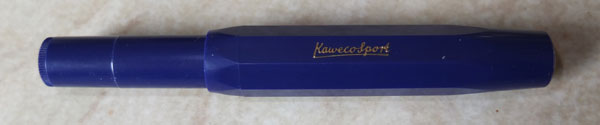
As you may have noticed I seldom buy modern pens.  Not my thing, really, but I had a bundle of small international cartridges that came in a lot I bought some time ago and I wanted an inexpensive pen to use them up.  I didn’t really consider any of the Chinese pens.  They haven’t worked out for me – metal sections and brass barrels make no sense to someone whose usual pens are Swans and Conway Stewarts.  I’ve had earlier piston fill versions of the Kaweco Sport with gold nibs and I knew that the current classic Sport isn’t as well featured as they were, but I like the idea of the long-short pen.

DSCF2027

I bought mine from Amazon and it came directly from Germany.  Postage included, it was around £20.00.  I opted for the broad and that’s what I got but it isn’t all that broad.  More of a generous medium, I feel.  That’s not a complaint, really.  The nib width is good.  I’m pleased with it.  The pen weighs practically nothing, which is how I like them and it does what it’s meant to do.  The threads, both cap and section, are good.  There’s no clip but I wasn’t going to be carrying it anyway and the octagonal cap keeps it from rolling off the desk.  The plated nib has a few curlicues on it as they all do nowadays, but it also reminds us that Kaweco has been around since 1883.  There’s a little gilded disc with “Kaweco” on it on the top of the cap, and “Made In Germany” is on the bottom of the barrel.

DSCF2029

In use it’s long enough posted, the ink flow’s great out of the box and I’m very pleased with it.  Great little pen.  Everybody should have one.

DSCF2014

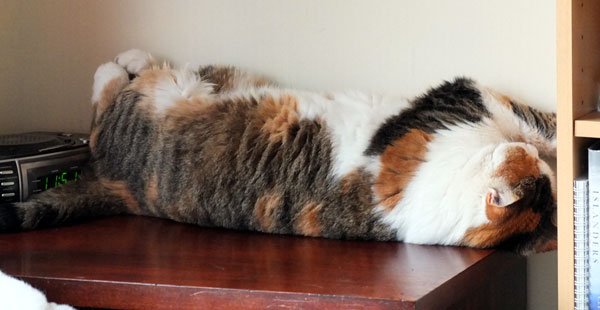
My assistant doesn’t work on Saturdays.

DSCF2018

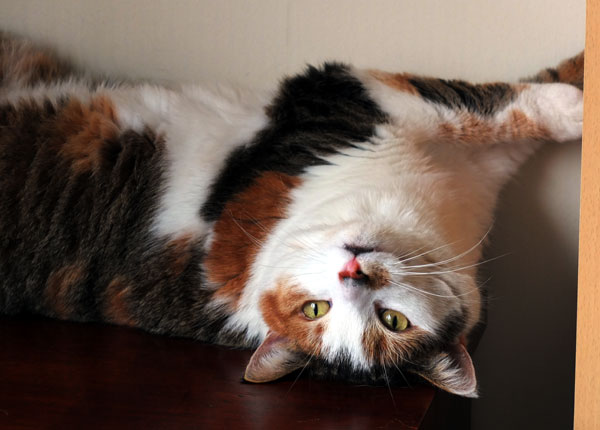
She’s not very keen on having her photograph taken either.

The Waverley Nib

DSCF1997

Once upon a time, children, in the long, long ago, there was an inspired inventor called Duncan Cameron.  In those days of horseless carriages and ridiculous hats, people wrote with either a goose feather or a pointy steel dip nib.  The feather was OK but the nib had a tendency to dig into the paper, sending a spray of ink, together with the occasional blot across your penmanship.  Duncan addressed this problem by creating the Waverley nib, characterised by a narrow waist and and an upturned nib.  Some say the nib was patented in 1850 and others say it was 1864.  Either way, ’twas ages ago and I don’t have the energy to hunt down the truth of the matter (bad, bad historian; slaphand).  Anyways, it was an immense success and the nib was taken up by almost everyone except schools where they liked to continue to torture the children with paper-slasher nibs.

The Waverley nib became Macniven & Cameron’s best-selling product, and when they later decided to branch out into fountain pens like this splendid example:

various-001

they retained their well-known narrow-waisted, leaf-shaped nib as a selling point.  What they didn’t do, of course, was tilt the tip of the fountain nib, for the simple reason that fountain pen nibs have smooth, long-lasting tipping material and have no tendency to dig into the paper.  Such a thing would be redundant, so they didn’t do it.  Here’s the fountain pen version of the Waverley nib, as straight and untilted as any other:
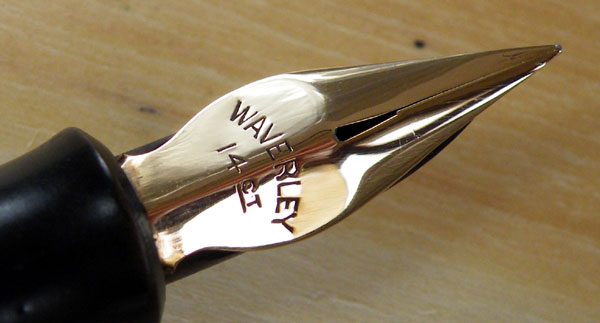
various-008

Probably independently, Sheaffer took up the idea of tilting the tips of nibs, particularly their tubular nibs, in the belief that this made them smoother writers.  They were wrong, of course.  Those tip-tilted Sheaffers don’t write any more smoothly – or indeed any different – than any competently-made nib.

Mr. Richard Binder took up the idea of the Waverley nib some time back, though for some reason he transferred the idea to fountain pen nibs, rather than dip nibs where it actually has some benefit.  Now, I see in FPN, he has acquired the commercial rights to the term and is getting a little snappy about others using it.

Considering how much the term has been bandied about in the last few years, it seems unlikely that it could be legally limited in this way.  It’s amusing, though, how these things come around.

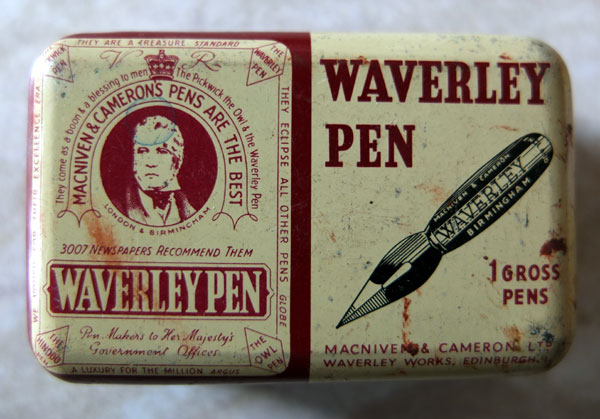
They come as a Boon and a Blessing to men
The Pickwick, the Owl and the Waverley Pen  

When Duncan Cameron named his improved nib after Sir Walter Scott’s novels and the area of Edinburgh where the main railway station is, he couldn’t have foreseen that the concept would give rise to litigious grumblings on the other side of the Atlantic a century and a half later.  However, as we know, the history of the fountain pen is one of homages and copies.  Truly, there’s nothing new under the sun!
The Conway Stewart 57

DSCF1988

I don’t usually buy pens from Conway Stewart’s later output so I must have been dozing off when I bought this 57.  It happens.

I got around to assessing and restoring it today.  Actually, it was in pretty good order and didn’t need a lot done.  I had to put a new sac on, but removing the Pressac sac shield and refitting it was no trouble at all.  Other than that, I flushed the nib/hood unit until the water ran clear, cleaned the pen up a bit and that was that.

DSCF1989

This is by no means the last of Conway Stewart’s pens and while it shows a decline in standards from the high days of the fifties and earlier, it’s not at all a bad pen.  There are the usual slight markings of use but that’s all.  To my surprise, the gold plating has held up well despite clear indications that the pen has been well used.

DSCF1991

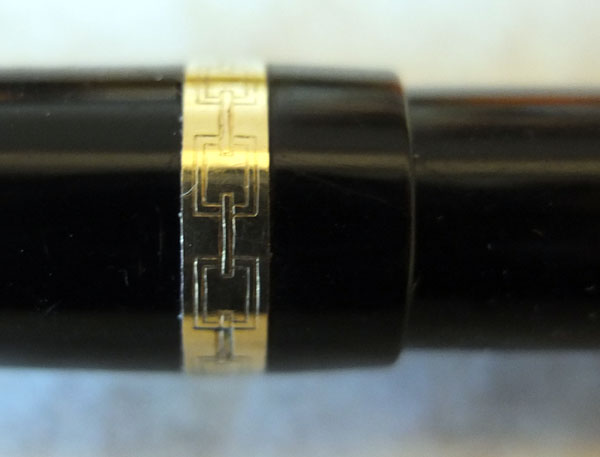
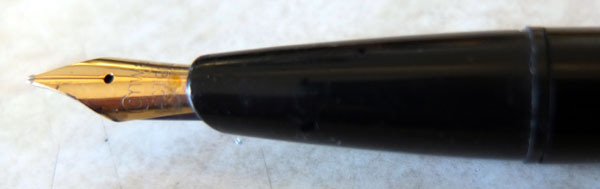
So how does this pen of Conway Stewart’s declining years stack up just as a writing instrument?  I think one might be entitled to knock off a point or two for the filling system.  The Pressac bears a superficial resemblance to Parker’s Aeromentric filler but it isn’t as efficient as it lacks a breather tube.  It’s just a squeeze filler.  The nib’s a nail but that’s OK – plenty of people like nails.  The clutch works well and the pen closes firmly.  The ink flow’s good and the pen sits well in the hand.  I could use this pen quite happily.  It wouldn’t be my first choice but it wouldn’t give me any problems either.  It’s on a par, I think, with the better Chinese pens that are being produced today, with its squeeze filler and nail nib, except that it harks back to a well-respected line of pens and it has a gold nib, which sets it a step or two above.  Also, the chain motif on the cap band might lift it another half a step further.

DSCF1994

One other thing about this pen is that it’s a bit of stylistic grab-bag.  It’s a long, tapering pen like the 85L but it shows pretensions to something more modern.  The nib is fully exposed.  Why then does it have a long hood – which serves no practical purpose – rather than a normal section?  I think it shows two things: that Conway Stewart’s designers knew that the public wanted something new, but also that they didn’t have the money to tool up for a completely new pen, so they made this cheerless compromise.

The 57’s diamond clip is a reminder of past glories but the purposeless hood is an omen of things to come.