Stephens Leverfil No 76 in Dusty Rose and Black Marble

Stephens had a comparatively short but very productive period as a seller of gold-nibbed fountain pens. Beginning in 1935 with their stud fillers, this period in their much longer history was pretty well over by 1955. Though details of their later history when they were involved with Jif-Waterman are confusing, the earlier chronology of the company is, in general terms, quite well known.


For instance, this beautiful Leverfil No 76 was introduced in the autumn of 1941, a period when Stephens used some very lovely patterns of celluloid that seem to have been unique to them.


Though at seven shillings and sixpence it was their second cheapest pen it is well made with admirable attention to detail, such as the nib that was made specially for this pen.

 

What remains a puzzle, to me at least, is the variety of clips that Stephens used over a short period, apparently without much consistency. There’s this clip with “Stephens” stamped into it, a similar ball-ended clip in either gold or chrome plating without the lettering, and sometimes an arrow clip appears.

The greater mystery that has yet to be resolved is the extent to which Stephens own employees were active in the production of these pens. It is possible, though unlikely, that they were entirely made under contract by some other company, with Langs being the most obvious choice. The early stud fillers were made to a Langs patent and bore a striking resemblance to that company’s other output. The component parts of these wartime lever fillers also resemble other Langs pens. It may well be that parts were manufactured by Langs and the final assembly was carried out by Stephens. Stephen Hull mention (in Stephen Hull: The English Fountain Pen Industry 1875 – 1975) that when their head office was bombed in December 1940, work continued at their main factory at Highbury. Prior to that, customer repairs seem to have been done at the head office, so it is fair to assume that the main factory may have been devoted to assembly if not complete manufacture of the pens.

My thanks to Stephen Hull for the factual information quoted above. The speculation is my own.
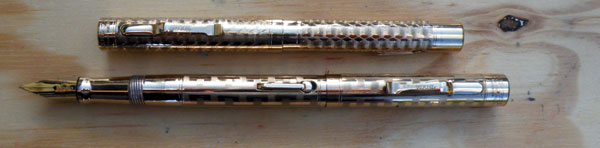
A Brace of Wahls

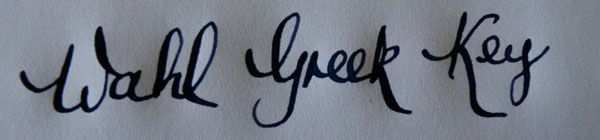
Recently somebody was selling off their collection of overlay and metal bodied pens and I bought a few of them. These are the shorter Wahl Gold-Filled pens, measuring 10.8cm (41/2 inches). They were made between 1920 and 1929, the height of the Art Deco period, and these are often called Wahl Art Deco Pens. That’s odd, in a way, because there’s no individual feature of these pens that relates to the Art Deco Style. They’re restrained and symmetrical. The machined decoration on one – the Greek Key Pattern – is entirely classical in origin and the other, the Diamond Wave Pattern, is without any obvious influence. The overall effect, though, with the shapely clips and the tiny, decorative levers, is, perhaps, slightly Art Deco Mild, as it were, and the fact that the patterning is machined rather than hand-engraved as it would have been in an earlier era, adds to this.


These are quite practical pens. Capped, they’re no longer short at 14.8cm, which is an average size for a pen. Both have the excellent Wahl 3 nib. The Diamond Wave patterned one is semi-flexible, but the Greek Key pattern is fully flexible. Both are a delight to write with. There’s a little loss of plating where the pens have been posted, but at 80 – 90 years old they’re as pretty and useful as when they were made.

How Are The Mighty Fallen!

This no-number pen was made by Conway Stewart in its years of decline. I can’t find an image of it in my usual sources, but there’s a fibre-tipped pen in Steve Hull’s Conway Stewart book that bears a close resemblance. The defining feature seems to be the raised, lined ring near the cap lip and the fibre-tipped pen has something similar. That would place its manufacture at 1972. This pen’s design is decidedly seventies, in the sense that form triumphs over function, as it did in so many objects made in that decade. The raised, lined ring might make some sense if the cap was screw-on, in that it would give the user additional grip. However, this is a slip cap. It doesn’t have a clutch, but the section and barrel meet in such a way that one protrudes fractionally at the top, the other at the bottom. This forms a sort of ridge which the cap clicks over. It’s cheap and effective but quite offensively inelegant.


This shoddiness is pervasive. That the pen is made in the particularly unfortunate green that Conway Stewart favoured in those years is neither here nor there, but the very evident seams and flashing left by the injection moulding process indicates that quality control was not high on the company’s priorities. The fixed clip is at an angle, not because it has been bent but because that’s how it was inserted. The process of clip insertion has caused rippling in the thin plastic of the cap. Once known as “the pen with the wonderful nib” Conway Stewart Has now become the pen with the cheap, after-market, folded-tip, white metal Flowline nib, and that’s truly a sad comment on how far the company had fallen.


The filler parts have been lost at some time from this Pressmatic filler and, to crown it all, the pen has begun to warp, giving a slightly banana-shaped front-to-back profile. It would, actually, be possible to restore this pen. I expect I have the metal parts of a Pressmatic filler in the spares box and the pen could probably be straightened without much difficulty, but why bother? Who, in their right mind, would want this pen?

The Bayard 2000

I don’t often buy French pens* but I couldn’t resist this boxed Bayard 2000. It’s a beautiful pen and it’s in wonderful condition for its sixty years. With its torpedo shape, narrow/medium/narrow cap rings and inserted clip, it bears more than a passing resemblance to the Swans of the same date. I don’t think there was any particular reason for that. So far as I’m aware there was no relationship between the companies – that’s just where design was at the time, and in fact Bayard had been making this shape of pen for some time by 1950.


Though its origins lie deeper, Bayard actually began production in 1922. Their logo was a knight with a fountain pen for a lance and a nib for a shield. Their motto was sans reproche which I’ll translate as “beyond reproach” or “irreproachable” until someone with better idiomatic French than me (most people) comes along and puts me right. They made consistently high-quality pens until the mid-fifties, when competition from the increasingly successful ballpoint pen began to seriously erode sales and, like so many other manufacturers they tried various cost-saving exercises that affected the quality of their pens. The company closed in 1965.


Among the last few high-quality pens Bayard made, then, the 2000 is an excellent pen by any standard. The gold plating remains very good on this example and a rub with a soft cloth soon restored the plastic’s original shine. It’s nicely balanced and sits well in the hand. Like many 18ct nibs this one has noticeable “give”. It’s not particularly flexible – though there is a little understated line variation – but it’s soft, making writing with it a very pleasant experience.


*This is not to cast aspersions on French pens. There are many superb French pens and I wish I could pursue them all, but the truth is that you can spread yourself too thin. There are so many British pens I have yet to write about, and many I’ll want to say more about. Also, unlike American and Canadian pens which have always been common here, European pens’ penetration of the British market was very slight.

Conway Stewart Universal 479 “Bottle Green”

This is the second exceptionally colourful Universal 479 I’ve picked up in a few days. I believe this is the pattern Jonathan Donahaye called “bottle green”. It isn’t really the green of a bottle, but it is a very strong, vivid colour.

Before anyone suggest that because this is a bright colour it must be casein, let’s lay that one to rest. Yes, casein takes some wonderfully rich colours and displays them in often rather different patterns from celluloid, but celluloid comes in some pretty wild colours too. In fact, the surprising thing is that the colour capability of celluloid was so seldom exploited to the full. Generally, before World War II the bright, strong colours were mostly confined to the Dinkie range and were often in casein. Perhaps it was thought that the users of full-size pens were more conservative in their tastes, and would prefer the more sober patterns that predominate among surviving celluloid pens.


The 479s were something of an exception in this respect, having the brightest celluloid patterns in the pre-war Conway Stewart range. Perhaps this is, as Donahaye suggests, because these pens were often used for promotional purposes and it might have been thought they should be eye-catching.

Sales

As it turned out, Sunday’s sale of pens turned out not to be as disastrous as the previous two weeks. Not good, but not disastrous. A large part of the reason for that was because I went through all my sales items with them and demanded that they be made fully visible in the default listing as I’d paid for. They didn’t quite manage it – a few pens went for their opening bid or not much more – a superb Leverless 4261 for £24.00 and a BHR Waterman 52 for £26.00! Good bargains for the lucky buyers but not sustainable for me.

I’m going to take a holiday from sales while I get some costings for a retail site and wait to see if eBay returns to normality. They’re not very communicative, which doesn’t help. I have a backlog of pens to be restored so that should keep me out of trouble. The weather has improved after a cold and miserable spring so I might just take advantage of that for a while.

Plum And Black Marbled Conway Stewart 479

The Universal 479 was among the longest produced of Conway Stewart pens, appearing first in 1931 and remaining in the catalogue until 1950. As you might expect, it changed quite a bit in that time. Indeed all that remained consistent was that it was bandless and had chrome plated trim. I have a fine old early thirties black chased hard rubber 479 with a fixed, stepped clip, original warranted nib and a flange lever and it bears little resemblance to the later output like this plum and black marbled example.

The last version of the Universal 479, of which this is one, has a lot of variety between models. The handsome, deeply chased black celluloid version looks like a different pen from the coloured examples. I’ve said before – and I doubtless will again – that bandless pens show off a pattern better than those whose lines are broken by a band across the lower part of the cap.

Up to the 1940s, Conway Stewart pens were issued without a clip, if that was the customer’s preference. I’d like to pretend that that was the case here, but the worn line just where the end of the clip would have been gives the lie to that suggestion. Conway Stewart clips are often interchangeable but not the 479 which is quite a thick pen. This one will just have to hang around until a donor 479 happens along.

eBay Shenanigans.

I’m selling pens in eBay this Sunday but I won’t be listing any more tomorrow. In fact, I have no idea when I’ll do so again – if ever.

I’ve had two weeks of catastrophic sales. Pens that would normally fetch £70.00, for instance, have been going for half that or less. This week’s sales are shaping up to be just as bad. I can’t carry on like that and I don’t intend to try!

Earlier in the week I was contacted by another high volume UK seller of restored pens in eBay. He had suffered the same sudden fall-off in sales returns and had begun to investigate. He found that most of his pens didn’t appear in the default listing in the US and Canada, despite his having paid a fee to ensure that they do. Instead, they appeared down the bottom of the listing in the “Items From International Sellers” section, which appears below various adverts and which nobody looks at anyway. Not only that: though he always accepts returns those which had been bumped down off the default lists were all marked “Returns Not Accepted”. This replicates what I have found, too. We contacted other high volume sellers; all were in the same boat. Basically, our pens are selling poorly because few people are seeing them. A proportion of those that do see the pens are misinformed that we won’t take them back under any circumstances, a good way of ensuring that the pens don’t sell.

Trying to get eBay to understand a problem is a torture that I’m sure Satan has copied for the deepest pits of Hell. They actually use bots for their Live Chat Support! The human beings they employ to answer the phones or emails are little better. That may sound like a very unpleasant thing to say but I speak as I find. If the concept has any complexity it’s just not going to be understood, and the support people start from the premise that nothing can be wrong with their system and the customer is always wrong. After an hour’s wearying conversation today, the support person I was talking to finally conceded that the problem was beyond her competence and agreed to “escalate” (awful word!) it to the technical staff. I asked to be transferred to the technical staff but no. The gods of eBay do not condescend to talk to those who put food on their tables and toilet paper in their loos.

I’m developing a seething, boiling hatred of supranational monopolies. Selling my pens on a retail website under my own control is looking very attractive right now.

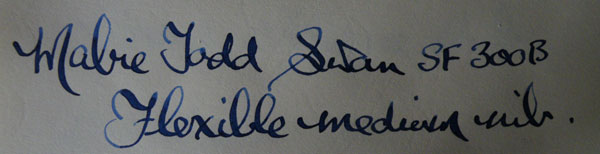
Mabie Todd Swan SF300B

Mabie Todd introduced the Swan SF300B in 1929. It was one of only two pens the company brought out that year, the other being a mottled hard rubber Blackbird, so it seems to have been an attempt to plug a hole in the market.


At 12.7cm capped it’s a short pen, especially by the standards of the day, but it’s longer than you would expect a vest pocket pen or a ring-top to be and, indeed, it’s fitted with one of Swan’s classic gold-filled stepped clips. It isn’t a chopped-off version of one of the larger pens either; its parts are all in proportion. Though it has a No 3 nib, being a short pen with no cap band, it was doubtless aimed at a spot a little lower down the price range than some of their more prestigious pens.

It appears not to have caught on, though. The following year the Swan Minor range was brought out, aimed squarely at the same section of buyers. Though not quite rare, the SF300B isn’t commonly found nowadays. Doubtless it had a short run.


The SF300B may not have appealed to the pen-buying public of 1929 but it appeals to me. This example I have is without fault except for a very slight fading of the hard rubber. The gold plating shows only a little wear at the ball end of the clip and the chased pattern is crisp. The No 3 nib is fully flexible and slightly stubbish – perfect for my writing style. I’ve had a couple of these pens before and both were flexible, so the chances are good that they all are. They don’t appear all that often but if one does, grab it. The SF300B is a real writer’s delight.