Last Check-In For A While

Well, it looks like I won’t be back online from home until 5th January.  I suppose it’s the holidays that are the cause, but that’s the date we have from BT so that’s the date I’m stuck with.  I’ve got lots of things to post about so please bear with me through the next few weeks of silence.  I will still try to check in every few days but I don’t want to wear out my welcome at my friend’s house, using his computer, so it may be sporadic.  As before, please be patient if you do send a query – I will answer it as soon as I can.

 Wishing good holidays to all, and a great 2012 once it arrives.  

Offline, Unwillingly

I find myself without an internet connection these days because TalkTalk are evil and must be stopped. But I think they will be stopped, seeing as how I am only one among thousands who are leaping away as far and fast as possible because they’re hopeless. Am writing from a friend’s computer but will not have much access to the internet due to impending gales which will certainly discourage me from wandering the streets of my village looking for anyone who will lend me a computer and some broadband.

So if you have sent a query or made a comment and I have not replied, please forgive! I simply can’t at this time. Hopefully within a week or ten days I’ll be back up and running… Wish me luck!

Watermans

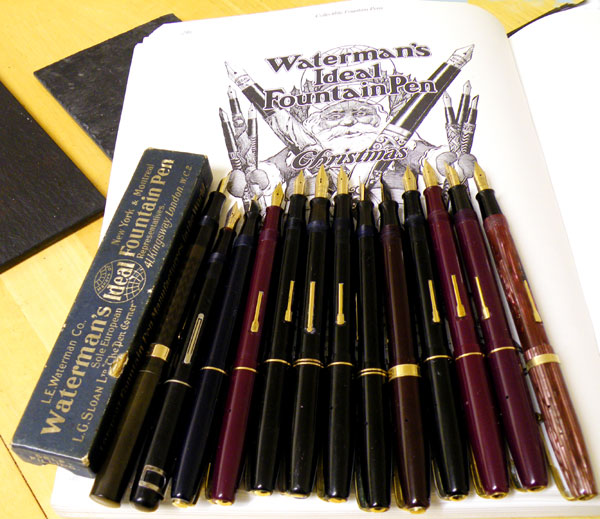
I buy a lot of Watermans. Mostly, they’re English and made in the late forties and early fifties. In this lot, the current accumulation of Watermans in my “restored” box, there’s a thirties Canadian Junior and a twenties American 52. All the rest are English and post-war.

Unrestored English Watermans, especially the less expensive models, don’t fetch much of a price. That’s understandable in a way. They’re quite undistinguished pens at first glance and the plating, especially on the clips, is often poor. Many people are reluctant to tackle repairing them as they have a deserved reputation for being difficult to disassemble. The part of the section that meets the barrel is usually ridged to provide extra grip and if that’s not enough, they’re also not infrequently glued with some mighty substance known only to Waterman. On the upside, it’s worth saying that dry heat and patience will eventually loosen them all and once that’s done they’re an extremely straightforward repair and they smarten up pretty well – plating loss aside. Waterman’s spoon feed was a great, efficient and much copied invention, which delivered ink in all but the most extreme circumstances, so even the older ones write very well. In the forties, with perhaps a sideways look at Sheaffer’s multi-finned feeds, Waterman developed much more complex feeds that do an immaculate job of ink delivery. If you have a Waterman from this period, provided it hasn’t been stamped on repeatedly, it won’t be too hard to get it to lay ink on the page.

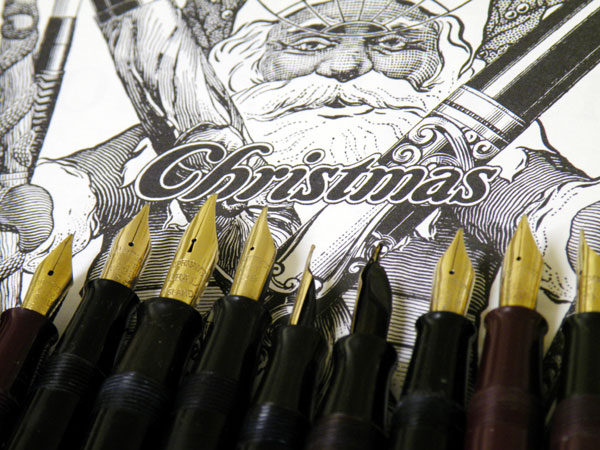
The other part intimately involved in laying the ink down is the nib, and the nibs are why I keep buying so many Watermans. Many have some degree of flexibility, quite a few are impressively flexible, and all write well, even the rock-hard ones. Even through the company’s worst times, Waterman always made superb nibs.

It’s certainly the case that the W5s and 515s have some pretensions to being prestige pens, but in truth these pens aren’t collector’s items, or not to any great degree. They’re pens for people who like to write, and as such they’re exactly the kind of pens I love to send back out into the world to be used again. Going on the number available today, they were hugely popular here in their time, and rightly so. They’re great pens.

Selsdon Again

I wrote about Selsdon Fountain Pens Ltd before, back here: http://wp.me/p17T6K-5K

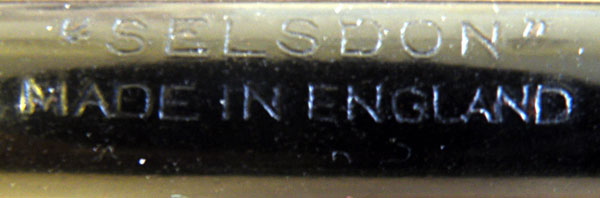
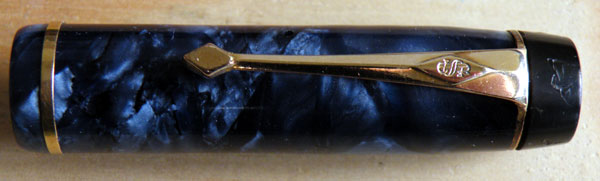
Another one came my way recently, again in the shape made familiar to us by the Eversharp Skyline, with the sharply tapered barrel and rounded cap top. This one’s slightly smaller than my previous example, and lighter too.  Unlike the Skyline, this pen posts well.

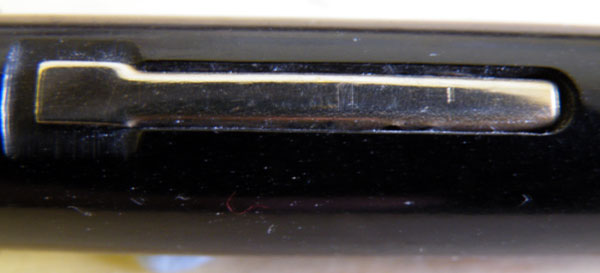
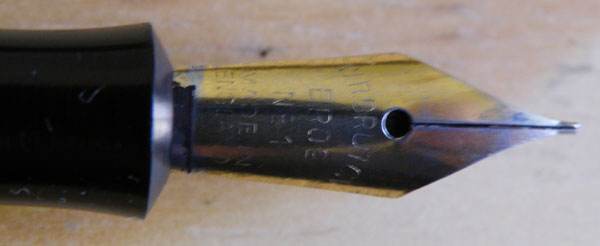
Otherwise it’s very much the same, with its very lightly gilded clip and Mystery Metal lever which maintains a shine forever. This one has a W. R. Bruton Bros nib. Bruton Bros Ltd were a West Midlands company which made very fine dip nibs back in the day and went on to make inexpensive fountain pens which are quite uncommon now. They also made plated, folded-tip fountain pen nibs which were installed by some makers of low-cost pens.

I commented before that the plastic in these pens seemed unusual, and I’ve since found out that Selsdon Pens dabbled in the creation of new plastics. After the collapse of the fountain pen company, Lesley Selsdon went on to create Selsdon Filtration and he is interviewed here:
http://www.eurekamagazine.co.uk/article/29312/60-second-interview-Lesley-Selsdon.aspx

These pens will never be prime collector’s pieces (though there are better models), and yet, it seems to me, they have considerable interest as one of the fascinating by-ways of British fountain pen history.

The Conway Stewart Universal 476 (Among Others!)

If you want to really mangle your head, spend a morning trying to make sense of Conway Stewart Universals. The one we all know and love is the 479, usually presented in black with some of the best engine-chasing on celluloid there is. Beyond that, though, there’s (at my last rather shaky count and in no order except how I found ’em) the 476, the 467, the 466, the 480, the 486, the 464, the 470, the 466M, the 470M, the 479M, and, in a whole other range of numbers, the 356. Phew!

They’re all in the lower to middle price range for a full size pen. Some have cap rings, some don’t. Some of these were earlier pens that died out by the end of the thirties but a confusing variety still remained. At that time they cost five shillings and sixpence or more, a substantial amount. I wonder if even the clued-up buyer ever had any idea of what the full Conway Stewart range on offer to him was. How did one decide between, say, a Universal 479, with its wide array of colours and a Universal 356, with a different selection of colours that were unique to that pen alone?

Well, what you did was bought a Universal 476 instead. At least that’s what one discerning buyer did somewhere between 1935 and 1938. Then he took it home, placed it carefully in a drawer and never disturbed it again, judging by the freshness of its condition today:

The gold plating is absolutely perfect and the barrel imprint is about the sharpest I’ve ever seen on an old pen. The only fault is a scratch or two on the clip screw, otherwise the pen’s as new.

This blue marble is a wonderful pattern. Jonathan Donahaye assigned names to the various patterns. They have no authority; they’re not what Conway Stewart called the patterns on the rare occasions that they called them anything at all. Nonetheless, Jonathan’s pattern names are perfect. He called this one Marbled Slate-Grey Blue and that’s what it is. Exactly.
Of Bulb Fillers And National Security

And by National Security I don’t mean police with sub-machine guns and big, watchful men at airports. I mean the wonderful pens sold by British Carbon Papers, about which I’ve written here: http://wp.me/p17T6K-6C. More on that anon.

You remember that thing about “it never rains but it pours?” Well, after lamenting that I’d only restored one bulb filler this year, I find myself in possession of two more. One’s a National Security and it’s already back in working order. That’s the one I’ll be discussing today. The other, a beautiful red and black hard rubber No-Name pen is clearly made by the same hands as the National Security, but it’s in rather worse condition and repair will take a little longer.

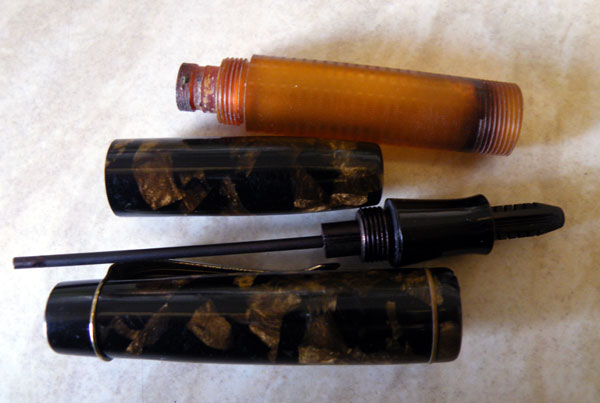
So here’s the National Security Vis-A-Tank after disassembly and cleaning. The amber barrel has come up well.

These extra channels in the feed connect up to the breather tube, and they help to create a highly efficient filling system.

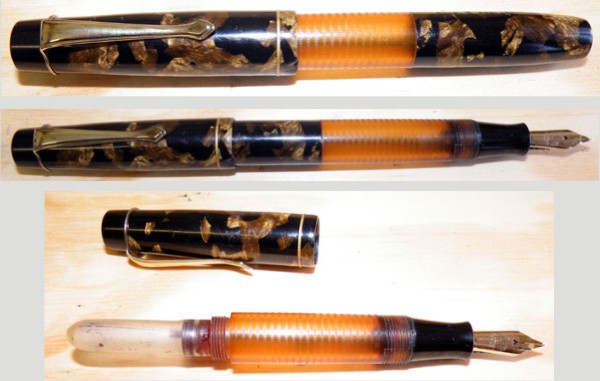
The repair was absolutely straightforward, and here’s the pen reassembled and ready to write. I love the subtlety of this very dark brown/black marble, which I think is unique to National Security pens. National Security produced the most astonishing range of pens, all the way from this slightly eccentric and very beautiful bulb filler to the most traditional pen imaginable:

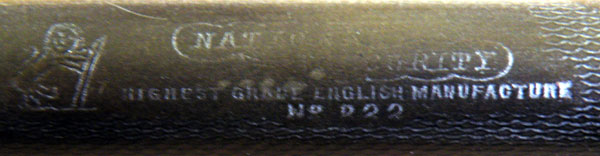
This black hard rubber lever filler is about as plain as a pen gets, but its saving grace lies in the imprint

which includes the National Security logo of the Lion & Pen, which they employed on their pens all too rarely. It’s quite worn here, and I’ve been unable to reproduce it in as detailed a form as I’d like, but take my word for it, he’s a charming, smiley lion. Quite unlike those scary men at the airport…

Mentmore Imperial


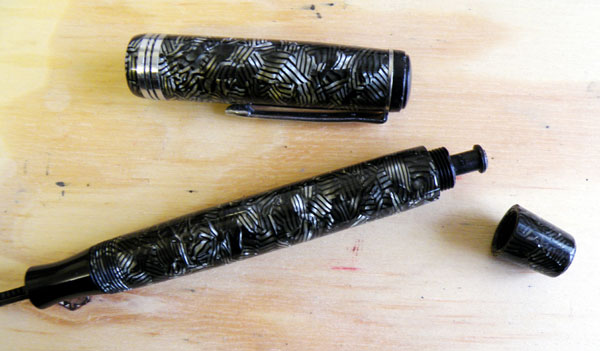
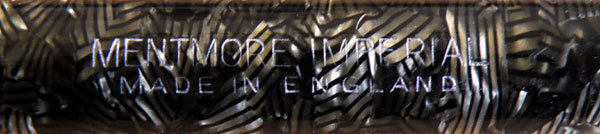
I’m guessing that this is a post-war pen. Though the beautiful hatched celluloid (which almost every company used) was around in the thirties, it became much more commonly employed after the war. The flat clip looks like an early fifties design to me, as do the closely set medium/narrow/medium cap rings.


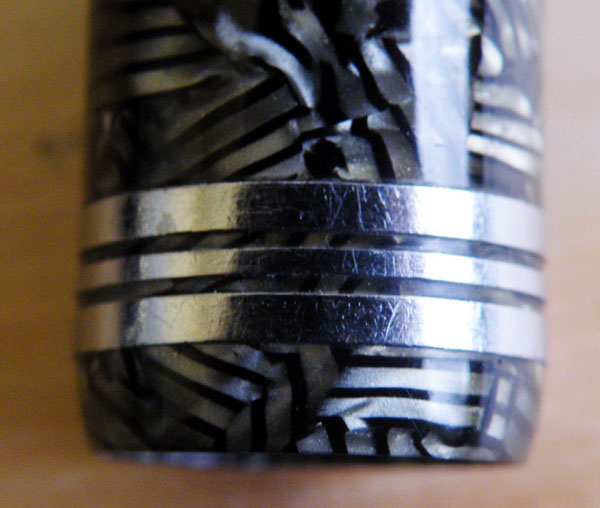
At first glance I took this to be the quite common arrangement of a single broad cap ring incised and painted to look like three, but no, this is the real thing, as the picture shows. The use of aluminium in the clip and (quite possibly) the cap rings seems like a late development for the company too.

Though they made many lever fillers and even a bulb filler (so I’m told) Mentmore excelled at making very efficient button fillers. The usual brass button has here been replaced by a screw-in plastic one which was novel enough when this pen was made to require a patent of its own, as is recorded in tiny embossed printing on the end of the button.

It is often the case that things become most dear to us when we’re on the point of losing them. If my dating is right, and this is an early fifties pen, the British Empire was well down the long slide to dissolution as emerging nations booted us out left, right and centre, but the company chose, perhaps defiantly, to call this “The Mentmore Imperial”.

Though Mentmore was soon about to be quietly allowed to die while Platignum took over, this pen shows no sign of the company’s imminent decline. The substitution of base metal for gold plating in the trim may well be an aesthetic decision rather than a cost-saving. The cap and barrel are machined from the rod, instead of being made from wrapped celluloid, a saving that many companies were making at this period. Everything fits together beautifully and the well-machined threads remain unworn today, even on the blind cap which gets used frequently. Mentmore were still making fine writing instruments at this point.

Boxed Crox 2

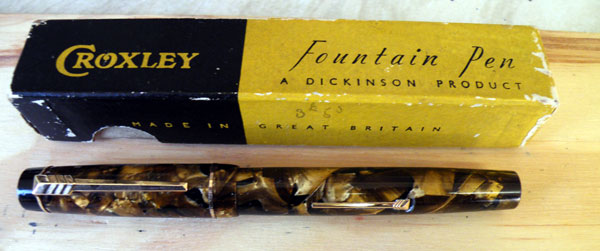
Sometimes it never rains but it pours – but in a good way. A few posts back I was complaining about most Croxleys being black (http://wp.me/p17T6K-dy) and here I find another, colourful, in excellent condition and complete with box.

I love this black/brown/gold/russet marbled mixture. It isn’t quite as bright as the gold/brown marble that Mentmore had around the same time (see here: http://wp.me/p17T6K-dQ) but it has great depth and glorious shades of colour. You could lose yourself in this pen.

According to the graffiti on the box, this pen first belonged to Kenneth Purnell, and judging by the writing, Kenneth was about eleven at the time. That was long ago, though, and if Kenneth is still with us, I would guess that he will be on the high side of sixty now.

The box contains the filling instructions and warranty. It’s advised to use Croxley ink. I didn’t know that there was such a thing, and I’d love to find a bottle of it. You are warned that fitting any parts other than Croxley ones to the pen will void the guarantee. Sadly, it doesn’t answer the question I still have: did Dickinson make those said parts – and indeed the whole pens – themselves, or were they supplied by a contractor? There are many pen mysteries that I feel sure will always remain unresolved, but I think I might find the answer to this one, one of these days.

A Well-Worn Conway Stewart 356

As you may be aware from my earlier ramblings, well-worn pens and pens that have personalisations and other engravings hold an especial fascination for me. They’re more interesting – though obviously less valuable – than the pristine New Old Stock examples that occasionally turn up. Though those worn pens don’t have a history we can recount, they’ve clearly seen a lot of use and haven’t spent the bulk of the twentieth century in the back of a drawer.

This black hard rubber Conway Stewart 356 has a wonderful soft shine from much handling. The 356 came out in 1932 and at three shillings and ninepence was probably the company’s cheapest full-size pen at the time. It was produced in some delightful colours but the company which bought this one settled for chased hard rubber.

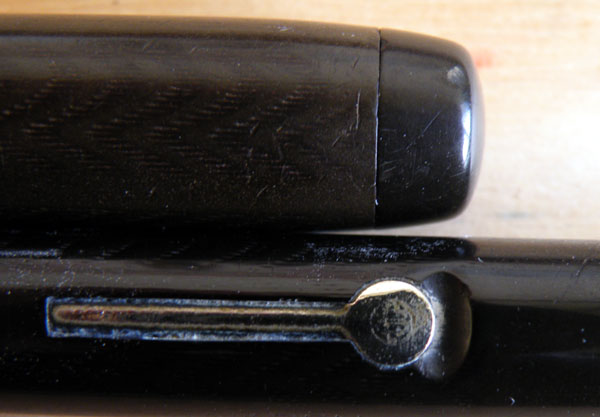
Judging by the tiny shield on the lever, this is one of the earliest ones. The chasing is shallower than it once was but it’s still there. The pen has no clip, and it doesn’t look like it ever had one – Conway Stewart made quite a feature of the “with or without clip” prices, and even of the fact that their clips could be easily removed.

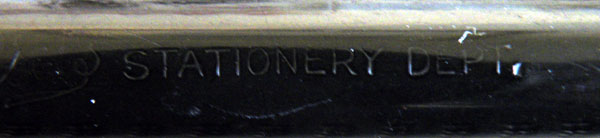
It’s clear that it was a company pen because the faint imprint “Stationery Dept.” can be seen in this enhanced photo (Thank you, Photoshop). I suppose it was available for everyone to fill out their stationery requisitions – a far cry from today’s attitudes, where it’s believed that lending your pen to someone else will irretrievably damage it. Of course, everyone knew how to write with a fountain pen back then, unlike today. Perhaps the clip was left off to make it less likely that someone would slip it into their pocket.

When it arrived on my bench it bore a modern plated nib. Worse still, when I opened it up, I found that the peg that the sac is attached to had been sawed off! I’m not sure why, or how the previous owner had thought the pen was going to work. Because the 356 is quite a slender pen with a concave section, it took quite a bit of hunting among the spares before I was able to return it to its original condition. But here it is, ready to write again. Perhaps it isn’t the most valuable pen I’ve worked on this week, but it’s a treasure all the same.

Price

I see the search terms that people use which lead them to this blog, and sometimes they become the subject of what I write that day. One thing that comes up time and again is a source of frustration to me because I can do nothing useful with it, and that’s the question of value for individual pens. Today there’s a search for the value of a Conway Stewart 55 and a Conway Stewart 27. Both of these are highly esteemed pens which sell quite well, whether in eBay or on retail sites. However, there are so many variables that affect value that it’s impossible to put a price on a pen without handling it. Even if I had the pen in my hand to examine, I could in all honesty only give a range of prices because it’s sadly true that so much depends on who is in the market on a given day.

Condition is of considerable importance. A pen that is in pristine condition is likely to be worth well more than twice the price that would be paid for a well-worn example. Black pens sell for less than patterned ones and some patterns will sell for many multiples of the price of others.

It might be, of course, that those entering the search terms merely want to know whether their CS27 and 55 are worth anything at all. The short answer to that is yes they are, they are both very good pens and in almost any condition short of broken, they will have a value. Of course we’re not talking in the large sums that are paid for the rare and opulent. More like £20-£30 unrestored and around three times that much in good working condition, bearing in mind all of the above provisos. Both of these were everyday working pens when they were made, but they were at the higher end of the quality that the company produced.

I realise how unsatisfactory a response this is to those daily queries, but unfortunately that’s about as good as I can do. There are, dare I say, restorers and repairers who will evaluate your pens for a fee. Try ten of them and you’ll get ten different answers, and I expect there will be a pretty wide spread between the lowest and highest estimates.

There are few things more slippery and harder to grasp than the price of an old pen.