The Homage, The Copy and The Fake

The history of the fountain pen is one of the transfer of ideas, whether as homage, copy or fake. For example, the Parker Duofold is probably the most-copied pen ever. Within a year or two of its appearance, almost every American pen maker, and many elsewhere, had produced a very Duofold-like pen. Homage? Hardly. That’s the excuse the copiers might give, and Parker might have felt mildly complimented by the fact that their flagship pen was so appreciated, but in reality those Duofold-alikes were made to invade the Duofold market. The fountain pen world was a dog-eat-dog one, and the ethics of the industry were always a little shaky. Actual theft of original technical ideas was intended to be prevented by patents, but such was the ingenuity of the industry that ways were quickly found to adapt new ideas sufficiently to avoid the provisions of patents. The industry was hair-trigger litigious, but even aggressive use of the courts couldn’t stop the spread of good ideas. Most of what was done – or had to be allowed to continue to be done, at least – was legal.

So it is that you find lesser (and sometimes not so much lesser!) pens that look like Patricians or Skylines or Parker 51s. If you were a pen manufacturer who believed that the Parker 51 was the way that pens were going to go in the future, you would be foolish not to emulate that style, while keeping clear of the specific patents that related to that pen. That’s not so different from what’s happening today in China, where they make all those pens that look suspiciously like Parker 45s, Sheaffer Triumphs or various Montblancs, but carry the Chinese manufacturer’s name and are therefore copies or homages, and not fakes. There’s nothing new in pendom. The Chinese are only doing today what American, British and Italian manufacturers did long ago.

True fakes are another matter, and are a modern phenomenon, only possible because some highly-regarded pens sell for many multiples of the cost of production. It is that huge margin that opens the door to the fake, or at least to the fake that will convince beyond the first glance. Tooling up to produce a fake costs little or no less than it would cost to make an original pen. Certainly, savings are made in using cheaper materials throughout, but the more convincing fakes have to be at least adequate pens in their own right. Selling those pens in huge numbers with a more slender margin is where the profit lies. The absence of any real warranty or after-sales service also keeps costs down, and as with fakes of other labelled goods, the amount of money that can be made ensures that they will always be with us.

I concentrate on pens made before 1960, for the most part, and fakes aren’t really a concern for me. Some older pens are faked, of course. Very ordinary older pens are covered with fake overlays, for instance, but these are a bit outside what I usually handle, and the collectors of these items are pretty perceptive. Those fakes are quickly identified whenever they appear. Among more ordinary pens, you won’t find fakes. In recent weeks, I’ve seen buyers of a Stephens Leverfill and a Swan Calligraph expressing concern that their purchases were not as they expected and might be fakes. They weren’t, of course. No-one’s going to tool up to fake £35.00, sixty or seventy-year-old everyday pens. There’s no money in it.

What can happen, though, is that inappropriate parts will be mated together to make a pen look like something other than what it is. Be on your guard against that, especially with 1920s Swans. Ask questions and if the answers don’t satisfy you, don’t buy. A clearly genuine example will be along soon!

It’s All About Efficiency – Or Is It?

Technological progress, one might say, moves from less efficient to more efficient. That would seem reasonable. I often think about this in regard to the history of the fountain pen. It seems to start well, but by the latter end it tends to fall away. Perhaps in the later years of the fountain pen the target was not so much efficiency as something else.

The eyedropper filler was certainly a step up from the dip pen, in that you only had to mess around with ink occasionally instead of constantly. It was still a decided hack, though. Unscrewing the section (can be messy), loading the pipette, filling the barrel, screwing the section back on, tapping or shaking the ink through, rinsing the pipette. It’s all a bit of a distraction. The various coin fillers, match fillers and especially the admirable crescent filler were a notable improvement. Plunger fillers and syringe fillers are convenient and clean too. The button filler, especially the larger ones like the bigger Duofolds, are exceptionally convenient to use – were it not for the possibility of losing the blind cap. Pens with a fixed button filler, like the Stephens stud filler, may be among the most convenient pens of all. In the main, the industry settled for the lever filler. It’s a good system, but it can be messy when the ink is low in the bottle, and some of those levers seemed designed to do injury to the thumb. Later pens, like the Parker Aerometric fillers, seem like a cop-out from the struggle towards greater technological efficiency. Unscrewing the whole barrel to operate a squeeze filler works well enough, but it’s not elegant. I suspect that the unbroken line of the barrel trumped efficiency of use here.

Finally, we have the cartridge filler. Frankly, it has little to recommend it. You unscrew the barrel, remove the old cartridge (distinct risk of ick at this point), push another cartridge in, put the barrel back on and tap or shake the ink through. It’s not a self-contained system. We’re three-quarters of the way back to the eyedropper filler! The cartridge filler, it seems to me, is the means whereby very small quantities of ink can be sold at a premium to the gullible.

For myself, I love the elegance of Stephens’s clever button filler, but the pen that keeps returning to my desk is my old Conklin Crescent filler. It’s simple, intuitive, efficient and it has the technology on the outside, like a Richard Rogers building. That’s style!

The Mabie Todd Swan 3230

Grey is an unfortunate colour for fountain pens. It discolours, almost always. The pre-war celluloid grey/black marbles didn’t show the yellowing quite so much, and even when it did, the marbling reduced the unpleasantness of the effect. In the post-war period there was a fashion for self-coloured pens. Quite a few manufacturers, including Mabie Todd, Parker and Wyvern had self-coloured model ranges in the late forties and early fifties. All included grey as one of their colours, and all dropped it quite quickly and reduced the range to the burgundies, blues, greens and blacks that retained their original colours. Small wonder, because the self-coloured greys invariably discoloured, often very badly.

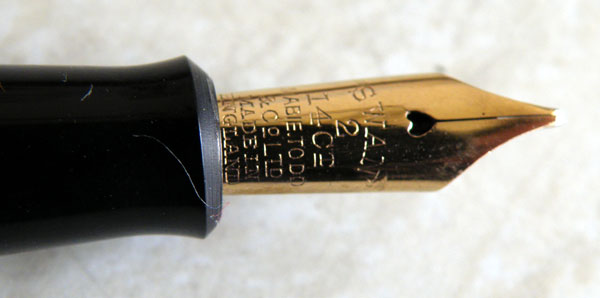
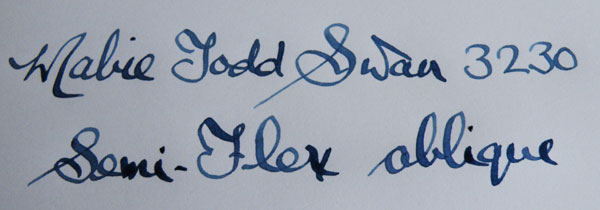
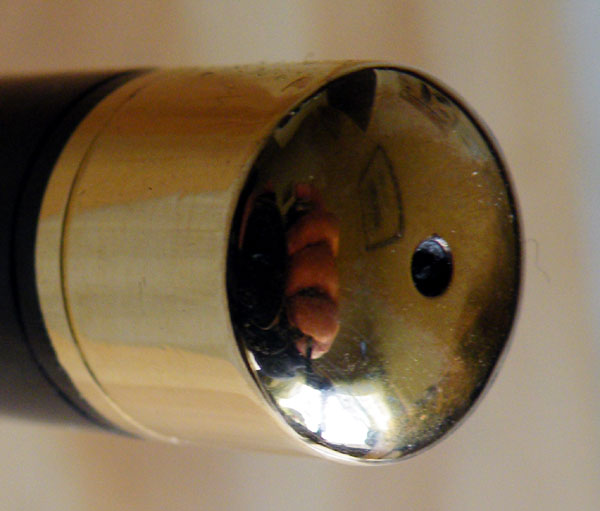
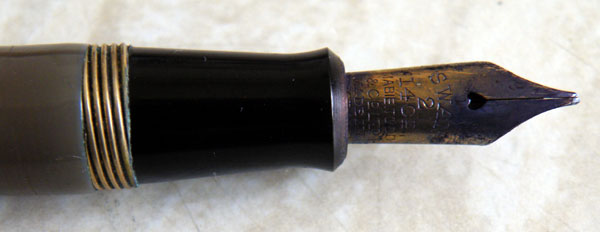
This is a Swan 3230, made between 1947 and 1950. Mabie Todd was still a maker of very high quality pens in this period, though I think the gold plating on these pens is thinner than it would have been fifteen or twenty years earlier, and there has been some plating loss on this example. It’s a well-made pen, though, comfortable and well-balanced in the hand – a real writer’s pen. The stubbish nib is a medium oblique. The pen is, of course, discoloured, with an obvious difference between the cap and the barrel. It’s by no means the worst I’ve seen – these pens can become a hideous muddy yellow.

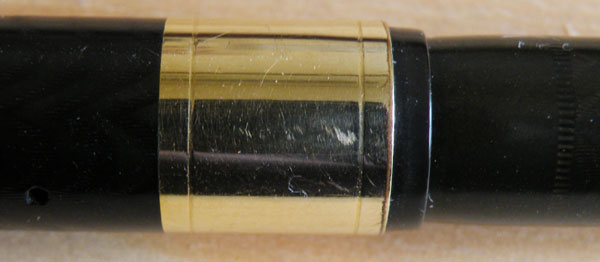
Though it confers no obvious benefit, Mabie Todd went to the added expense of threading the sections of these pens, rather than making them a press fit. The brass threads and the two cap rings place this pen in the middle of the price range. As always with Swans, it’s an easy repair and it’s the work of a matter of minutes to return the pen to working condition. I pop in a silicon sac to prevent further discolouration. When tested, the nib is decidedly flexible. It’s a real pleasure to write with.

Like black pens, grey pens are often cannibalised to provide spares for more colourful pens that will sell for a higher price. That’s something I try to avoid. True, if a pen is extremely discoloured to the point where it looks repulsive, I’ll strip it for spares but otherwise I’ll repair it. After all, they’re not making any more 60-year-old Swans, and these pens are splendid writers. I’m not in the business of reducing the numbers available. Yes, it may sell for rather less than a more a colourful one but I didn’t pay much for it and it didn’t take a lot of my time to put it right. It’s not going to have collectors fighting over it, but someone who wants a thoroughly excellent writer and doesn’t care too much about its appearance will treasure this pen.

Fountain Pen Books – Dragoni & Fichera (Eds): Fountain Pens History And Design

This book has received a bad press within the hobby. I can’t argue with its detractors; there are egregious errors of pen identification and the information given about some pens is wrong. Also, the text from one page to another doesn’t follow on in a couple of instances, which I assume is a layout issue.

Nonetheless, I like this book. It takes a more discursive form than other fountain pen books. It stands back from the minutiae of the subject and comes to conclusions of its own. It’s profusely and beautifully illustrated, with many examples of pens in art that you won’t see elsewhere. Lots of advertising posters are illustrated too, though sadly few of them are dated. Still, it’s good to see them and quite a few are unique to this book.

There are, I think, around a hundred pages of individual pens from the beginning to the present day. The selection is eccentric and the information unreliable in this section, making it useless as a reference. The illustrations here, as elsewhere, are excellent.

I don’t regard this book as an essential for the pen enthusiast, but it is entertaining and may give the reader pause for thought. Priced at £29.40 new, it isn’t worth the money, but it often appears second-hand for very much less. If you get it cheap enough, I think you may well enjoy it, despite all its faults.

The Pen Conundrum

Paradoxically, though fountain pens feature large in my life nowadays, I rarely have an occasion to write with them. I restore fountain pens, sell them, write about them, talk about them, advise on them, but I hardly ever apply one to paper except for testing.

In reality, of course, few of us hand-write much at all these days. When I entered the world of work, there were armies of clerks charting production, commerce and finance by filling ledgers with advancing columns of figures. Since the late seventies, the hosts of pen-pushers have been replaced by a radically smaller number of keyboard jockeys. Even in those days, though, it wasn’t fountain pens the clerks used (I’m not quite that old); it was the ubiquitous Bic ballpoint. The hand-written business letter disappeared long ago, and social correspondence is conducted by email. This is not a complaint, by the way, or a yearning for the good old days that never were. It’s a huge and unalloyed benefit that people’s lives are no longer deadened by the crushing boredom of being a progress clerk or a commercial assistant, condemned to spending days shuffling figures from one ledger to another. That’s what computers are for; tedium doesn’t poison their lives. Email’s a lot quicker and more reliable than airmail, too.

I was rather lucky. In quite recent years, I had use for fountain pens at work. In one job, the use of a fountain pen with indelible ink was actually statutory, so that a permanent and unalterable holograph record was created. That function disappeared around 2003 when the powers-that-be concluded that the Portable Document Format file was equally secure and moved the work onto computer. Our £20.00 pens were replaced with £500.00 PCs in the interest of cost saving. You and I might be aware of how trivially simple it is to hack even a signed .pdf file, but my superiors and betters closed their minds to this possibility and progress marched inexorably on.

In a later job, I had colleagues and superiors who were tempted to edit my decisions and reports in pursuit of their own agenda, so I left my laptop closed and reverted to my fountain pen. It may not be impossible, but it’s well-nigh insuperably difficult to alter a handwritten script produced with a very flexible stub Onoto that leaves a line almost as individual and characteristic as a fingerprint.

Now that I restore pens for a living, I have neither time nor opportunity to write much. On the pad by my keyboard rests a Pentel Liquid Gel pen to scribble the odd note I might have to take. My correspondence is done in OpenOffice Writer and my accounts in Excel. All these wonderful old pens pass through my hands and once I’ve established that they write as they should, they’re flushed out and laid aside.

There’s something not right about that…

A Mabie Todd Swan SF2

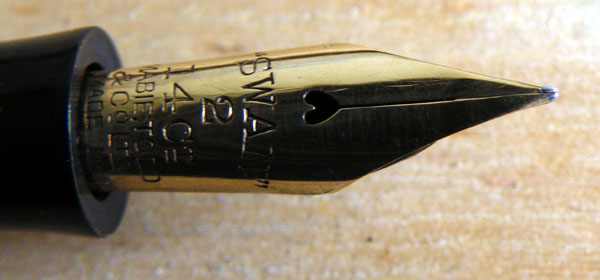
When was the first English Swan lever filler made? Authorities vary in their opinion; some give 1916, others say the first self-filler did not appear here until 1921. On grounds of style, I would favour the earlier date but I have no way of being certain. Technically, the SF1 and SF2 pens are very modern, and already bear many of the attributes that remained recognisably Swan throughout the brand’s existence: the long-tined nib with the heart-shaped breather hole, the ladder feed, the long, slender lever with a rounded end, the high quality of manufacture and the attention to detail. They differ from later models in style, in the number of turns needed to secure the cap (a full two and a half!) and in being clipless, though some later SF1s and SF2s had fixed clips.

To my mind, the SF1 is a little too slender for comfortable use in a modern hand, and it’s also a little fragile to repair. The SF2, though, is a large, robust pen at 14.4cm capped and a long 18.5cm posted. It’s as practical a daily writer as any more modern pen. Aimed to suit all pockets, the SF2 came in various guises, from the unadorned black chased or mottled hard rubber to those with gold-plated barrel bands, cap bands and even solid gold overlay. This one has a plated cap band and a plated cover over the end of the cap, a configuration I haven’t seen before. The plating is good quality and shows very little wear. Despite the metal on the cap and its great length, the pen is not overbalanced and it sits very well in the hand.

Though clearly well-used, the pen is in excellent condition. There’s very slight fading of the black chased hard rubber and there’s a little wear of the scalloped chasing on the barrel, though the pattern remains clear. The cap and barrel imprints are sharp.

The imprint at the end of the barrel reads “2S-F MED, denoting a No2 medium nib in a self-filler pen. By modern standards, the nib is at the fine end of medium. A delightful writer, it has a little understated flexibility, just enough to show some line variation.

Like its immediate predecessor, the Safety Screw Cap Swan, the SF2 has proved a durable pen and survives in great numbers. As a superb writer with the full range of nib styles, it is much in demand, and the variations in trim make it very collectible.

The Staff

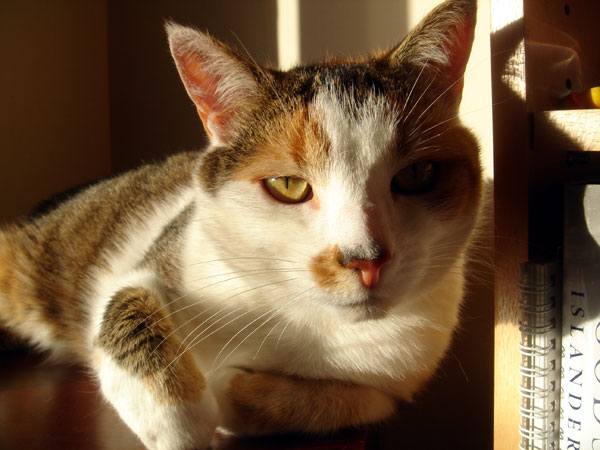
This is my assistant, Smartpants.  Miss Pants mostly looks after the paperwork. She’ll chase a crumpled up tax form for about quarter of an hour.  Additionally, she helps by poking pen parts behind things so that I can’t find them.

Good help is hard to find these days so I’ll just have to persevere with Smartpants.

Fountain Pen Books – Marshall & Oldfield: Pen Repair

People quite often say to me that they would never attempt pen repair because they fear they would break a valuable pen. Fair enough. Pen repair’s not for everyone, but in truth, fountain pens – all fountain pens – are low-tech and routine repair of the simpler types should be within the reach of us all. That said, it’s important to know before you begin what difficulties you might face, what tools and spares you will need and what method of working is most likely to ensure success.

That’s where this book comes in. Marshall and Oldfield’s Pen Repair will give you all that and a lot more. In the opening general section, all the parts of a pen are discussed, potential problems are listed and repairs are explained. The second part covers the various pen brands and models, giving methods of repair for each type. The final section deals with the more advanced repairs like replacing cap bands and cutting threads. Everything is carefully explained and well illustrated with photographs and drawings. The tools you will need are listed and discussed and there’s quite a bit of pen history here as well.

Numerous pen repairers’ and manufacturers’ service manuals are listed in the bibliography, so this book is the distillation of the work of many skilled professionals. It builds on the work of Arthur Twydle and Frank Dubiel, and surpasses the latter’s work with all the additional knowledge and techniques that have accrued since that was published.

The book is spiral-backed, which makes it easy to keep it open at the page you want on your workbench. It’s now in a second edition with additional information and costs £30.00 plus postage. If you repair two lever-fillers that you would otherwise have sent away, the book will have more than paid for itself. Even if you never repair a pen, the additional understanding of fountain pens that you will gain from this book will greatly increase your enjoyment of them. It’s a must for the bookshelf, and probably the most important fountain pen book to have been published in twenty years.

It’s out of stock at Amazon for the moment, but various fountain pen retail sites have copies. A Google search will quickly find you one.

The Conway Stewart Dinkie

For more than forty years, tiny pens were extremely popular in Britain. Though several companies produced their own versions, by far the best known is the Conway Stewart Dinkie. It was introduced in 1922 or 1923, depending on who you read, and the first examples were advertised as men’s waistcoat pocket pens, but they soon became the favourite ladies’ pen, whether in purse form with no clip, the chatelaine type with a ring or as a standard pen with a pocket clip. Many of the earliest ones were in hard rubber but they soon became a showcase for the new material, casein, and appeared in an almost limitless range of wonderful colours and patterns. Later, in the post-war period, the 550 range Dinkies became miniature versions of the company’s standard pens, with the same shapes and patterns.

Though they were advertised as “the smallest practical fountain pen ever made”, I, for one, don’t find them practical. Though I have small hands, Dinkies are too small for me to write with for an extended period. What they are, though, is the collector’s pen par excellence. Such is the range of models and the variety of colours and patterns within each model that one could build a very large collection of Dinkies alone. Many of the pre-war models are rare or uncommon and fetch high prices.

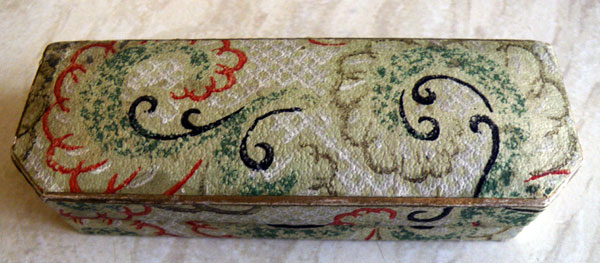
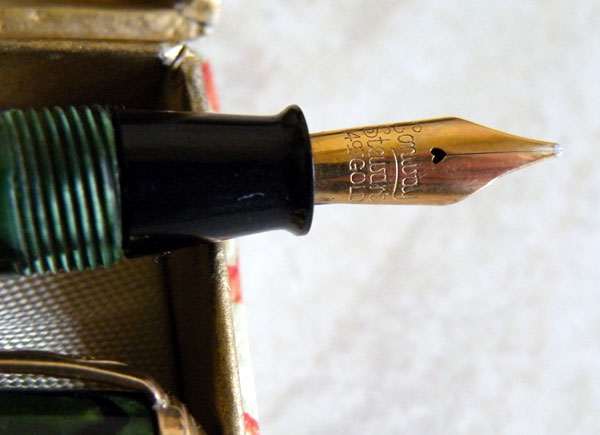
The post-war 550 is very common and doesn’t fetch especially high prices. They’re beautifully made, jewel-like objects, and the sets are well-presented in attractive boxes.  Popular as birthday and Christmas gifts, the sets often remained unused and frequently appear in first-class condition today.

This example is in what Jonathan Donahaye described as a “wallpaper pattern”.

The pen and pencil are in the “marbled green/black veins” pattern which was issued quite late in the 550 series. The gold plating is immaculate and I suspect that the pen and pencil have hardly ever been out of the box. The tiny nib is an example of the jeweller’s craft and the pen writes with some flexibility.

The Conklin Endura Symetrik

Though I mostly write about British pens, imports can be interesting too. German pens, for instance, fluctuated greatly in popularity. Their quality was admired but there were periods when it would have been seen as unpatriotic to use a German pen. I’ve had an inexpensive glass-nibbed piston filler German pen that had the maker’s name roughly scratched out, doubtless for this reason.

Throughout most of the period when pens were the main writing tool, there was no market here for French or Italian pens. They turn up, but are not at all common. In the fifties and sixties, as demand for fountain pens plummeted, cheap, poor quality fountain pens from Italy flooded the market.

American pens were popular. Parker, Waterman and to a slightly lesser extent, Sheaffer all had a big presence. Pens like the Duofold and the Waterman 52 sold in huge numbers. Wahl Eversharps sold quite well too, and Conklins were much appreciated in the crescent-filler days. Thereafter, Conklins were pretty thin on the ground in Britain. Perhaps there was no importing agency later, or maybe the pens were no longer sufficiently different from the home-grown brands, but it’s always interesting when one does turn up.

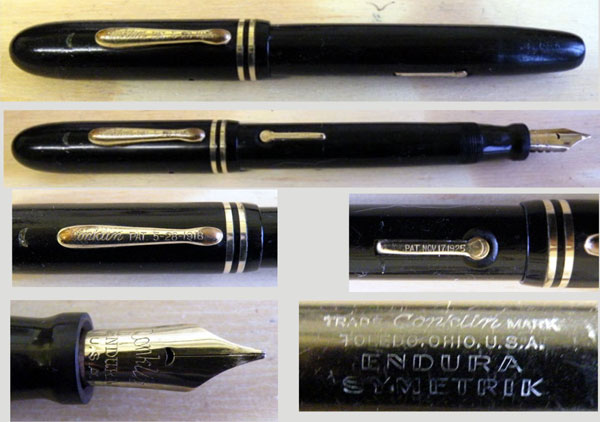
This is an Endura Symetrik, made from 1931 until the company was taken over in 1938, and it’s therefore among the last of the high-quality Conklins. Both well designed and well made, the Symetrik is unexceptional at first glance but has subtle features that are unique. The patented clip is spring-loaded and the short lever is attractive. The Endura nib differs from the Toledo in my old crescent-filler in that it is no super-flex, but it’s not a nail either. There’s a little line variation there, just enough to make it pleasurable to use.

This example is basically sound but it has had a hard life. Though the cap rings and the lever are holding up well, the plating on the clip is showing signs of wear. When I got it, the pen was incredibly dirty, as if it had been dipped in something sticky and left to gather dust. It looked like it had been dropped nib-first on a concrete floor, and straightening the nib was a challenge. There are nibbles, particularly on the end of the barrel, but actually all over. I think it had ended its early life as a kid’s pen, poor thing!