English Duofolds

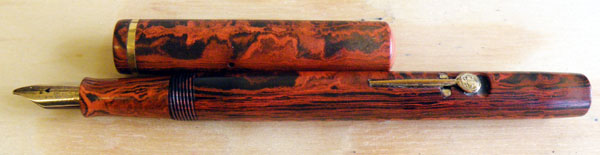
A few years ago, if you wanted an English Parker Duofold in good condition and working order you would have had to pay quite a bit. Not now. The market for these high quality pens seems to have fallen away. The Maxima and New Style models still sell well, but even the Seniors have dropped in price and you can have the standard Aluminium Filler or Aerometric Duofold for very little. If you ever fancied one, now’s the time!

I don’t know why this has happened. Maybe everyone who wanted an English Duofold has one now. Still, it’s strange. The build quality of these pens in unbeatable, they still look good because they were made from tough materials, the style is timeless and they’re great writers if you like a firm nib and a consistent line.

This isn’t a sales pitch, by the way. I more or less gave up on English Duofolds a few months ago, as it became hardly worth my while to restore them. I still sell the odd one, but these are ones I’ve picked up as part of a lot. You won’t see many in my listings.

Conway Stewart Associated Pens

Part of the genius of Conway Stewart was hitting the right niche in the market. Soundly made and instantly recognisable but comparatively inexpensive, the pens had an air of worth and respectability that recommended them to other companies and associations wishing to advertise themselves. Conway Stewart sold thousands of pens in this way. Many associated pens are listed in the late Jonathan Donahaye’s excellent web site:

http://www.ftic.info/Donahaye/ConwayStewart/csbook/page1.htm

and other previously unlisted ones are frequently discovered. Mostly (though not always) the pens chosen for this purpose were from the lower end of the range, often 475s or 479s. Such a pen is this one, apparently a give-away for Bennett College in Sheffield:

Though the name “Conway Stewart” is not imprinted on the barrel, the intertwined “CS” initials are stamped on the shoulder of the clip and the nib is a Conway Stewart one.

For several decades, Conway Stewart pens were produced for the Boy Scout Association. Given Baden-Powell’s Imperialist vision, it’s perhaps fitting that this is The Empire Pen! The first Empire pen I got, many years ago, before such good reference materials were available, was a black pen with chasing. The barrel imprint was “The Empire Pen 411” and where the Conway Stewart logo would normally be on the clip, there was a fleur-de-lys, the emblem of the Scouting Movement. The nib was warranted. Nonetheless, every inch of that pen insisted “Conway Stewart” and so it turned out to be.

I bought another one recently, an older Empire Pen, probably from the early thirties, bearing the number 46. Sadly, the inserted clip was missing and, even worse, there’s a hairline crack in the cap lip. The pen is unsaleable but I’m not too disappointed. I’m happy to keep this one as a daily user. I’m fond of mottled hard rubber Conway Stewarts, especially the ones with the flange lever. As a bonus, this one has a broad flexible oblique nib. That’ll do for me!

Less Common British Pens: The Savoy

The Savoy pen remains a mystery to me – not that that’s a bad thing! It’s something to puzzle over in the hope that one day all will become clear.

They’re by no means common pens, but they happen along now and again. Most of those I’d seen, and all of those I’ve had until recently, were black celluloid pens with engine-chasing, very like Stephens, and often with a slightly crude-looking stepped clip. Due to the resemblance, I assumed that they came from the same manufacturer, namely, Langs.

Now, however, I hear that it is asserted (on what basis I know not) that Savoy was a sort of off-brand of De La Rue, created in the nineteen-thirties as a test-bed for new celluloid patterns. It’s true that some Savoys are in really nice colours, but not, so far as I have seen, ones that are so unusual that the manufacturer would want to keep at arm’s length from them by creating a new company to test the market. It would seem to be a way of ensuring that not many pens were sold. Also, the parent company wouldn’t gain the credit should one of these new patterns prove popular. And how does that explain the fact that most Savoys are black? I don’t say they couldn’t have been made by De La Rue but I remain unconvinced. They don’t look like De La Rue pens, but that’s not conclusive.

I also hear that Savoys might have been made by Valentine at Newhaven, in the pre-Parker days. That’s perfectly possible. Valentine made pens for many companies, and they had no real “house-style” of their own. The fact that Savoys don’t look like Valentines doesn’t matter. They would make any pen you wanted. The point is, though, that Valentine’s sub-contracting was for other pen companies, like Unique, for instance. If they made Savoys, who did they make them for? Was Savoy a stand-alone company? Was it a sub-brand of Valentine or De La Rue? What’s the story ? Enquiring minds wish to know.

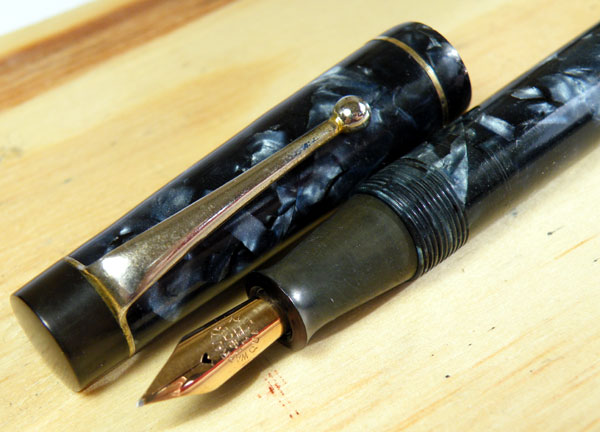
Anyway, those Savoys that have passed through my hands have been well-made pens, usually with warranted 14ct nibs. As a brand, they have captured my interest. This is the only colourful one I’ve had:

Not one of the more exotic patterns, but an elegant large flat-top in a good conventional blue marble.

Mabie Todd Swan SF1

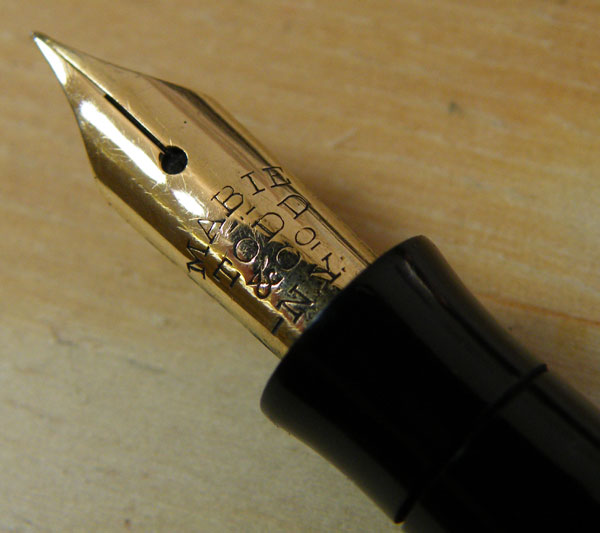
It’s hard to get a certain date for the introduction of Swan’s SF1. I’ve seen 1917 quoted and that’s possible. It’s obviously early because many examples come with New York nibs, so it pre-dates the establishment of Mabie Todd’s nib works in Britain.

Perhaps a little slender for modern tastes, in every other respect it’s a delightful pen. Though the illustrated example was a firm needlepoint, most SF1 nibs are flexible. Some are very flexible indeed. Posted, it’s a long pen with good balance. It comes as a plain black hard rubber pen, but also in mottled hard rubber and with a variety of gold trims. All in all, it’s one of the best and most practical of early lever fillers.

From my point of view, however, the SF1 has a down-side. It’s the only Mabie Todd pen I don’t like to work on. The tolerances on this pen are often very tight indeed, and it’s not difficult for the repairer to break one. The section fits into the barrel very snugly, and it requires a lot of heat and patience to get the section out. Putting it back in after the sac has been replaced is even worse, and it’s at this point that the dreadful “snap!” that can really spoil your day can be heard. It’s not that the pen barrel is especially fragile – it’s fairly robust, in fact, but the fit is unforgivingly tight. I’ve once or twice been tempted to plane the section down, but then I’d have to shellac it in, and it wouldn’t really be the same pen.

That’s the SF1 – a pleasure to use, a pain to repair!

Ink Flow And The Unanswerable Question

Occasionally, looking at one of my listings, an eBay member will ask, “How wet is this pen?” That’s an impossible question to answer well, for a couple of reasons. One is that, simply, there are no adequate standards of comparison. I can’t say, “It’s as wet as a…… “ or “It’s as dry as a……” because there are no recognised standards of wetness in the pen world. Nor is there ever likely to be. I can refer him or her to my writing sample but he or she has already seen that. The result is that we both end up a little frustrated, due to the impossibility of conveying the information.

Secondly, in a sense, it’s the wrong question. No pen is (barring a fault) intrinsically either dry or a gusher. Ink flow is a setting. Particularly with traditional pens with a simple feed like the Mabie Todd ladder feed or the Waterman spoon feed, there are a number of ways to adjust flow. As part of testing and adjusting a pen, I set the flow to provide an unbroken line in which the ink shows its natural colour, in other words, not paler than usual, which would indicate that the flow is too dry. The line should not be raised, nor should it spread or feather on my testing paper. If it meets those tests, the flow is right for the pen, allowing for whichever nib size it – fine, medium or broad.

Those pens that have more complicated feeds, like the Sheaffer multi-finned feed, the Parker 51 collector or the complex feeds that Waterman made in the late forties, can also have flow adjustments made but – again barring faults – it’s rarely required. Those feeds were designed to deliver exactly the amount of ink the nib needs, and they do it very well.

Any pen that flexes, whether semi-flex or super-flex, makes special demands on flow. If it’s set to deliver the correct amount of ink in an unflexed state, it may rapidly run dry when the much greater demands of flexing are applied. Conversely, if it’s set to handle maximum flex, it will be too wet in an unflexed state. I try for the best compromise. It usually works, provided the user slows for the flexed lines and allows the flow to keep up.

After the pens are restored, I test them, but only for about half a page or so. That’s enough to use up the residual ink in the feed and test the actual flow. All being well, I flush the pen, give it a final wipe clean and I’m done. Flow’s a funny thing, though, and if you buy a pen from me and find that after a few pages of writing the flow is clearly wrong, either gushing or not giving an unbroken line, I’ll take the pen back and put it right at no expense to you. I’ll pay postage both ways, as I would with any fault that’s my responsibility. If, on the other hand, the pen that you bought from me writes properly, but you would like the flow increased or decreased, send it back to me and I’ll alter it to suit you, but you pay the postage in that case. The adjustment, however, is free.

One final thing. Don’t perform surgery on a feed. The well-known pen makers knew what they were doing when they made those feeds. They had infinitely more experience than any of us can ever have. Gouging deeper channels is not the way to increase flow.

Pen Photography

I’ve taken photographs for many years but I’m no more than averagely competent. That’s not false modesty; I only have to look at some other people’s photographs, whether of pens or landscapes, and I can see how much better they are. That doesn’t matter a great deal. I don’t need studio-quality pen photographs. I need ones that show the pen and its condition clearly to illustrate my descriptions and I can manage that.

When I started taking pen photos, I discovered that neither of the cameras I had were really suitable for the type of close work I wanted to do. After asking around and checking out what was available, I settled on a Fujifilm Finepix S8100.

It has a good lens, a two-level macro capability, it takes an SDHC card and it’s light and easy to use. After 18 months of use it has fulfilled my requirements very well. I photograph between fifteen and twenty pens every week. That’s at least 90 photos. It takes a while and it’s surprisingly tiring. For the sake of speed I dispense with a tripod, which means returning to the same shooting position and holding still, time after time. Gets a little wearing by the end of the session…

Light is the most important thing. Wherever possible I use natural daylight, but in winter in the north of Scotland that’s not always easy. The sun is low in the sky, and the light’s either low-level or beating straight in the window, creating deep shadows, so I diffuse it as much as possible and fill in with white lights. I have a light box, and I do use that method on occasion, but it slows things down a lot. It’s not a practical solution for me.

Despite these restrictions, it works quite well, due to the forgiving nature of the camera and its light-gathering capability. If I can show a barrel imprint, the condition of the nib, plating loss on the clip or a scratch on the barrel, that will do for me.

Editing – cropping, resizing, colour correction – gets done in PhotoShop. PhotoShop’s overkill really. I could do what I need to in a less expensive – or even free – photo editor, but I’ve used the program for a long time and I have a routine that speeds the work along.

Though I do get quite a bit of satisfaction from seeing useful photos at the end of it all, I must admit that photographing and photo-editing the pens is more a chore than a pleasure. I’d much rather be restoring!

Osmiroid

The humble Osmiroid has a much longer ancestry than most fountain pens. It was made by EH Perry in the factory at Gosport. The company had been founded in 1918 by Edmund Perry, grandson of James Perry, a major figure in the development of practical steel nibs. Perry’s first steel nib patent dated back to 1830 and the company’s Iridinoid and Duragold nibs were a success for many decades.

The idea behind the Osmiroid, perhaps not surprisingly, was much more about nibs than pens. Steel nibs in a variety of calligraphic styles were united with screw-in feeds. Oblique (left and right) italic, copperplate, music nibs and many more were available individually. Quality of the nibs was very high. The intention was to provide school-children with excellent writing instruments at an affordable price. Calligraphers benefitted too!

The first pen, the Osmiroid 65, was almost an afterthought. A very basic lever filler, it was adequate for the purpose, though some of the colour mixtures it came in were unfortunate. Many of the 65s have not survived well. The early injection-moulded plastics used in their manufacture were subject to shrinkage over time, with the result that caps often no longer fit and other distortions have taken place. Not all are affected, but buy with care.

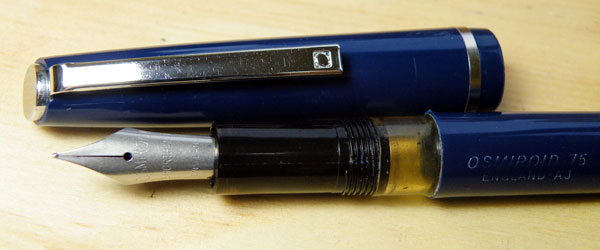
The next pen, the Osmiroid 75, was altogether better. Much less subject to deterioration (though it can happen) these self-coloured pens are excellent piston fillers, many still working today without any servicing. Together with a collection of nibs to suit your hand, the 75 remains one of the best calligraphy pens around.

The Osmiroid 75

Later, a different Osmiroid system was developed. The new units included nib, feed and section, which screwed into a cartridge pen. These are not interchangeable with the earlier nibs, and the quality is not so high.

Thankfully, the original Osmiroid nibs still appear on eBay quite frequently and some retailers still sell them. These nibs also fit Esterbrook J and SJ pens , and some post-war German piston-filler school pens.

Not a collector’s pen, the Osmiroid project was nonetheless a worthy one that gave a generation of children good pens with which to learn to write well, and remains a useful workhorse for calligraphers to this day.

Nibs: Does Size Matter?

In one sense it does. A big Swan No 6 nib is a glorious sight, but that’s purely aesthetic appreciation. It doesn’t really do anything more or better than a smaller nib.

In the case of a rigid nib, that expanse of gold between the tipping material and the section doesn’t really do very much. It provides an anchor point for the tipping, it covers the feed and aids capillary action. You might as well make a short, slender tube to enclose the business end of the feed and apply hardened tipping material to that. Wait a minute! Did I just reinvent the Parker 51 nib?

With a flexible nib, the metal does a bit more. It’s the springiness of the tines that enables the line variation. Again, though, large size isn’t really an advantage. One of the flexiest nibs I ever had was a Wyvern, one of the tiny ones the company was infamous for in the early fifties. The little thing would safely flex to a fishtail shape – four or five times its original width which was fine – and snap back instantly. I’ve had other, larger nibs that were as good, but none that was better.

I’d say nib size doesn’t matter except as eye-candy.

But eye-candy’s important too.

Stephens Pens

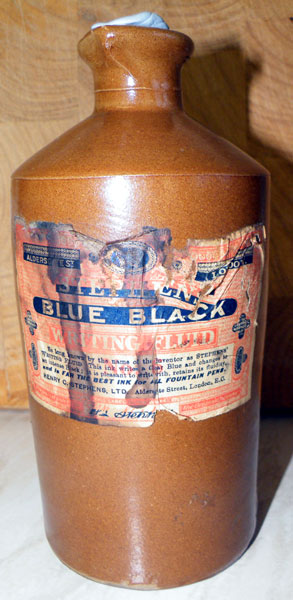
How old would you say that stoneware ink bottle is? I can’t say, though I do know that they were in use from around 1860, and might have continued to be made as late as 1950. What I can tell you is that there is blue/black ink in there that’s still perfectly usable! Though the label is damaged it can be seen that this ink was made by Stephens, and I would guess that it was probably a school ink bottle. They’re moderately common.

Stephens made ink from the middle of the nineteenth century and they were by far the most successful ink manufacturer, being seen as the automatic choice for schools, government offices and many businesses. They had their competitors, some very good, like Diamine, which is still around, Colliers and Watsons, both long gone.

It was not until the 1930s that Stephens put their name to a fountain pen. I believe all Stephens pens were manufactured by Langs, who also made the Summit and Savoy pens, and there is a strong resemblance between all of these pens, with their traditional lines, machined patterns and good quality build. Best known is the Leverfill range, issued with different levels of trim to suit different pockets. Most seen today are in black celluloid with an engine turned pattern, but marble-patterned examples in a variety of colours are not uncommon. Stephens clips appear in several shapes – tapered, stepped and in an arrow shape.

Stephens No 270 Lever Filler

Stephens also produced an excellent stud filler, a button-filler with a fixed plunger button. This efficient and durable filling system had been patented by Langs but was employed (so far as I know) exclusively in Stephens pens. It also came in a range of prices, from seven shillings and six pence to twenty-one shillings and was made in the same range of colours as the Leverfill. The nibs were either marked with the Stephens name or warranted 14ct.

Stephens 76 Stud Filler

I’m fond of Stephens pens, particularly the stud fillers. The nibs are good and often semi-flex. Many of them are broad. They’re reliable and comfortable to use.  The patterned examples and the stud fillers sell well, and there are quite a few Stephens collectors around who appreciate their quiet, unpretentious quality and the company’s long history.

The Mentmore Manufacturing Company

Mentmore, which started production in 1923, is often regarded as one one of the smaller British companies but this is far from true. Until the company ceased trading under this name in the late fifties, sales of their own-branded pens were healthy and they also produced many no-name and promotional pens. The company’s earliest pen was the “Spot”, a high-quality pen with a white dot on the cap. It isn’t common now and is sought-after by collectors.

Mentmore Autoflow Button Filler

Mentmore is probably best remembered now for its Autoflow range of lever and button fillers. They are well made pens with efficient filling systems and appear in black hard rubber and black and variously-patterned celluloid. The 14ct gold “Osmi Iridium” nibs were made in-house. They usually have a generous amount of tipping material and most are firm mediums. Less often seen are the Mentmore 45 and 69 with sterling silver caps. Towards the end of the company’s life, a hooded-nibbed Diploma was produced. The quality of these injection-moulded pens was variable.

In 1927, the Mentmore Manufacturing Company created a subsidiary, Platignum, to make inexpensive pens aimed at the school student market. Most of the Platignum output had white metal or plated nibs, though there were some with with gold nibs. Platignum was innovative both technically and in aesthetic design. In the early days they utilised unusually-coloured hard rubbers, such as olive and black and yellow and black. Many of these pens were acceptably well made and can be found in good condition today. They also produced pens with an ink-view section and later, a version of Waterman’s capillary X-Pen was manufactured under licence. This was a high-quality pen which still occasionally turns up. In the late fifties Platignum produced the “Quick-Change” calligraphy pen, a lever filler that was threaded to accept different oblique and italic nibs. Unfortunately the plastic in these pens tends to shrink, so that caps often don’t fit well now, but a good one remains a usable calligraphy pen.

Platignum Varsity Pressmatic

Around the same time the Varsity Pressmatic was offered. Made from better plastic, these steel nibbed squeeze-fillers have often survived well, though their odd design means they’re not to everyone’s taste! During the sixties, Platignum made some truly awful school pens, plastic with plastic “gold” caps that leaked on your fingers. They made many a school student of that era glad to switch to ballpoints. Since then, cheap cartridge Platignums appeared in the eighties and nineties and I believe Platignums are available once again, though I don’t know whether they are made by the same company or another that has bought the name.

That’s by no means a comprehensive listing of MMC output, whether as Mentmore or Platignum. Successful at both the quality and value ends of the market, they were an interesting company with a fascinating history yet to be written.