
There are very few pens I don’t enjoy working on. There are some, however, that are an especial pleasure and this Duofold Special would be high on that list. Late twenties/early thirties Duofolds are at the very peak of quality. There is no skimping of effort to achieve the best possible result in the manufacturing process. Apart from the slight barrel discolouration due to the decomposition of the sac, and a little wear on the plating, this pen is almost like new and that’s because of the original attention to quality.
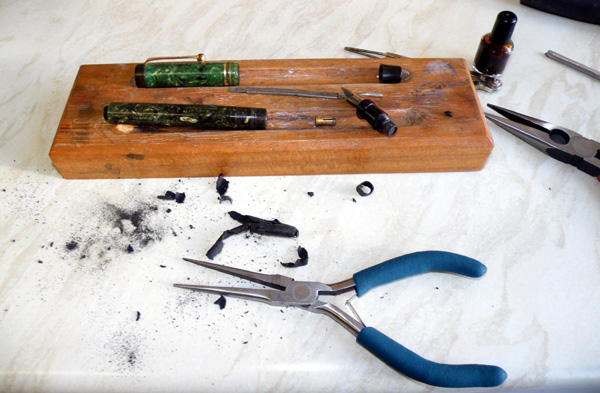
There’s a routine to restoring a pen – assess, disassemble, clean, assess again, re-assemble. The only part that needs replaced here is the sac. I use a silicone one to prevent any further discolouration of the jade. It’s important to clean the inside of the barrel thoroughly; any fragment of the old latex sac that remains will continue to discolour the barrel. As it’s a screw-in section, sac size is critical. It has to be as large as possible to contain the optimum amount of ink, but narrow enough to clear the walls of the barrel. Then it’s time for reassembly and a gentle polish, and the pen is ready for write-testing.
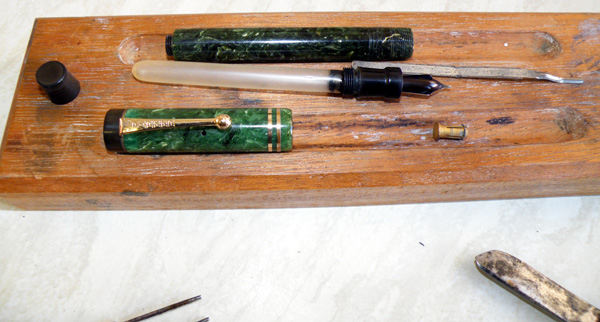
I have read that the Duofold Special, or JL (for Junior Long) as it’s also known, was not listed in Parker’s catalogues of the time, but was made to meet popular demand for a Duofold the length of the Senior and the thickness of the Junior. Actually, it’s a tiny bit shorter than the Senior and a little thicker than the Junior – but near enough! From the first black hard rubber model in 1922 the Special was very popular in Britain, and survives in moderately high numbers. This two-ring green jade version was made in 1928 and 1929, and is not so often seen.

 Goodwriterspens's Blog